Beijing Chinglish

Hello readers,

My tour continues in Beijing and beyond to Chengdu, and more on that soon enough. (And more on the security situation in Beijing, on a serious note…)

But first, via Instagram, some Chinglish in Beijing. Including disgusting meat. And a just plain weird candy.

Without further ado:

BECAUSE WE (ALMOST) MISSED IT: Best of expat nonfiction 2015

ML Awanohara's avatarThe Displaced Nation

Best of Expat Nonfiction 2015

As some readers may recall, I posted, at the end of January, a “best of” list of fiction works by, for, and about expats and other international creatives that came out in 2015.

I know, I know, it should have come out in early December.

And now it’s nearly the end of February, and I still haven’t posted my list of nonfiction books that appeared last year: all of those lovely memoirs, photo guides, guides to expat life, and so on.

But then Leap Day arrived, and I thought to myself: we only get an extra day every four years; why not take the leap and tackle my nonfiction list (so much longer than the fiction one!) once and for all?

Today I present the fruits of my Leap Day labors. May I suggest that you follow my example by springing for one or more of these for your…

View original post 4,767 more words

Attending the Bookworm Literary Festival: Beijing and Chengdu

home_logo

http://bookwormfestival.com


Next week I will be continuing my book tour to all-new heights: I will be traveling to Beijing and Chengdu to participate in the Bookworm Literary Festival!

This is my first time attending, and I’m very excited.


Beijing Bookworm Festival

On March 14 (Monday), I will be discussing and reading from my novel South China Morning Blues, at 7:30 p.m., at the iQiyi venue located next to Bookworm. The moderator will be City Weekend’s Adam Robbins. Attendance is 50 RMB.


Chengdu Bookworm Festival

Then on March 19 (Saturday) I will be traveling to Chengdu. The talk there is at 4:00 p.m. at The Bookworm Chengdu. Tickets are also 50.


Please click on the links for more info.

I haven’t visited Beijing since 2009, and it’s unbelievable that it’s been so long. It will be my first time in Chengdu ever. I’m really looking forward to further traveling in China, and meeting other authors and readers. Most of all, I am grateful – and lucky – for the opportunity to be a part of these events.

Hope to see you there!

GZ Poet Aaron Styza

IMG_4189


Guangzhou-based poet Aaron Styza organized and spoke at the Yi-Gather event of which I was a part of last month. His poems have been published on Heron Tree, Sediment Literary Arts Journal, and Two Cities Review.

As he is a talented writer in China, I thought it would be nice to interview Sytza and talk about the craft. Little did I know what a fascinating conversation it would be:

(Also, not that I am an expert at poetry but I have occasionally tried to expand my own writing palette…)


What issues or answers does poetry provide or provoke for you?

I’m concerned with the limits of language: how can we measure the effect of what we say? The truth is language cannot adequately express anything. If language were able to express the complexity of thought, there would be no need for poetry. I would say X, and you would understand X. This is not the case. But the inherent inadequacy of language is the very thing that gives poetry its agency: the freedom to investigate a subject obliquely rather than approaching it head-on. Language has a duel effect that causes intense intimacy and terrifying alienation, like birth.

The relationship (or metonymy) between intimacy and alienation haunts a lot of my poems.


How has China shifted your aesthetic focus?

The personas in my poems are often coping with psychological trauma. And like a patient hypnotized into summoning their repressed experiences, poems replay that trauma. Trauma manifests itself as a subjective experience and as a reoccurring, collective experience.

Myths and Fables are a great example of a collective experience: something so ingrained in a culture that it’s inextricable from it. They are our first life lessons and indelible marks on our consciousness. I allude to, and re-appropriate, elements from such sources to “fable-ize” modernity. That is, distance a subject from its context and place in time. And China, with its innumerable stories derived from different characters and dynasties, has opened up a new store for me to work with. This may further reinforce what I said earlier about intimacy and alienation.


What poetic conventions do you avoid or adopt?

I tend to avoid intellectual witticism most, because that techniques imposes the writer’s voice too much and becomes didactic. I admire the poet Robert Frost for his ability to ground his subjects in reality, without intruding his predispositions onto the poem. Even the times when Frost’s voice spikes through the poem—I’m thinking of his piece “West-Running Brook”—he’s laughing at himself, poking fun at his own authority (this is one of many subtleties in Frost’s work which caused him to become one of the most misread and mistaught poets). Yet his representations of the world are some of the closest poetry has come to accessing the humanities. For him, surrendering to the world was a release from it.

Grounding poems in common, understandable images aligns with my own goals (or tastes), rather than getting tied up in heady, theoretical subject matter, or racing to create a new poetic form, which is plaguing a lot of contemporary writing. I’m a sucker for crisp, well-laid images.


As it pertains to artistic inspiration, how does being in Guangzhou, China, contrast with the Mid-West in the United States?

Continue reading

Interview with Glen Cornell

PastedGraphic-1


Glen Cornell is a local friend, and heads the ChinaSquat language & teaching resource website for expats. He lived in China for a total of five years, starting out as an English teacher in Dalian and finishing up in Shenzhen for three years working for a manufacturing company while simultaneously working as a freelance teacher. He also started up the Shenzhen Book Exchange, an amateur library of sorts for expats to find books in their own language. He recently returned to America and I thought we could catch up via blog…


Hi Glen, how’s the transition back home been? Where are you living now?

I was very ready to move back to the US, but to be completely honest it’s been a bit of a whirlwind the past month, but that’s what I expected. I left China in a bit of a hurry going after a job opportunity that I really couldn’t pass up on. Part of me had hoped things could have gone more smoothly, but normally the transition for expats from China to the U.S. can be a really tough one, with weeks of unemployment, so I’m really glad that I was able to avoid that.

I’m now living in Boston, Massachusetts, working in sales for a marketing software company called HubSpot.


Can you go over about your decision to move to China? Where were you in your life when you made the choice? Why China?

I first decided to come to China about six months after graduating. It was 2010, and the recession still felt like it was in full swing. My “dream job” after college fell through and I was working at a steakhouse living with Mom and Dad. It wasn’t ideal. However, two of my good friends, one from childhood and the other college, were living in China and pushing for me to come check out that side of the world. On my end, I was just happy to get out of my current situation and see a new country. I was also thinking that learning Mandarin would be a good career move, as China and Chinese were becoming more important in the world.


How exactly did you actually get to China? Did you have a job lined up?

So I took a pretty risky move and just came on my own. My friend Eric Lewandowski was currently living in Dalian and he encouraged me to just get myself there with a tourist visa and then I’d find something. In retrospect, that was probably a dumb move, but luckily for me it worked out. I flew in to Chengdu and did some “sightseeing” for a week, and then moved to Dalian to crash on Eric’s couch while looking for work. I found a job my first day in Dalian, and moved into a new place within 5 days.


So clearly you’re not afraid of making big decisions in a hurry.

I guess one could say that.


Without getting into too many specific details, how would you generally summarize your time living in Dalian and working as an English teacher? And how did you get to Shenzhen?

Actually I lived in Xiamen too before I moved to Shenzhen. Haha, it’s a pretty important part to my personal story, but I’ll get to that later.

Continue reading

My experience being rounded up by the Chinese police at the big Shenzhen drug raid

[In the early hours of February 21, 2016, there was a major drug raid at a Shenzhen rave party. It has since become international news, reported on by The Guardian and Vice. I was rounded up along with hundreds of other people, and this is my story.]


One of the surprising things I discovered upon moving to China all those years ago was that illegal drugs are remarkably easy to come by.  Before arriving, one would assume that wouldn’t be the case in a pseudo-Communist country. Yet, the party scene introduced itself to me almost immediately and I saw that often times drugs among expats were no big deal. Perhaps it’s the chaos that comes with rapid economic expansion, but for whatever reason that’s the way it’s generally been.

To be specific, expat stoners I know seem to usually find a source and easily keep up their stoner lifestyle. It’s only marijuana, and it’s becoming legal in America nowadays anyway, so what’s the big deal?

Besides that, there’s MDMA in the club scene. From what I’ve observed, psychedelics such as LSD are almost unheard of unless one has a very good source –  as that kind of psyche-spirituality vibe is not apparent here. Opiates rarer still. I have heard tales of cocaine and ketamine, and newspapers do report that methamphetamine is a growing problem in China.

Based upon my admittedly anecdotal evidence, among foreigners in big cities at least, it’s mostly a bit of MDMA at clubs and the usual marijuana hit if you are into that kind of thing.

Not to mention, like almost everywhere else in the world, the main drug of choice is a certain legal narcotic which is definitely the most destructive of all: alcohol.

Personally, I am not into most that. I think I’ve done the normal amount of experimentation in my life, and politically I am quite against prohibition. But marijuana doesn’t do it for me. It’s not to say that I am morally opposed, the THC chemical reaction simply makes me feel extremely anxious and uncomfortable and I’m not a fan. I don’t particularly like alcohol either, to be honest.

The unfair thing about the world is that the random chemical reactions specific to my brain and genetics more or less keep me clean. It’s not like I’m making any major effort to “just say no.” There is nothing at all fair about functional people who enjoy smoking being punished so harshly in society, while I am not. It’s nothing but luck. And when the police came to drug test me that night, I got to go home, while some of my friends weren’t so lucky…


mmexport1456324418135.jpg

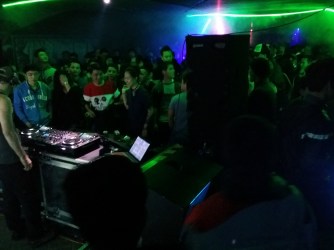
The Real Deal is a group of partygoers in Shenzhen who organize underground outdoor parties with electronic music – raves, if you will. I’ve been going to their parties for years. In fact, the big party that got raided was their 4th year anniversary. They advertise openly, book famous Hong Kong DJs, and have been a fixture on the community for quite some time. It never felt subversive to enjoy their events. I for one appreciate the efforts of the organizers to create a fun place for people to listen to music and find something different to do in Shenzhen. Certainly beats overpriced drinks at pretentious nightclubs.

On the night of February 20th, I decided to go to the tunnel party with my girlfriend. It happened to be near the Ikea, in walking distance from my home in the Baishizhou neighborhood. Several of my friends were there, and I expected we would all enjoy ourselves. Me and my girlfriend arrived at about midnight, met up with some buddies, had some drinks, danced, and so on. I did note that the anniversary party was quite crowded. Still, it seemed legit to me.
20160221_004842.jpg

Don’t get me wrong. The Real Deal organizers, from my understanding, don’t go farther than make deals with local security guards.  Being that it’s outdoors and unlicensed, it’s still pretty much a “rave,” isn’t it? Yet the worst that ever happened in the past is that there’d be noise complaints and some police came to shut down the party. Normal risk, right? Or so one would think.

Without naming names, I did notice LSD and nitrous oxide around. (Are those chemicals even illegal in China?) Pills appeared to be harder to come by, ever since the two unfortunate overdoses back in December most people had been avoiding that sort of thing. No, as usual, the normal culprit was the noticeable smell of marijuana.

I don’t know what made this time so special, why there had to be a crackdown that day. I have no doubt the police knew about these parties for years but never cared. Why now? Was it because of those two overdose deaths that they felt they needed to protect us from ourselves? Was it that the crowds were getting too big and China doesn’t like big, potentially protest-y, crowds? Was it, as currently noticeable from Beijing to Hong Kong, the general atmosphere of authoritarianism which has been growing of late under Xi Jinping…?

In any case, at about 3:45 a.m. a whole lot of shit went down. I remember it clearly because my girlfriend and I had previously discussed that we should leave at 3:30 in order to not to stay out too late. When the time came, she suggested we dance a little more, and I said okay. We tried really hard to not wallow over that decision after the shit went down.

It was totally surreal. I was sitting on a curb catching up with a few pals, and suddenly saw a few police officers run down the hill. I took my girlfriend’s arm and everybody walked away at a brisk pace. Then, the abrupt end to the music caused a weird shift in scenery. The silence came with a sense of panic, and everyone started dashing toward and exit. There was a serious danger of trampling at that point. My first thought was that people were overreacting and it couldn’t be such a big deal, but I soon noticed there was something different about the closure of this party.

We got to an exit and a line of riot police with shields and batons had completely blocked the way. I have never experienced anything like that before. I couldn’t even see behind me because of the crowds, but nobody could move and it must have been blocked on every side. A bilingual, senior looking cop started yelling in English and Mandarin. “Turn off your phones! Sit down! Stay still!” It was a very confusing moment.
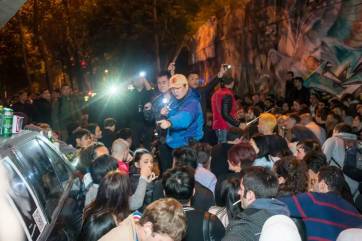
mmexport1456120953563.jpg

The weirdest thing was not knowing what to do next. Although this was an extremely coordinated attack — Shenzhen Daily reported “the Nanshan District Public Security Sub-bureau confirmed the raids had happened and that they had been planned for ‘quite a bit of time.’” — all those hundreds of officers working through the night seemed to be out of their element. We sat around for about an hour. People stood up, and were told to sit down. There wasn’t much room to sit. I saw my friends in various piles, and we tried to keep each other’s spirits up.  I had my arm around my girlfriend. On another side, I saw some expat guys getting rowdy and then handcuffed.  I saw cops with streams of plastic cable tie handcuffs, yet thankfully they were never used. All in all, in retrospect, it was pretty peaceful. At the time there was just so much speculation; we didn’t know what was going to happen.

Finally, small groups were formed and were told to walk to the nearby parked police buses. We lined up and put our hands on each other’s shoulders like a cheesy conga line.  Mine was the second or third group and I was glad to get it over with. I wanted the next step to be done with already.

Once piled into the police bus, we driven around for a while. I had no idea what kind of route they took, but I later learned that it wasn’t even that far; still walking-distance from my home. All different police stations in Nanshan District were working in tandem, and luckily the Taoyuan station was nearby. Along with my girlfriend, two other American friends also joined me in that police station. Along with about fifty people in total. I know that because we were given numbers drawn in sharpies on our hands. I was number 43, and I’ll never forget it.
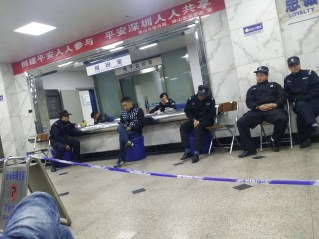
20160221_073523.jpg

I had to pee so badly! That was the most painful part of the process. There would be more urine-related activity to go around, and they gave us plenty of water. After things were eventually organized and settled down, the station waiting room was full of chairs and we weren’t allowed to leave and then the real waiting began. The boredom was the absolute worst. No music or anything.

As the sun came up, one-by-one we had to take urine tests. I heard that women had to be watched by a female officer, which is rather humiliating. Men could turn their back while being watched, though I did notice the toilet had a camera positioned above.

Somehow, it occurred to me that it would be appropriate to joke as much as possible. What else could I do but try to laugh it off? I tried to make my friends laugh, and said ganbei! (“cheers”) to the cops as I held my own steaming cup of urine. That got some smiles. I asked if they had Wi-Fi, I declared that I would pee sitting down in solidarity with the women, I sang Taylor Swift songs, I told bad jokes about horses in bars with long faces, and I suggested that I ought to call the police after such treatment. Lastly, when they put the testing device in my cup I asked if it showed I’m pregnant. Get it?

mmexport1456114924925.jpg

Although I tried to be on everyone’s good side, deep down I felt a lot of animosity for being treated this way. Obviously, the police officers I met are only cogs in a greater machine. Yet they are willing cogs, and cannot approve. Early in the morning they brought some steamed buns for people to eat – struck me as a good cop/bad cop ploy – and I refused to eat any.

Actually, to be fair, our station wasn’t bad compared to what I heard about others. People were made to sit outside on the floor in the cold. Victims were told that the Chinese government has a right to detain anyone innocent for 24-hours without any arrest. Some weren’t allowed to talk. Many weren’t allowed to leave until many hours later than my group.

mmexport1456051147978.jpg

Of the four of us in my own personal set, only three were to leave that morning. Sadly, one of my friends, of the stoner sort, was sent somewhere else after the drug test. Briefly, I had witnessed some people in a cell in the back; sad scenes of men crying and couples cradling each other. It was very worrying that a friend could be hanging out with us one minute, and then taken somewhere else the next.

After all this grueling time, just before 10:00 a.m., they started letting people out. First a Spanish woman complained until they processed her information and she was allowed to leave. Then a Chinese woman left. I crossed the barricade a few times to complain and plead and just learn what the situation was. Turned out, when I didn’t give them my passport number before (I feigned that I had forgot), they wouldn’t let us leave until everyone gave their numbers so the authorities could check our visa status. Fine. I gave in and gave my number. Then waited another hour or two. How long could it take to look up? I had even crossed the border from Hong Kong the day before. What was the big holdup?

There was one drunk, half-passed out gentleman who couldn’t be bothered to give a real passport number. People were getting angrier and angrier, turning on each other. Interesting to see how easily sleep deprivation can affect people, and on the other side to see how freedom can have the opposite effect. At last, when they had called out numbers and one-by-one we were allowed to leave, we clapped and cheered in joyous relief. “44.” “43.” “42.” Even the cops smiled as us newly freed detainees applauded.

20160221_073453.jpg

My phone was out of power. My stomach was empty. In minimalist attire, without sunglasses to protect from the morning light, we all went home. That Sunday was a write-off day, like jet-lagged with sleep patterns all askew, and I didn’t get much done. I am getting too old for all-nighters.

In a sense, I was relieved after the experience. A part of me always wondered what would happen if I was got in trouble with the police in China. I feel vindicated now. They didn’t interrogate me or anything, they simply checked my visa status and after a long while let me on my way.

According to a translated press release, the numbers were surprising. 491 people were detained that night. 118 had tested positive for drug use, majority marijuana of course, and 93 held. (It’s not clear why 25 people weren’t held. Connections, corruption?) Of those 93, 50 of them being foreigners. Perhaps they caught like two drug dealers, but most were released after 4 or 5 days. It was called “administrative detention” or “violation.” Not arrest.

“They were after the dealers…” my detained friend later reported back to me. “Everyone else is a pawn to them.”

Those limbo days were rather terrifying. Rumors abounded, and those of us left free all scrambled to figure out what was going to happen to our friends. Moreover, there was the great question of what was happening to the community within China. Simply put, is it worth it to live here anymore?

It has now been confirmed to me that nobody (at least not the vast majority of non-drug dealers) is getting deported. Chinese and foreigners alike, they don’t even have to pay fines. All that fear, and what was the point? The city of Shenzhen undertook this massive operation, apparently all in the legal grey zone haze that is the China system, and just what was the real purpose?

With 80 percent of the detainees drug-free, and only half foreigners: The question remains, what possibly could have been the point of all that?

Whatever the point is, some kind of message has been received. Shenzhen is no longer what it once was. The expat and party scene will get past this, but something has changed. A threatening cloud of authorities now hovers over the community, and somehow China doesn’t seem as welcoming as it used to be.

The party is over.
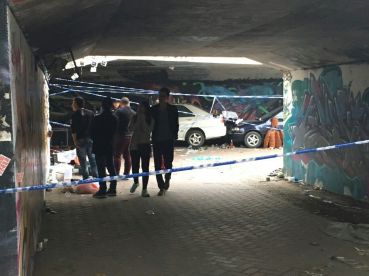
 

mmexport1456051015487.jpg

A couple of Chinglishes to tide you over

In these dark times, we must take what we can get to cheer us up 🙂

From a hike in Meilin, and a Snoopy-ish shirt:

(In other news, I finally saw the Peanuts movie and twasn’t bad…)


South China Morning Blues: Excerpt 2

This week I’d like to share another excerpt from my novel South China Morning Blues (last week’s), this time concerning the city of Guangzhou and my favorite character symbolized by the Chinese Zodiac character of 猴… The Monkey!

You can scroll down and read the embedded file below, or download the PDF file via this link:

South China Morning Blues: Monkey


If you’d like to read more, please feel free to order on Amazon or directly from publisher Blacksmith Books

http://www.amazon.com/South-China-Morning-Blues-Hecht/dp/9881376459

http://www.blacksmithbooks.com/books/south-china-morning-blues


unnamed

Excerpt: South China Morning Blues

Now that New Year celebrations are over with, I’d like to share an excerpt of my novel South China Morning Blues published by Blacksmith Books.

You can read the embedded piece below, or download the PDF via this attachment:

South China Morning Blues – Shenzhen: Prologue


It is the very beginning of the story, a prologue to Book I’s setting of Shenzhen. Opening in media res with one character represented by the Chinese Zodiac animal 虎 (Tiger), the story then jumps back and forth with the point-of-view of 兔 (Hare), and finally gets to the introductory character 牛 (Ox). I hope it isn’t too difficult to keep track, hope it’s worth the effort.

These tales represent my attempt at capturing the jagged essence of the modern cityscape experience, as expats and locals try to make sense of this rapidly-changing setting. These people are flawed, don’t always do the right thing, but maybe just maybe they come across as somewhat realistic humans. There are all kinds out there. At least, there are 12 knds out there…


If you’d like to read more, feel free to order on Amazon or directly from the publisher

http://www.amazon.com/South-China-Morning-Blues-Hecht/dp/9881376459

http://www.blacksmithbooks.com/books/south-china-morning-blues

unnamed


Reflections on a Chinese New Year

20160207_232119.jpg

My own humble attempt at adding to the festivities

The city of Shenzhen is nearly emptied-out. Like a major metropolitan ghost town. Not quite postapocalyptic, but slightly eerie.

All the migrants are back in their hometowns, crowded in record-breakingly awful train stations. And most of my expat friends are posting pictures of paradisesque beaches in Southeast Asia. I’m saving up for a trip later this year.

It is the Year of the Monkey, and cartoon monkeys are everywhere.

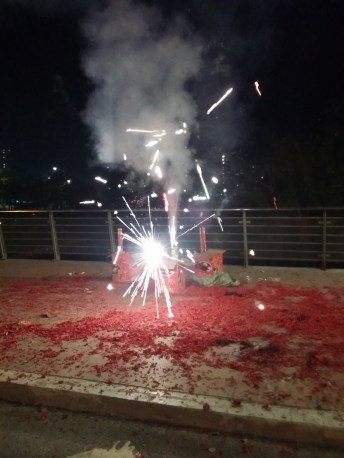
Even with Shenzhen at a fraction of its normal population, Lunar New Year’s Eve sounds like a war zone. Bang! Pow! Ka-BOOOOOM!!!! Fireworks — mostly procured illegally — are for sale everywhere. The ancient Chinese traditions.

Many firecracker stands have popped up, selling dangerous flammable items in an unregulated market and it is so much fun.

An odd thing about living in China/Asia is that you get an extra month to reflect upon the new year. There’s the Gregorian calendar to celebrate and I like it. Then there’s several weeks to break resolutions and mull over how your life is progressing. And then you get a second chance to celebrate the new year all over again and embrace the future! The intervening time may be sort of a limbo, but I still like it.

I’d like to wish a particularly happy new year to all you twenty-four and thirty-six year-olds (even though it’s bad luck to have your birthday on your own animal year, right?), as the twelve year cycle begins anew.

新年快乐!

恭喜发财!

Letters From China… Cold Reading in Guangzhou

12540756_10207474402091770_8562495052131559806_n

Last weekend, I was honored to have been invited to the Letters From China bilingual poetry event in Guangzhou courtesy of GZ-based poet Aaron Styza. It was at Yi-Gather, one of my favorite places in the city, and the turnout and conversation were excellent. I, of course, read from my novel South China Morning Blues.

Unfortunately, it was one of the coldest nights of the year and the place doesn’t have heating! This happens when living in the tropical southern regions; all year you’re sweating and you never know what week is going to be actually cold… and you are not at all prepared for it. Seriously, even though it doesn’t get below freezing (and I did grow up in a place with four seasons), the combination of humidity and winds makes for some very harsh conditions.

The next day, something magical happened that made the weather more than worth it! It actually SNOWED. It was about two or three degrees Celsius and by some miracle small pellets of frozen water (maybe technically hail, but looked enough like snow) softly fell to the ground and immediately melted. Brief and ephemeral, we couldn’t believe our eyes. Not that it was a polar vortex like elsewhere, but in the context of this tropical environment it was amazing. Sadly, wasn’t really photographable.

I heard it’s the first time the weather had been this low in the region in some fifty-sixty years. And, a month ago was the warmest year’s winter ever. Not going to get into climate change or anything, just sayin these temperature extremes are interesting.


Anyway, here is an Instagram picture followed by Youtube video concerning the event:

[Yes I know I do not look good nor sound good but the self is an eternal process and I shall work on it]

Chinglish 2016

Not much Chinglish to occupy my eye these days, but I do have a few to start off 2016 while it’s still January:


While I’m at it, here’s some more funny China stuff in the form of bootleg Star Wars toys! Followed by my own small Lego Star Wars collection, and you can guess which ones are fakes…

Would you like a sneak preview to read?

Dear readers (and writers),

The time has come for the announce that I am about ready to share something new. If you happen to be one to enjoy my humble writings, here it is.

At a mere 50,000 words, it’s more a novella and not too much commitment to read. Took me the greater part of 2015 and the working title is “Modern Love Story” and yes I know that needs work. Or possibly “This Modern Love” as in the Bloc Party song — see below. “Modern Love” as in the song by the late great David Bowie would be a nice reference as well but seems too similar to Aziz Ansari’s recent recommended book Modern Romance.

Similar in structure to that novel about the twelve animals of the Chinese Zodiac, this new story only focuses on four people: Two men and two women. Half are modern and the others more traditional, and the point is each pair would be perfect for each other but they keep getting distracted and miss their chance.

Also, it’s about the soul of America.

See, I was inspired after the last time I visited the United States, and after being away for so long I now feel I have the outsider’s perspective. Mostly it was from observing some friends using the Tinder app in order to hook up. I never got the chance to use it, but I thought about all that online dating stuff from a literary point-of-view, and thus..


Well, if you would like to read more about my take on how modern technology has skewed sexual relationships between men and women, then please email me via rayhecht@gmail.com

Any input at all would be appreciated, from catching typos to scathing critiques and expertise on technological language.

And as always, if you would like to share anything you are writing I’d be happy to help edit as well!

Keep reading and writing, everybody


Here’s that song ~


Book Review: South China Morning Blues

Why I Write

http://www.whyiwrite.net/2016/01/ray-hecht/


Ray Hecht

South China Morning Blues 

Ray Hecht is an American author based in Shenzhen, and blogs at rayhecht.com. Raised in the American Midwest, he studied film in Long Beach, California before moving to China in 2008 where he divides his time between fiction writing and freelance journalism. South China Morning Blues (Blacksmith Books, 2015), a story of depraved expats within the hypermodern southern Chinese sprawl, is his debut novel.


Why I write

That is the ultimate question, isn’t it? I don’t truly know the answer. Perhaps because I am a lonely person and I got into certain habits and now after years of this I am compelled. I want to express myself, I have enough ego to believe that others should read what I write, and it’s just a part of what I do and who I am. I have these things in my head and this compulsion to write it down and I hope beyond hope that people would like to read.


How do you go about writing?

I try to write every day. When a long-term project is going, I write about four days a week on a decent week. Good weeks more, bad weeks less. To me, it’s not about hours so much as word count. Five hundred works at least, or a thousand words on a very productive night. That may take hours or it may take 30 minutes.

I like to stay up late, because that’s the time when everyone leaves me alone. That magic time from midnight to about 2 a.m. I used to write later, but it’s getting harder and harder to keep up with a night owl lifestyle these days. That’s when all the original words come to me, and the next afternoon I tend to do rewrites.


Where do you write?

I like to lay down in my bed in my underwear with the laptop. I remember the old days when I had a big PC, it was much harder to motivate myself. The laptop is the most perfect invention ever…


Worst distraction?

…excepting, of course, that the Internet is the absolute worst distraction ever. If left to my own devices I tend to constantly check my email, Facebook, news sites etc. Porn isn’t even as bad as social media. Sometimes though you just have to unplug and force yourself to finish a deadline. Unless there’s research to be done.


Best inspiration?

I suppose I’m inspired by various things. A good song can inspire. A book, a show. A crazy life experience can especially inspire. Most of all, combing through my own memories of complex life issues and mix and match it into new combinations; somehow that give me ideas about what to write.


How often do you get writers’ block? Do you ever doubt your own ability?

I don’t really believe in writer’s block. However, I doubt my own ability all the time. When I compare myself to the major authors whom I respect, I am not in the same league at all. But I’ve chosen to write and even if it’s shit I have vowed to finish what I started.

The thing about writer’s block is that I always have more ideas than I have time to write them down. It should always be that way. Instead of being choked by the blank page, I suffer more from sheer laziness. Writing can be mentally exhaustive, and although endless ideas are swirling around in my mind, sometimes I don’t have enough energy to record and tinker with those ideas.


Contemporary writer you always read?

I always read new Haruki Murakami and Neal Stephenson. Murakami isn’t as good as he used to be, frankly, in my humble opinion. Stephenson is such an insanely prolific writer that it takes me longer to catch up with his latest thousand-plus tome then it does for him to write, yet I always do try to catch up.


Favorite book on China?

Speaking of which, Reamde by Neal Stephenson is a great book that takes place in China, full of hackers and gold-farming. He really gets it right.


Favorite Chinese author?

My favorite may be Su Tong, and especially his novel My Life as Emperor. Written very matter-of-factly and full of cruelty, it rather haunted me.


Favorite book?

There are several books that have supremely influenced me. I’m going to keep it in the realm of fiction: Snow Crash by Neal Stephenson is the ultimate irreverent yet smart novel, with so much energy. I know I’m not smart enough to write science fiction, and cyberpunk in particular, I am purely a fan with no desire to emulate.

I have to mention The Illuminatus! Trilogy by Robert Anton Wilson and Robert Shea which sent me on a lifelong journey to figure out what the hell is going on in the world.

As for literary inspiration, Irvine Welsh’s Trainspotting and Bret Easton Ellis’ Glamorama are works that have directly influenced how I string words together…


Favourite writer?

As for other mediums, I would like to say that comic book writer Grant Morrison is one of my absolute favorites. Able to write mindfuck profound postmodern comics, as well as fun superheroes, and I am very envious of his abilities.


The book you should have read but haven’t?

I am currently trying to find the time to start Gravity’s Rainbow by Thomas Pynchon. I have a feeling it’s going to be a tough one.


You look back at the first thing you had published and think…

Wow I was lucky!


How did you get started writing?

I scribbled on occasion when I was a kid, more interested in drawing than writing. When I was in school I decided to study film on a lark, and I didn’t really finish, but I decided I like prose more than screenplays because you can be alone. I decided to write novels when I was twenty-three years old, wrote several, and then almost 10 years later it worked out.


Does writing change anything?

I suppose it changes your social life, because friends and loved ones can’t understand why you are always avoiding the outside world. It’s worth it though, I hope.


What are you working on now and when is it out?

Well, I’m still working on promoting South China Morning Blues which is currently out in Hong Kong and beyond.

I have another novel in the works, a full draft is finished, and it’s not about China. It’s about how technology effects relationships and I got the idea from last time I visited America and observed as an outsider the whole Tinder dating thing. If I’m incredibly lucky it will be published in less than a year. A lot has to fall into place. I believe it will be published eventually. Wish me luck!


Continue reading