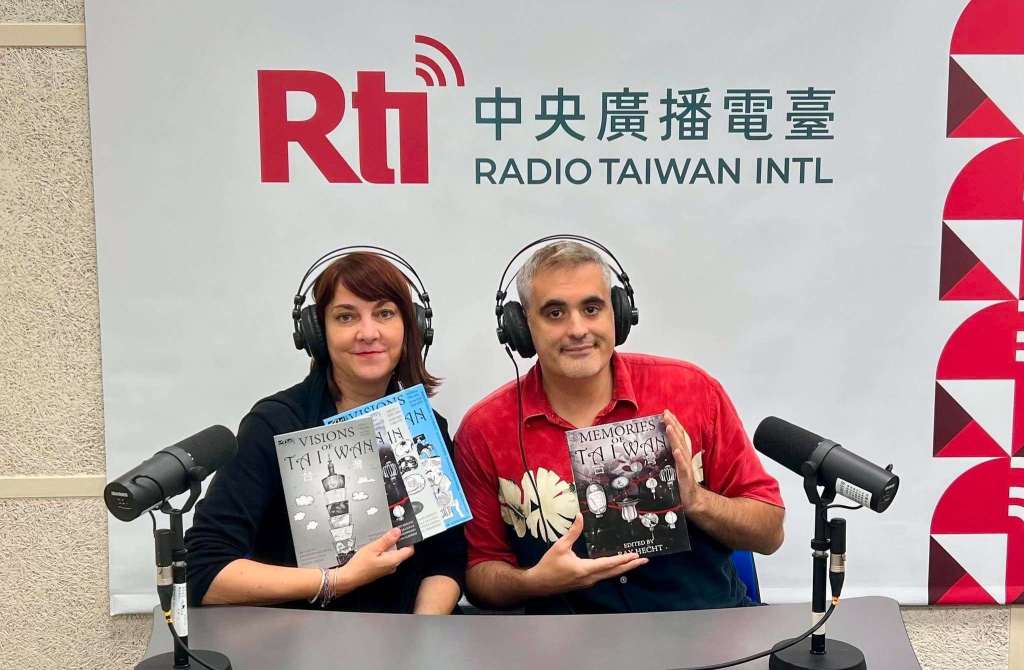
I appeared on Radio Taiwan International’s Geek Out podcast to talk with Bronwen Shelwell about our Memories of Taiwan comic anthology. Great conversation with host Michelle Chiang, about the creative process and our favorite comic stories in the book, a fun exchange all around:
I also appeared on the Formosa Files podcast to talk about the history of comics in Taiwan. Thanks to host John Ross who did extensive research on Taiwan’s political history as it connected to popular art and the challenges of facing censorship through the years. A very informative and fascinating talk:
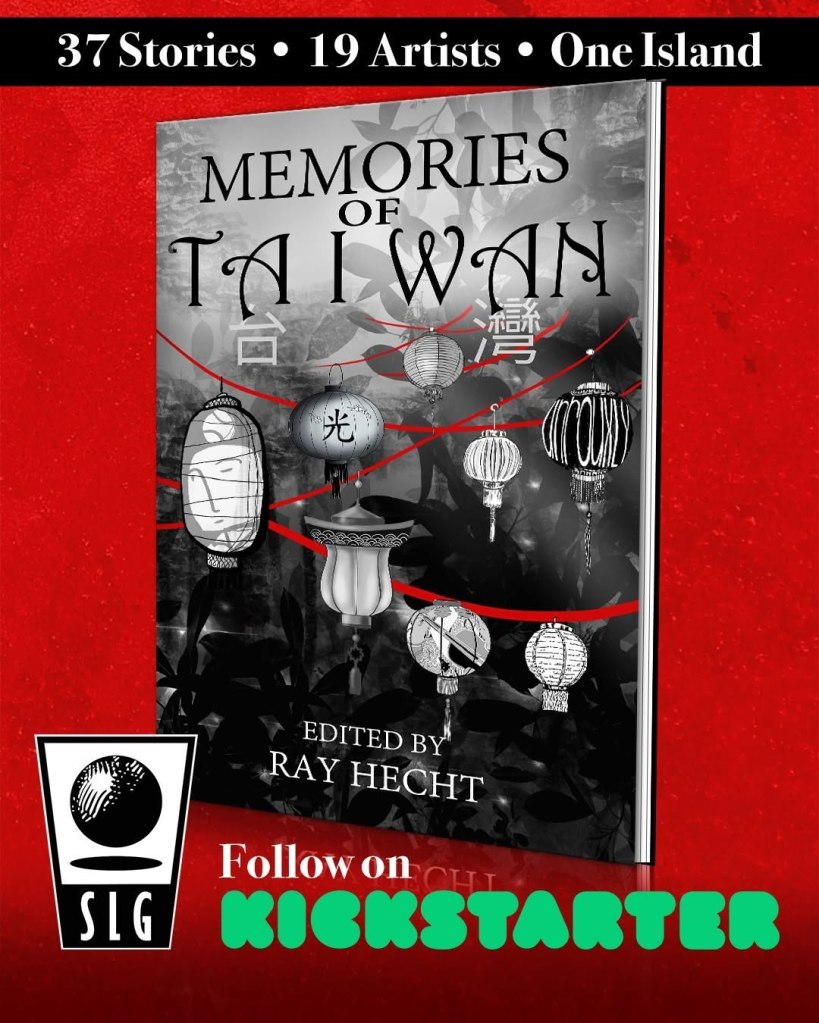
I am proud to announce that my comic anthology series Visions of Taiwan is getting reprinted as a new graphic novel anthology, with the complete run of issues # 1 – 4, now retitled Memories of Taiwan
Published by SLG Publishing, there is now a Kickstarter active for raising funds pn this new book. If you pledge $15 USD, enjoy the eBook edition which is perfect for backers from all over the world. For $35 USD, get the softcover book mailed to you (if located in North America)
We’re nearly at the goal, almost 90%, we only need a little more to get over the finish line. Offers available until September 25, don’t miss out!
37 Stories. 19 Artists. 1 Island.
Memories of Taiwan is a graphic novel anthology collecting the complete Visions of Taiwan comics series, featuring thirty-seven stories by nineteen international artists. Edited by Ray Hecht, the book presents Taiwan through a wide range of outsider perspectives: funny, personal, awkward, observant, anxious, celebratory, and reflective. With stories about festivals, art, travel, food, friendship, cultural confusion, and everyday life, this collection offers a many-voiced portrait of Taiwan as remembered by the artists who lived there, visited there, and were changed by the experience.
Memories of Taiwan features work by Erique Chong, Kristin Foss, Joel Fremming, Kim Glidden, Fabienne Good, Ray Hecht, Patty Hogan, Roelien Immelman, Thai Martin, Stefano Misesti, Daniel C. Moore, Paulina Olejnik, Andrew Quartermain, Jon Renzella, Angela Sauceda, Bronwen Shelwell, Daniel Martinez Sierra, Royce Widjaya, and Todd Allen Williams.
As an American living in Asia for over a decade, and a writer at that, I have read my fair share of “expat” books. This term refers to those privileged Westerners who move to generally poorer countries, which differentiates it from the typical immigrant story. I’ve read many memoirs, by men and women who have traveled the world and gotten into various bizarre or disastrous situations, and written my fair share of that sort of thing as well. More often than not, these sorts of books are about young white men (often English teachers) with similar attempts at bouts of literary hedonism, sex and drugs in the Far East and so on, some more shocking than others, with a wide range of quality writing.
Although these aren’t necessarily typical experiences, this has become something of a cliché—at least in the circles I’ve been a part of. Honestly, I get it already. If you’re willing to give up everything, it’s a surprisingly easy path to just show up in a nonwhite country and suddenly have access to an extreme lifestyle that is far more interesting than the boring drudge of Middle America. This was very interesting to me, back when it was new. But by now, I’ve just read too much of it.
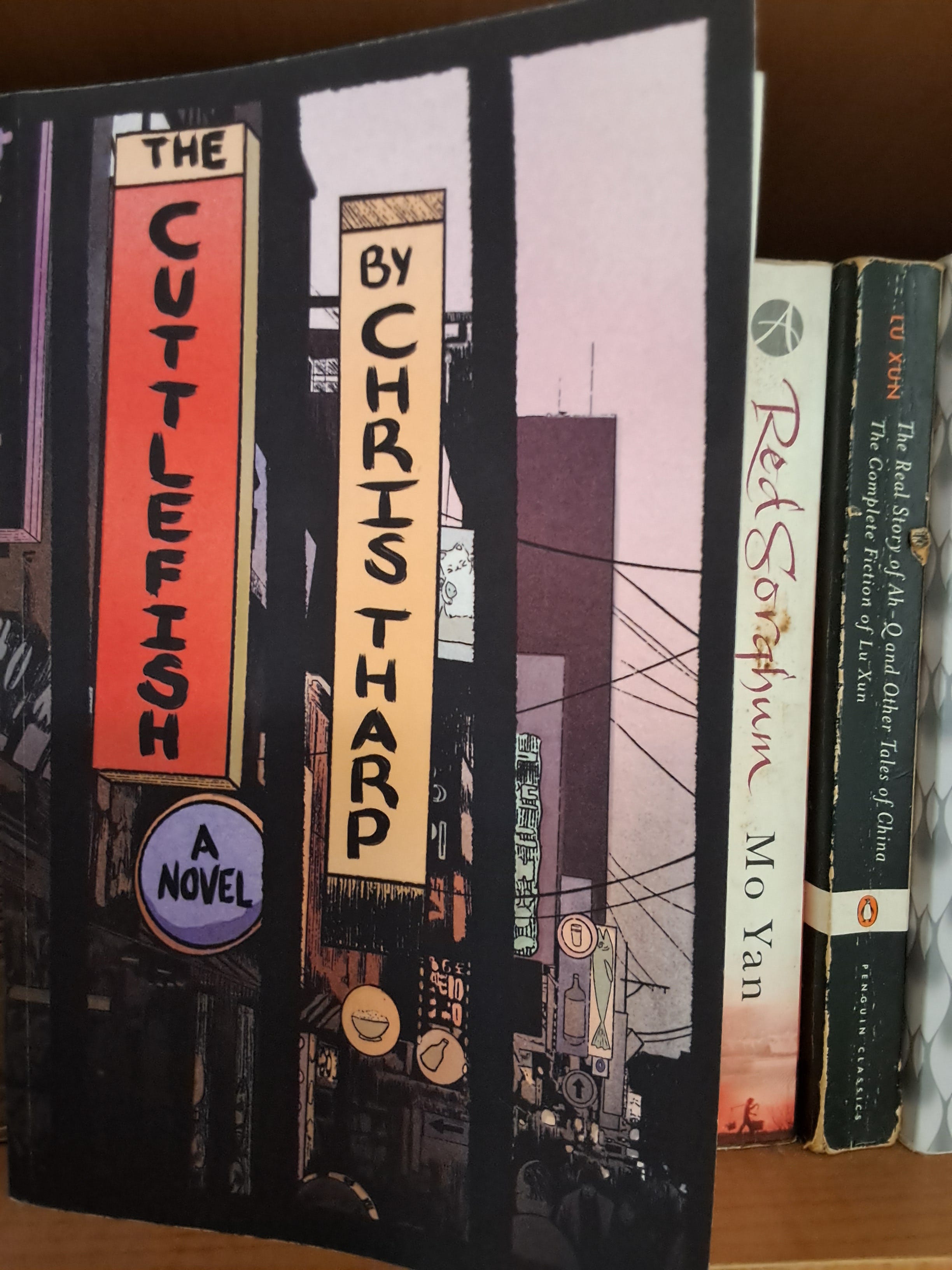
In the first few chapters of The Cuttlefish, I was admittedly worried this novel was going to be more of the same. But as the story developed, it became a page-turner with unexpected twists and turns which took a sharp mind to come up with. Like many such books, the writing is about being a writer: the protagonist is Zach who is an aspiring writer. One wonders how much of it autobiographically corresponds to Chris Tharp himself. Zach is a bit of a loser teacher, a young American phoning it in at his overpaid English classes abroad while drunk or hungover half of the time. It’s a cynical take, and also hilarious. He works at Bichy Bee English Institute, at least for a while, where the children call him a pig and fantasize about murdering him. He gorges on oily streetfood dumplings, strikes out with women, there’s a bit of a romance as well, and he feels jealous over the more successful writers he comes across. If the character is autobiographical in nature, it’s definitely the self-deprecating kind.
But then it gets more interesting. One reason the novel works so well, is that it isn’t actually about a real country. It takes place in the fictional city of Paigon on the island of Sukhan, and this gives the author freedom to imagine anything without having to pinpoint any one real place. It becomes more universal this way, and Sukhan becomes a fascinating setting. This Southeast Asian nation is both modern and backwards, full of chaos and corruption and speeding scooters with traffic laws barely followed. It seems to be a mix of the Philippines and perhaps Taiwan. Maybe some Vietnam, and/or Indonesia in there as well? It’s traditionally Confucian, but also Catholic. It used to be a dictatorship, had a bloody civil war in recent memory, is currently under the threat of a Chinese invasion, and is also wealthy enough to have once had the world’s third-tallest skyscraper. And it is very, very hot (it opens during the “fire” season of the year).
Almost like a fantasy novel, there is much world-building. One chapter is devoted to the complex political history. It feels like there is a real culture referenced, with locals spouting proverbs like “You must wear the medal that the general pins to your breast,” or “like a shark’s greedy mouth.” Very clever. There’s another infodump chapter about baseball, with just as much detail, being that sports fandom matters plenty to a culture. Baseball becomes particularly central to the plot later with the introduction of a celebrity pro player in Zach’s cast of characters. The only thing that’s missing in the book is one of those high-fantasy maps on the last page, the kind that used to be so fun to pour over for readers of Lord of the Rings and it’s derivative paperbacks.
As much fun as Sukhan is, one of the most interesting parts is when Zach travels to Thailand. For the purposes of drug trafficking, by the way. Chris Tharp’s descriptions of a real place, which many of the readers attracted to this kind of novel have probably been to, are written with authority and feel eminently familiar. It’s still comedic, mostly, and the dark underworld aspect works well in the narrative.
By the midpoint, Zach gets arrested. This is when the novel gets even better. Ostensibly, he does this on purpose for the literary credit in this goal of one day selling a powerful memoir. A narcissistic, unsympathetic decision for a fool who gets what’s coming to him? Or, a cautionary tragic circumstance by a desperate artist who doesn’t deserve the overblown punishment from a cruel system? You decide. Either way, Zach’s arc shows tremendous growth as a person over the course of his journey.
I don’t think it’s a spoiler that he ends up in “the Cuttlefish,” the maximum security island prison, being that it’s the name of the book. He ends up there due to a prison break attempt, which shows how exciting the story gets. Zach’s new life as an inmate is fascinating, showing a whole other side of life which is not typical at all for the usual expats slumming it. The climax is likened to a sports movie, with a high-stakes game of baseball—prisoners versus the guards—and descends into a fantastical and satisfying ending which I shall not spoil.
The Cuttlefish is perhaps overwritten at times, but also often poetic, with lines such as: “He could think of nothing more dramatic, brutal, or absolute than being ripped apart in a feeding frenzy of ravenous crocodiles. There was something beautiful in the natural violence of it.” The crass sense of humor is one side of the writing, and then all of a sudden stunning prose comes in out of nowhere: “On the morning of May 1st, the sun rose over the Pacific like a bloated tangerine, pouring its rays over the dappled waters and bathing the rocky outcropping known as Nangki Island in a brilliant, golden light.”
The Cuttlefish ispublished by Plum Rain Press based in Taiwan, and is a book I’d recommend above all to the English-speaking world within Asia. It’s also a highly entertaining yarn for readers anywhere in the world.
This is not a timely post at all in the year 2026, but it happens to be currently interesting to me, so here I go:
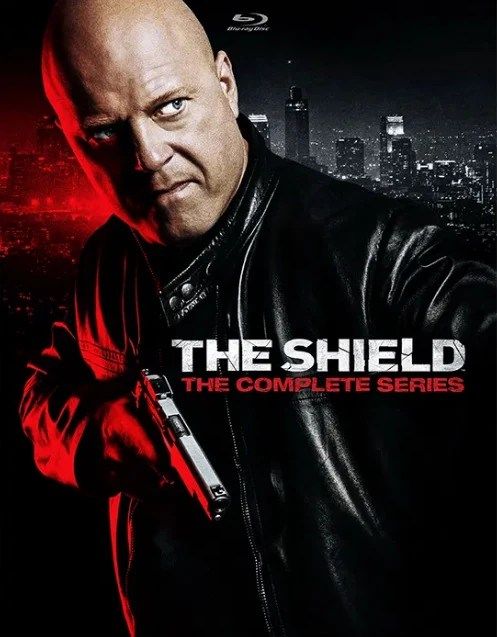
As a young man in the 2000s, it was almost my duty to watch these two gritty cop shows about crime and corrupt authority figures. When the Shield came out on cable in ‘02, I used to watch it every week on the FX channel. In those early days of prestige TV, it was gripping television unlike anything I’d seen before.
I’ve never been one to watch regular cop shows, with their quickly solvable mysteries of the week, it just wasn’t an interesting genre to me. I’ve always preferred long-running dramas that take a lot of work for the audience to keep track of ambitious storylines over the course of months and months—perhaps that’s why I’m also such a fan of comics—so those other shows where they catch the murderer in under 45 minutes aren’t particularly interesting nor rewarding. I want stories of a higher caliber, and the Shield didn’t disappoint.
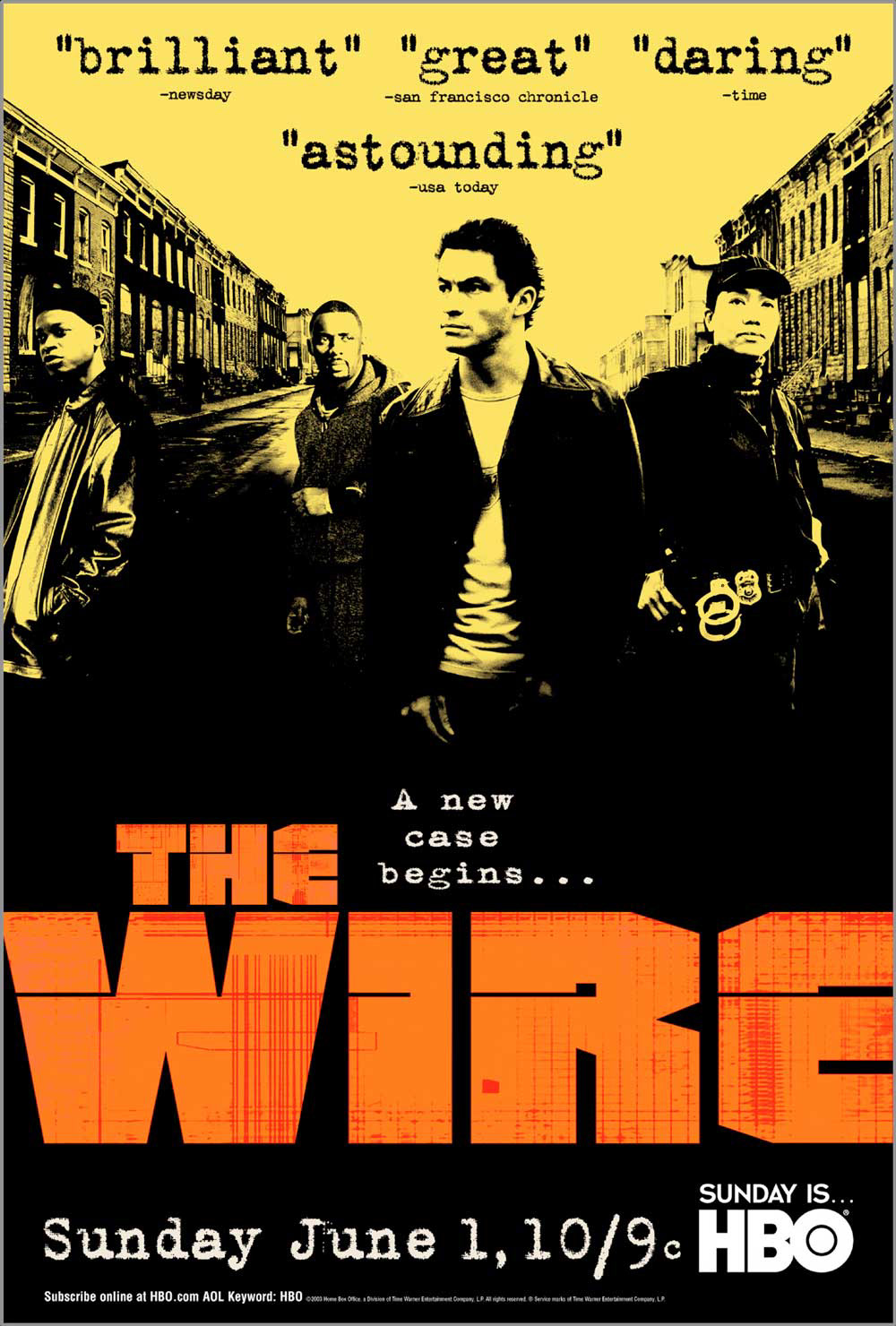
The Wire also premiered in 2002, and I had heard a lot of buzz about it over the years, but I didn’t have HBO and it wasn’t something I followed as it was coming out. Only after the entire series concluded did I finally get around to watching it on DVD in the late 2000s, and it has stuck with me ever since. Perhaps it was better to binge, anyway.
The Wire famously struggled with ratings, ever on the cusp of cancellation, and it never even won any awards. But history has been kind to creator David Simon, and now his masterpiece is regarded as one of the greatest television series of all time.
It may be apples and oranges, but I had always found the argument about which show is better to be very interesting. Some say the Wire is a deeper more complex story, a novel dissecting the degradation of an entire society. Others say the Shield has more intense drama, Shakespearian in its betrayal and moral corruption. What a fun debate, and whichever is the “winner” still leaves the other comparable to the best of the best.
When the HBO Max streaming service came to Taiwan in late 2024, I was initially most excited to re-watch the Wire with my partner and experience that world all over again. Before writing for TV, David Simon was a journalist in Baltimore for over a decade, and his experience shows. The thing about the Wire, is it was never just a cop show. It was about the entire system, from the laws of elites on high all the way down to the drug lords running those in poverty. It was about the criminals as much as the police chasing them, and that made it so fascinating. The gangbangers led by Avon Barksdale and the fan favorite Stringer Bell (played by Idris Elba before anyone had any idea he’s British) had as much screen time as Detective Jimmy McNulty and his team of wiretappers. Michael B. Jordan played a lowly drug dealer kid Wallace when he was only fifteen years old. I also loved Detectives Bunk, Freamon, Kima, and even Herc. The queer perspective was shown with stickup artist Omar. It had everything.
One of the most interesting characters, with an absolutely heartbreaking performance, was that of Bubbles the down-on-his luck junkie. Even the drug addicts where given three-dimensional humanity in this, something very rare in American media. An incredible ensemble cast, featuring the citizens of Baltimore from every class ranging from mayors to the most unfortunate of the poor.
At first, the show seemed to star McNulty—played by the also-British Dominic West—as the cynical detective who’s smarter than everyone else and gets chewed out by the bosses. A bit clichéd, admittedly. Slowly, as the ensemble cast expanded and was further developed, there was less of a focus on him until he all but disappeared. He did come back in the end, but the star was always the entire city of Baltimore as a whole more than anything one individual.
The second season was about crooked unions down at the docks, which was less centered on the Black experience, and had mixed reviews from some for that reason. The third season went back to focusing on gang warfare, then with more politics, and the fourth season was definitely the best about the institution of education and failing schools. Watching those arcs will break anyone’s hearts. And even if the fifth season wasn’t as well liked, despite Simon’s expertise on newspapers, the finale didn’t take away at all from what came before. I loved re-watching it all. The Wire is eminently timeless. It will always hold up.
Now, earlier this year I felt I finally had time to re-watch the Shield. I’m halfway through, and I have some thoughts on that old debate. I am now totally sure of the winner. In fact, in retrospect, it’s been really easy to choose.
The Shield, from it’s very first episode, was trying its best to be as outrageous as possible. Detective Vic Mackey of the Strike Team is shown to be dirty cop, who cheats on his wife because of course, and there’s always blaring music to let you know how messed up everything is. There’s a subplot about a pedo ring, Kid Rock music in the big climax, and then Vic kills another cop (who looked like he’d be a main character) for a final twist. It was a bold introduction from the get-go.
The Shield was indeed cool, but one thing it is not is timeless. It is extremely a product of its time. Specifically, a product of the 2000s, and was just trying too hard to be edgy. The shaky camera and raprock soundtrack is constantly trying to shock the audience, and it isn’t a smooth experience. Although the Wire on HBO was allowed to say “Fuck” and show nudity, it was shot in a more conventional way and sometimes showcasing society’s ills in a more understated style actually leaves one with a deeper impression.
Showrunner Shawn Ryan deserves a lot of credit for his show, which started out inspired by the real-life Rampart police scandal in Los Angeles. In fact, the show was almost called Rampart but that would have gone too far. Police corruption is a serious issue, and does make for excellent drama. Michael Chiklis’s performance as Vic Mackey was award-winning, deservedly so. There was a great cast too, over at the fictional Farmington division station, with the other officers such as Dutch and CCH Pounder’s Claudette standing out. Walton Goggins as Vic’s messed up partner Shane was the breakout role, and the show’s biggest legacy might be Goggins’s eventual stardom.
But overall, the Shield was almost always about Vic. It was his relationships with the other cops that made for the strongest conflict, fighting with his captain, along with his dwindling homelife with his (ex-)wife, his disabled kids, even his prostitute-with-a-heart-of-gold friend. It’s interesting, and the grimy parts of L.A. do make for dynamic filmmaking. On every level it is a strong show. It’s just not a broad dissection of American life, not quite that level of epic. That’s still a pretty high bar.
I’ll happily watch all the way up to the seventh season, I’ll be thoroughly entertained by the Shield, for sure, but I’ll never again compare it to the Wire. It’s the latter series that truly understands a major American city from top to bottom, with all its tragic failings. And thus, to re-watch and to study the Wire, is to truly understand America.
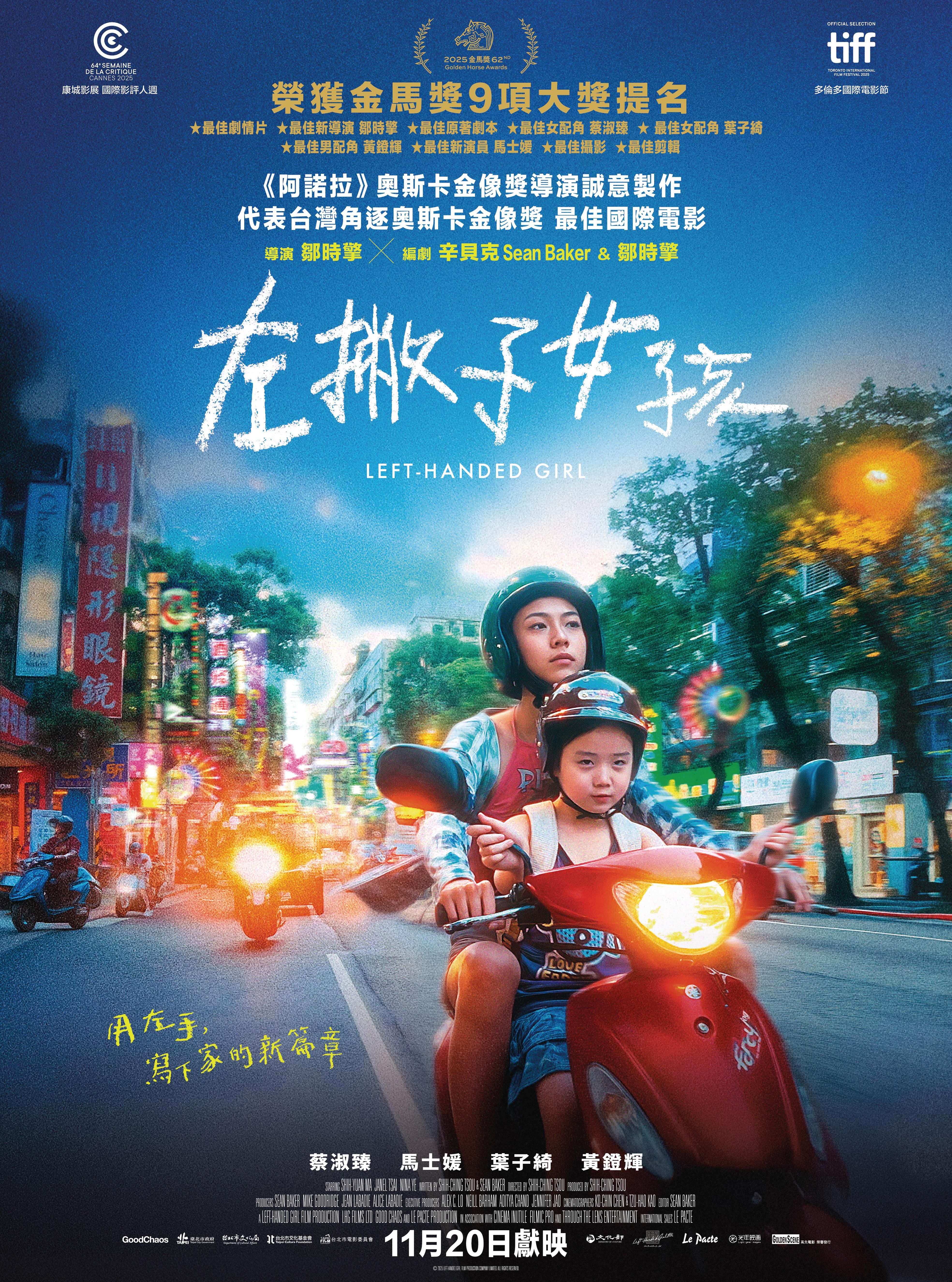
Left-Handed Girl (左撇子女孩), directed by Shih-Ching Tsou, is a movie you should have watched already. It was released last November on Netflix, at least in America. However, the theatrical run took longer in Taiwan and it was only recently released in its country of origin for streaming. Therefore, this review has come a bit late. But considering it is now the Lunar New Year holiday in Taiwan, a good time to catch up on movies at home, I think it’s a fitting time to share my view.
With gorgeous visuals, Left-Handed Girl takes the audience on a tour of the city of Taipei. The crowded night markets, the flurrying scooter rides, the steaming servings of noodles—all make for a wonderful setting that feels authentic to locals and a fascinating introduction to anyone who hasn’t been before. It’s quite something to learn that it was all shot on an iPhone.
Director Shi-Ching Tsou (鄒時擎) is a frequent collaborator with Sean Baker, who directed last year’s Academy Award-winning Anora. Baker, who also co-wrote Left-Handed Girl, is of the Dogme 95 movement which espouses naturalistic filmmaking without special effects and studio interference. Baker and Tsou make a powerful team fulfilling the ethics of that movement. She’s produced many of his films, but hasn’t directed since Take Out in 2004 which was Baker’s first film which they co-directed together. Left-Handed Girl is shot with lots of confidence, and one would assume the director must have had ample experience.
The story centers around I-Jing, the titular main character, who is a naïve little girl surrounded by adults with problems that she can’t understand. Her single mother struggles with money as the family starts up a noodle stand in Linjiang Night Market, while her rebellious older sister I-Ann works at a betel nut shop.
Sean Baker’s films are often about sex workers, such as the aforementioned Anora, and working at a betel nut shop is at least adjacent to this line of work, although that may not be clear to those who don’t know as much about Taiwan. It’s a semi-sleazy job, known as a “betel nut beauty,” who dress provocatively to sell a kind of stimulant. But they don’t necessarily do offer any other services. Seeing the personal lives of the girls who work at such a place is very humanizing, and of course makes for drama in the larger plot.
There is a multi-generational theme throughout the film, with four generations in all but to say more would spoil the main revelation in the end. The grandparents are also central to the story, as the grandfather insensitively tells little I-Jing that it’s sinful to use her left hand, causing the poor girl to have a crisis of her own. The climax of the film takes place during the grandmother’s 60th birthday party, where terrible family secrets come out and there is much losing face. Even for Western audiences, it’s a cringe scene and the drama is pure cinema.
There’s lots of tragedy, but there’s also lots of love. When I-Ann steps up to take care of I-Jing, it’s very heartwarming and moving. There’s also a certain strange, almost surreal atmosphere in the world of this struggling family. For a while, they have a pet meerkat of all things. Apparently, the director is left-handed and was shamed by her own grandfather about using the wrong hand. In some criticism of the film, it’s been said that no one in Taiwan today, even the elderly, would demonize left hands anymore and that’s from a long-gone era. But in the world of Left-Handed Girl, where everything is a little weird and hard to understand from the point of view of a child, it works well and feels fitting.
Left-Handed Girl will be the Taiwanese entry for Best International Film in the forthcoming 2026 Academy Awards, and I wish the movie great luck. It’s good exposure for Taiwan, and it’s also good exposure for artistically dynamic films about real people in the real world. Definitely worth watching.
America has supremely lost the plot. As everyone knows, there was a tragic shooting in Minneapolis, Minnesota on January 7th. Renee Good was shot in the head by masked ICE agent Jonathan Ross, which has inspired protests throughout the city.
On the face of it, the shooting looked completely unjustifiable. There is video evidence from multiple angles, and it’s frustrating that ICE is even doing traffic stops harassing citizens in the first place. This whole thing shouldn’t have happened, and the argument that the officer felt threatened for his life makes little sense when there isn’t even sufficient reason why federal agents need to be in cities like this making “Kavanaugh stops” which contribute nothing to public safety.
These kinds of shootings which become viral on the internet are always disturbing. It’s sadly become commonplace to watch what are essentially snuff videos in this day and age, both because of the prevalence smartphone videos that everyone has and because of the epidemic of police shootings in the violent landscape that is America. People shouldn’t have to see this, and people should be mad when they see this.
But what may disturb me the most, is that the online discourse is so vitriolic and so incoherent. You’d think people could at least agree this was a tragedy? Social media websites have been right-leaning for a long time, and there’s even been new data showing that many accounts spewing the talking points are bots from third-world countries that make money by boosting engagement. All that being said, one can usually expect so-called debate no matter what the issue is, even when citizens are needlessly shot in the head by masked secret police.
It’s not 2020 anymore, back when there was at least something of a consensus that law enforcement outright murdering people on video is wrong…
But this era has become increasingly insane. There’s no other way to put it. Decent human empathy has gone out the window, and every site seems to be flooded with monstrous sociopathic comments about how this woman deserved to die. There are lies after lies about her, much of it obvious nonsense and misinformation simply making up notions about how she supported terrorism or whatnot, yet strangest of all are the lies contradicting all the videos we have seen. Serious journalists have analyzed the angle of the vehicle and the gunfire and all that, it’s worth getting deeper into if someone is serious about understanding what happened. Even still, just on the basis of having eyes, it’s easy to see that the shooting was unnecessary and this man’s life was not at risk.
Right-wing sources recently leaked a video from the point-of-view of the agent, which they claimed somehow proved he was in the right. It infuriates me to no end, because I really can’t understand the mindset of people who think this way. It’s been pointed out that the video was actually released not to exonerate Jonathan Ross, but to mock Renee Good because her queer wife is in the video talking back and that apparently proves they are bad people.
Overall, the narrative online is basically that anyone who doesn’t comply with the police deserves to be killed. Again and again these comments boil down to: If only you’d comply with orders then you will not be killed. Disturbing enough in a supposed free society already. What I find most bizarre about this take, is that it’s well-known that police are only supposed to shoot if they’re life is threatened. Isn’t that common knowledge by now? That’s what the eventual legal court case is going to be about. All this muddying of the waters, going on and on about compliance and victim-blaming, it’s all besides the point. And this is the incoherence of the era we live in now.
America is in a dark place. The far right government is failing and life is getting objectively worse for the majority of people, we can all see it happening, and the only policy that motivates their base seems to be the killing of “libs” and the worship of corrupt and incompetent law enforcement. The reasons why don’t matter at all, the reasons why get made up and all sorts of motivations are thrown like shit against the wall, and the truth eventually gets lost amidst all the screaming and bad faith flooding of the zone…
This is the real Putin-esque strategy in order to get people to disengage politically. It’s often not actually about getting people to believe in lies. It’s about getting people to give up trying to figure out what the truth is, so that there is no such thing as the truth and the people become apathetic. This is what authoritarian government wants in the end.
I have a terrible fear that it’s working. America is in a goddamn terrible place right now.
I read less than last year (which was a record), this time at over 34,000 pages – 140 + books. But that was more than in 2023.
As usual, lots of manga and superhero comics. Which is kind of cheating, admittedly. There were rereads of Grant Morrison’s DC and Jim Starlin’s Marvel work, lots of Daredevil in anticipation of the show this year, Chris Claremont’s X-Men through the ages, and Star Wars comics on Marvel Unlimited. And read all of Dandadan. Several high-brow indie comics in there as well.
Science fiction: the last two Expanse books, the Foundation trilogy–because of the show, several Neal Stephensons including Master of Revels the sequel to Rise and Fall of D.O.D.O. Also reread Robert Anton Wilson, and his excellent biography Chapel Perilous.
The biggest feat was definitely the six months of reading War & Peace. Got some more good literary fiction here and there too. My favorite of all might be the brilliant Power Fantasy graphic novel by my new favorite writer Kieron Gillen, and my favorite (nonfiction) audiobook was Black Pill by Elle Reeves.
As a young man in my twenties, I devoured Haruki Murakami. The Wind-Up Bird Chronicle, Norwegian Wood, Kafka on the Shore, Sputnik Sweetheart, IQ84, and more. Seventeen at last count. The dreamlike fantasies of other worlds, the magical realism, the meticulous prose of the English translations, the lack of plot and the melancholic atmosphere, I found great comfort in reading book after book. And then one day, after the author went past his prime, I started finding them repetitive and I stopped reading. Perhaps my tastes have changed, perhaps they weren’t as sophisticated as I once thought. I like to think my standards have improved, but who knows? In any case, it can’t be denied that Haruki Murakami is among the most successful fiction writers on earth and has had a great impact on literature.
I also happen to be a fan of Japanese manga comics. So therefore, a manga adaptation of Murakami short stories should be right up my alley. I have now finally read Haruki Murakami Manga Stores Volume 1, which adapts the author’s short stories “Super-Frog Saves Tokyo,” “Where I’m Likely to Find It,” “Birthday Girl,” and “The Seventh Man.”
I’m not totally sure these always work, but it’s certainly an interesting idea to adapt these stories into another medium. (There have been several successful film adaptations of his works, in fact.) The term manga in the title, however, does not really lend itself to assumptions about heroic shonen adventures and cutesy anime girls. Perhaps this should be thought of more as artistic indie comics.
The first story, “Super-Frog Saves Tokyo” is a weird tale of a Super-Frog. With a typical Murakami protagonist, a dull businessman/sarariman type having an existential crisis, it’s unclear in the story if the frog is real or just a figment of his imagination. In that way, it’s a good introduction to the vibe of this collection. I also don’t know what to make of it. Is it good literature? Is it just weird for weird’s sake? For more depth, I’d have to read the original prose short story to analyze. The comic version, with decent colorized art, is as confusing as it is anything else.
“Where I’m Likely to Find It” is in black & white, which is more typical for manga, albeit using a bit of color in some scenes in which a mirror seems to show an alternate world. This is what Murakami often writes best, a subtle fantastical mystery without any true resolution. In a sort of neo-noir genre, an amateur investigator explores a staircase to find a missing husband. There’s something of satisfying conclusion, but of course what really happened is never quite explained in the end.
“Birthday Girl” feels different in starring a female character, and probably has the most dynamic art. Maybe it’s clichéd that the main character is a waitress, but it’s suitable for the purposes of the plot. She meets an old man, they have a drink together, and she gets a birthday wish granted which the reader doesn’t get to know. It does inspire imagination, which is ultimately the point of this kind of style.
The final one is “The Seventh Man,” and it is the most haunting of them all. A story-within-a-story, a nameless man speaks about his childhood from a less modern era. There is nothing necessarily supernatural, when he experiences a typhoon and its horrifying aftermath. A childhood friend drowns, which is expressed with sadness and mystification. A good meditation on trauma. Like the rest of the stories, this may not be a good read for everyone. The overlap of Murakami and literary comic readers is rather specific, but for me I’m glad I gave it a try.
If you’d like to order any of the 4 issues of the anthology comic series Visions of Taiwan, whether in digital eBook format via the Kindle app or paperback, all the information is here…
New life plan: Live until I’m 90, so I can see the world make any progress at all
I’m going to have to be very patient. It’s more than waiting just four years, which will indeed be a long four years. The consequences of the Supreme Court especially will stall any societal progress for 50+ years. So I really will have to wait until the 2070s…
Still trying to make sense of all this. Once upon a time, I had hope. I’m not a naturally optimistic person, but there were rational reasons. Real signs. Basically, there was a narrative that Bernie Sanders was this generation’s Barry Goldwater. Although he lost, he inspired a new generation which would signal a shift in governing philosophy over the coming decades . These things take time. In the past it was Goldwater’s failed 1964 presidential campaign that signalled the end of the Roosevelt era, and solidified in the 1980s when Reagan was triumphant, and then Reaganism basically defined the next 40 years no matter who was in office.
Well, now it’s very clear now that Sanders is not the future, despite polling young voters or whatever. It’s MAGA that is going to set the defining tone for the next four to five decades.
It’s such a shame, because there are serious problems with the world due to neoliberal economic policies. And the only remedy is to bring back what worked in the New Deal era, as democratic socialist countries have already proven themselves around the world to have the highest standard of living, it truly is the only path to fixing anything. Unions, higher wages, environmental regulations, labor rights, minority rights, police brutality, housing costs, education costs, all those issues!
And yet now we are on a path to make every single one of those far, far worse. A second Gilded Age, with even more income inequality than the first. Historians note that rising inequality is a major sign of civilizations falling. So apparently, when these problems worsen it just causes people to become more bitter and aggrieved, blaming marginalized groups for why they can’t afford to live, and whining about niche ‘woke’ issues, and generally pushing the Overton Window further and further to the bigoted right.
Why does it have to be this way? There is an international trend that all over the world incumbent parties have lost due to voters being mad about inflation. Just goes to show how irrational voters are, since right-wing governments with austerity had it worse, but whoever is in charge gets blamed and most don’t look at what’s happening around the world.
It’s so crazy how random history is—he lost in 2020 because of the COVID-19 pandemic. Then he won in 2024 because of the pandemic-caused inflation.
With all the hindsight over the election and the campaigning, shoulda been more left or shoulda been more centre, nobody really knows what might have been. Biden was a risk in 2020, but it seemed to have paid off that time. Then it turned out not to work well. He probably should have withdrawn earlier and allowed a primary, but then who knows maybe it was inevitable that the opposition party would win. Or maybe it’s simply sexism that doomed America. Debates and ridiculous shitshow of a campaign and a billion dollars wasted, none of it seemed to matter in the end.
(I just wish so much he went away in 2020, and at least it would have been a normal Republican destined to win now. But normal Republicans are essentially extinct.)
Misinformation online also seems to be a huge factor in why the world is getting crazier. Social media completely ruining the very concept of objective reality. It even appears that the youngest generation isn’t getting more progressive, as earlier assumed, but rather are influenced by far right podcast bros. This misogyny is only going to cause more social unrest as young women go in the other direction and resentment will build up even more.
The 21st century, frankly, sucks. The second half of the 20th century, for all its problems, did have quality of life steadily improve with each generation. Now it is going backwards, by every metric from income to lifespans, and it’s going to continue to go backwards. There’s very little reason to have any hope.
And the goddamn climate. We’ve all given up. We are a society gone mad. Leaving the Paris accords, denying reality. Rising temperatures are becoming increasingly obvious, we are all feeling it, and we do nothing but vote in science deniers. Absolute madness.
Sigh, it’s so frustrating. It’s like the world we live in is a badly written story. There’s no Karma. No arcs. All those scandals, all those laws broken, the indictments and felonies and proven sexual assault. It doesn’t matter.I was stupid enough to believe that there was a trend towards justice, that problematic old men get theirs in the end, and the gross far right had kept losing elections since 2018 so that seemed like a rational take. But looks like all that was happening was normalization.
Turns out, #MeToo and Black Lives Matter did not have the biggest impact on history. Old-fashioned bigotry was the future after all. Herein Elon Musk gets to destroy government services, RFK Jr gets to destroy healthcare, all those horrible trolls online get to feel vindicated. Furthermore, expect AI slop to grow even more prevalent on a dead internet devoid of truth, as Zuckerberg said himself.
It’s certainly possible, even extremely likely, that the economy will implode and Democrats will win a trifecta in 2028. But by then, I believe, it will be too late. The opposition party, already corporatized and lame, will be pushed rightwards. There will be no going back. It will be too hard. And no revolution rebooting the system either. The damage will simply be permanent.
No one is going to save us.
Personally, I never wanted to believe in the Great Man theory of history. It gives individuals too much credit. But it looks undeniable now that it’s his world, that fucker, and we’re just living in it.
So, who knows what exactly will be, but for me it’s going to have to be a lesson in patience. If I am to have any sense of optimism, it will be for the very long-term. I will wait out the next 50 years, see if I can experience some progress in my lifetime, and then at 90-something I’ll allow myself to have hope again…