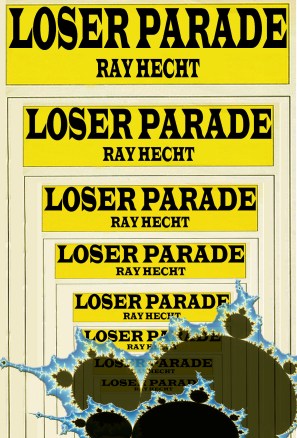
With this, the last of my free giveaways this season. Allow me to present my first novel: Loser Parade
(Well, my first halfway decent novel)
Written many years ago, so please don’t judge too harshly…
Fenton Ota is at his wit’s end. He thought he would have been more of a success at this point. What happened? He finds himself in Los Angeles an utter failure as an actor, and in the end there is nothing he can do but call Mom and go back to Ohio. The shame!
What is it they say about how you can never go home? Once back in Cincinnati with his tail between his legs, he reconnects with old pals, struggles to build himself up, and eventually embarks on a new goal: writing and directing his own play. Ostensibly based on his own “experiences.” Based on this author’s experiences. Writing about the fictional character who is him, writing about this author, writing about him, and so on. It gets a bit metafictional and postmodern.
He is, of course, doing this all for a girl. And their relationship is all based on lies. Ain’t love grand?
A tale of the creative process, the white lies that get out of proportion, and the deeper questions of just what is a story. Sometimes we are all losers, but hopefully its never too late to grow up.
I recently went to Hong Kong to check out some art galleries.
I highly recommend going to the Pedder Building on Pedder Street in Central. It’s very easy to get to; simply take the MTR to Central and walk out of Exit D1 and you’re right there.
From up to down: The 1st floor contains Gagaosian Gallery – 2nd floor PearlLam Galleries – 4th floor Hanart TZ Gallery – 3rd floor Ben Brown Fine Arts
The Rudolph Stingel exhibition at Gagaosian contained some interesting golden and metallic prints, large abstract scratches made from audience participation. I found it poignant that if you look directly into the reflective material you see yourself..
This slideshow requires JavaScript.
PearlLam exhibited ‘Perfection by Chance’ Yi Pai series, the space regularly presenting leading Chinese artists. Works by Qin Yufen, Su Xiaobai, Su Xinping, Tan Ping, Yang Zhilin, and Zhu Jinshi curated by Professor Gao Minglu.
This slideshow requires JavaScript.
Hanart TZ Gallary with Roundsky: paintings by Emily Cheng. Very new agey, lots of religious symbolism incorporating text into the paintings. Read closely.
And, the space had personalized arcade console with a working game!
This slideshow requires JavaScript.
Ben Brown presented Simon Birch: The Inevitable. I found these paintings very powerful. Large-scale, a painter with much talent in presenting the human form but choosing to cut up the figures, especially the faces. Seemed full of anger, almost violent, never still.
More free eBooks, do enjoy. This promotion will be lasting for several days further.
If you get anything out of this short story, tell your friends and share! And please feel free to post a review if so inclined… (As always, the Kindle app is free)
411 being an old horror tale I wrote years back, loosely based off of my time as a 411 operator. Does it disturb at all?
Allow me to take a moment to express my fondness for the works of Jim Starlin.
Since Guardians of the Galaxy – and yes the Avengers – has become mainstream, everybody knows Drax the Destroyer and Gamora and the Infinity Gems/Stones.
Most of all, now everyone knows Thanos.
But for it goes way back. When I was a precocious teen in the 90s, I couldn’t help but fall for the Infinity Gauntlet crossover. It was so epic, so cool. Thanos the all-powerful against a horde of superheroes and space beings. Followed by the exponentially-less cool Infinity War and Infinity Crusade, it was the epitome of overblown early 90s comicbook crossovers. What better to be introduced to the grand Marvel Universe?
The real story of Jim Starlin goes back much further that that. The cosmic escapades I am describing explore one of the great long-form stories of our time, with about forty years of history.
In the 1970s Marvel Comics was on top, having surpassed DC in the previous decade’s Silver Age quality. The medium was full of wonder, although it did get ridiculous as much as it got experimental. The Defenders, Howard the Duck, Jack Kirby’s Captain America. Comics hadn’t exactly grown up by then, no Claremont X-Men yet, but there was much fun to be had in the disco era.
Jim Starlin first got his break in 1972. He wrote and drew three issues of Iron Man, in which the metallic hero fought the Blood Brother aliens. And suddenly it was revealed they were working for the master villain of all time: Thanos.
The cosmic saga had begun.
It was in the pages of Captain Marvel that the saga truly unfolded. Starting with issue 25, the eponymous Marvel character finally found his own voice. The Kree alien (actually named “Mar-Vell”) was joined by the cosmic being Eon to become a protector of the universe, and was faced off against Thanos powered by a cosmic cube. The universe was just barely saved in the end.
I came across the trade paperback collection in my youth and I’m glad I did. The Infinity crossovers of the 90s made more sense with the backstory. That was the beauty of being into superheroes, to go back and endlessly collect and learn the whole story… Baroquean really…
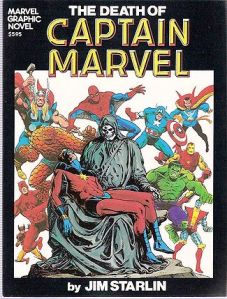
There was also Tbe Death of Captain Marvel, the first official graphic novel of Marvel. A sort of proto-crossover, it was simply about the Captain getting cancer and retiring from the world of the living. In typical fashion, Starlin explored themes of the afterlife and the psychedelic depiction thereof.
That was back when characters stayed dead.
Starlin is known just as well for Adam Warlock, a random character created by Kirby, who later became a sort of Christ-like figure. The artificial humanoid died and resurrected himself a number of times, just as often to fight against Thanos as he did ally with the mad Titan. An unlikely antihero.
The original build up of the Infinity Gems in comics was harder for me to find. I tracked down some rare reprints, an unsuccessful miniseries from the mid-90s. Weird stuff. Another villain was the Magus, who was Adam Warlock from the future and had started his own evil religion. Warlock had to erase the timeline to win. I think we can all relate to these kinds of psychological adventures.
It was a grand cosmic mythology, on par with Kirby’s Fourth World. The universe was a place of alien empires, tyrants with omnipotent power, and strange abstract beings overseeing the functions of all reality.
By the way, speaking of Kirby, Jim Starlin explained in interviews that Thanos wasn’t based on Darkseid — DC’s megavillain of similar stature — but rather more based on Metron originally. What with the floating chair.
Starlin is mainly well-known for the space operas, but he also had a diverse career. Even wrote Batman in the 1980s during the Death in the Family arc with poor dead Robin II. Cosmic Odyssey for DC as well, and his own creation Dreadstar. In later years, Rann-Thanagar War comes to mind.
But Starlin’s greatness is really showcased with the cosmic stuff.
In 1989 he wrote Silver Surfer (no longer illustrating) in a prelude to the Infinity Gauntlet. The anthropomorphic nature of Death had brought Thanos back from the grave, to harness his power and bring an evil balance the universe.
Much has been written of the ‘Infinity Wars’, the return of Adam Warlock and his multiple personas. It was Marvel of the 90s okay, and it was great. The followup series Infinity Watch wasn’t that great but it did further expand the mythos, as Warlock led his own ragtag team. Pip the Troll and Moondragon may not be top-tier franchises, but Drax and Gamora certainly grew in popularity in that series. And look that them today, full-fledged movie stars!
Back in my twenties, the prime of my life. Although I said I swore off Marvel, it didn’t take long for me to get back into the so-called ‘House of Ideas.’
It was Joe Quesada in the 2000s who headed the new era of mature storytelling for a certain biggest American comic company. He did away with the archaic comics code authority stamp, that self-censorship system imposed during in the 1950s ‘juvenile delinquency’ scare, Quesada was right to disregard, and mainline Amero comics became more like PG-13 films or prime-time television dramas. DC followed suit eventually as well, took them long enough.
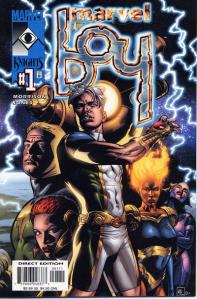
I particularly had to take notice when Grant Morrison was invited to write New X-Men. That changed everything. By the by, Morrison’s first for the company (at this time, never mind the 90s Skrull Kill Krew), was Marvel Boy. Totally awesome, with high concept ideas such as a humanless corporation villain and interstellar immigration policies. And a Fantastic Four miniseries illustrated by Jae Lee.
So, while I was already there I decided give some other X-Men a go. Chris Claremont went to X-Treme X-Men, after his return didn’t work out. I gave it a chance. Chuck Austin in Uncanny was, unfortunately, considered among the worst runs ever.
Then, Mark Waid got to write Fantastic Four! A lot of fun, and joined by the late Mike Weiringo of Flash fame. The first family of the Marvel Universe were seen as ‘imaginauts,’ as they explored time and space and other universes. Doctor Doom got a bit of an occultic retcon, and it was well done indeed. I love when Fantastic Four is done right.
Earth X came out in 1999, but I read the graphic novel a year or so later. Created by Alex Ross initially (written by Jim Kreuger) following DC’s Kingdom Come, the dystopian premise was a future in which everyone has super powers except for Captain America.
Jim Kreuger followed it up with Universe X and Paradise X, and I read all with great anticipation. Kreuger told a sort of final chapter to the Marvel Comics saga, revealing every secret character by character, giving a bittersweet farewell to everyone from Spider-Man to Galactus…
(Do prepare to see a lot of pics with Captain America standing there inspiringly, in this blog)
Meanwhile, the next big thing was to be the Ultimate Universe. Starting with Ultimate Spider-Man — written by Bendis whom I rarely cared for — it was a separate reality that was supposed to reboot everything for the sake of newer readers. Unburdened by decades of continuity, the Ultimate universe started anew with fresh modern takes on the various franchises.
Marvel Millar wrote Ultimate X-Men, and it was not good at all. Millar is an interesting writer; he’s pretty much a hack and yet a very entertaining hack. These days he’s only concerned with making comics to serve as movie pitches, such as Kick-Ass and Secret Service.
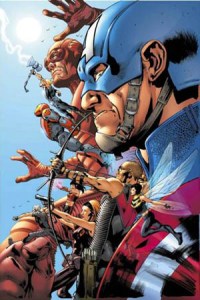
There was one masterpiece that stood out. Ultimates, by Millar and brilliant artist Bryan Hitch. That is, specifically the 13-issue Ultimates and sequal 13-issue Ultimates 2.
There wouldn’t even be the Avengers film phenomenon if not for Ultimates.
Millar was very successful at turning the Avengers into an incredibly awesome action movie franchise. Of the ‘widescreen’ style, written snarkily like the wittiest rated R cult classic, there was Captain America as WWII badass, homicidal Hulk, and biggest impact of all was Tony Stark/Iron Man as self-obsessed genius asshole. Thor as a new age guru was an interesting take. The super team and S.H.E.I.L.D. were all presented bit fascistic if you analyze too much, yet what a ride.
Very quotable. Cap: “SURRENDER??!! You think this letter on my head stands for France?” And when the villains overtake Manhattan: “The Great Satan has been liberated.”
With the climax of the first volume fighting aliens, familiar? I must admit I am definitely invested in the Marvel Cinematic Universe, and I fully give the Ultimates their do!
Other Mark Millar impacts included the crossover Civil War. Which will be getting a movie.
I didn’t read most crossovers of that decade. Secret Invasion by Bendis, no way. Fear Itself, yawn. Civil War was on of those cynical ‘realistic superhero’ tales in which Captain America goes to war with Iron Man over government registration of superhumans. The trade reprint seemed worth a read at the bookstore but not buying.
Spider-Man famously gave up his secret identity at the time, siding with Iron Man and revealing himself on camera as Peter Parker. Obviously, there was a retcon soon after and that never happened; back to the ol’ status quo for Spidey.
Afterwards, Cap was assassinated and resurrected Bucky/Winter Soldier replaced him for a while. I read some of Ed Brubaker’s run, it was critically acclaimed and so on, but kind of boring with all the predictable resurrections.
It’s been said that the comics scene — American superhero comics specifically, at least –is too much of a boy’s club. There are some legitimate criticisms in that, and I hope the field will prove more inclusive in the future.
I did like Louise Simonson’s 80s X-Men spinoffs, and Ann Nocenti’s Daredevil. Persepolis by Marjane Satrapi in the more indie vein. I grew up with Rumiko Takahashi’s Ranma 1/2 as for Japanese manga. Japan has always had plenty of female-friendly markets, and independent comics are surely more diverse.
Yet I have to admit that throughout the 2000s, the largest bulk of my reading centered on mainstream comics (mostly DC) by these authors: Geoff Johns, Grant Morrison, and Mark Waid.
Do allow me to add one more to the list: Gail Simone!
And I hope I’m not coming across as too affirmative actiony here, I really am a big fan.
Ms. Simone started out gaining prominence in the scene with her Women in Refrigerators blog, making the point that violence against women is often a plot point to motivate the male protagonist. And that’s not a very cool thing if you want to get more readers of the other 50% of the population.
She started writing Deadpool for Marvel, though I never read it I have heard good things, helping to build up the popularity of the character who is getting a movie. Deadpool is dark comedy, which is one of Simone’s best styles.
She truly has a brilliantly sick sense of humor.
For me, it began with Birds of Prey by Chuck Dixon. The series was great, as previously mentioned Barbara Gordon had become crippled and turned her talents towards being a sort of superhero tech operator. She mainly sent Black Canary on Bond-esque missions.
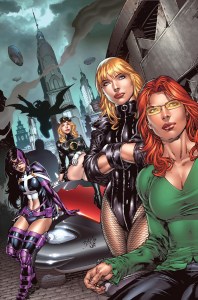
Gail Simone took over the writing, and Oracle was further joined by Huntress and Lady Blackhawk. The series actually became even better.
There was a hiatus, and at the Brightest Day event she returned to Birds of Prey with a new number 1 and it was most certainly on my pull list. Although that only lasted 12 issues, because of Flashpoint. See why I don’t like reboots?
I enjoyed Birds of Prey plenty, and then I became a rather hardcore fan during the Villains United minseries as as part of Infinite Crisis crossover.
The premise was that all the villains were teaming up into a grand secret society, with an inner circle led by Deathstroke, Black Adam, Lex Luthor, and Talia al Ghul.
Villains United wasn’t actually about the society, it was about a ragtag group of villains who wouldn’t play along. Deadshot, from the old Suicide Squad I loved, and a re-amped Catman, Rag Doll, Bane, and the new character their leader Scandal Savage — the daughter of Vandal Savage They became the mercenary group Secret Six (I’d list all six, but it wasn’t stable as some died and were replaced).
I knew something awesome was in the works. Best antihero villains-themed cover ever. The Six eventually got another miniseries, and then a long-running series that I followed to the bitter end. More below.
Simone wrote Wonder Woman for a while there by the way, and it was very well-received. So rarely is the character done right, a lot of those mythological epics are hard to do well. The new mega-villain Genocide was introduced. With a tweaked origin and a barbarian saga in mind, ’twas no George Perez but still quite good.
And then I moved to China in late ’08.
I continued to read Secret Six throughout my time in China. I brought all my back issues with me. Bought the new ones at my comic shop in Hong Kong.
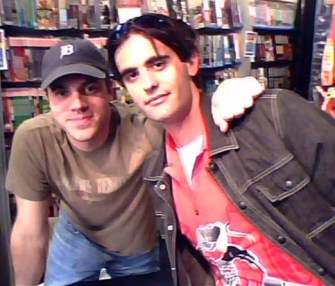
Met at comic shop opening L.A. Comic writers are always such nice guys.
Geoff Johns largely WAS the face DC Comics of the 2000s, in my twenty-something resurgence as a hardcore comics geek I basically read every single one of his books that entire decade.
Johns is not going to win any big literary awards and change your life, and that’s not the point. He is a great entertainer, a great storyteller, never dumbing down and utilizing the best aspects of the superhero genre. Throughout the 2000s, he was particularly skilled at taking complex continuity and streamlining into a way that pleased hardcore fans and newcomers alike. Nowadays is a different story, but that’s what it was like at the time.
I remember first discovering the former screenwriter’s first published Stars and S.T.R.I.P.E. at the very beginning, a certain humble 12-issue series about the Star-Spangled Kid, an update on old Golden Age retired heroes. It was the perfect start. Nothing grim and gritty (although later I’d learned the main character Courtney Whitmore was based on Johns’ deceased sister), just fun comics with respect towards history.
This also concerns Starman. Written by James Robinson in the 90s, Starman was one of DC’s finest works. Another legacy comic about a modern take on the Golden Age, Starman was very different from the norm. Jack Knight might be called a hipster hero today. His dad was the original Starman, and he was a normal, cultural guy with tattoos and good taste in movies, forced into the life.
Ultimately James Robinson ushered in the new JSA: the Justice Society of America. Thanks must also go to the success of the JLA at the same time, and DC was trying harder with classic team books.
Geoff Johns wrote from issue 5 and up to the end, and it was something special indeed. Unlike previous incarnations of these characters in Infinity Inc., the new book was ambitious and quickly became the centerpiece of the DC Universe. Arguably more crucial than the Justice League themselves. The society saved the world, introduced new mythos, let the original Flash and Green Lantern and Wildcat mentor the next generation, and not to mention a return to glory for Hawkman.
As for solo heroes, Geoff Johns took over The Flash…
This was back in the Wally West days, not Barry Allen like the new show currently airing. Barry had died way back in the Crisis on Infinite Earths event in the 80s, long replaced by his now grown sidekick. Wally was more of an everyman hero, without a secret identity, but still very much in the mainstream superhero scene.
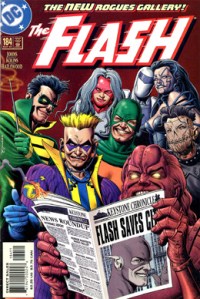
Flash already had very high standards, thanks to the extremely talented Mark Waid, and Johns – joined by artist Scott Kollins – focused on Wally as a sort of working class hero in a pseudo-Detroit. The villains were given the utmost important, with the Rogue’s Gallery often being the stars.
The Flash became my favorite hero of all.
I still really miss Wally West…
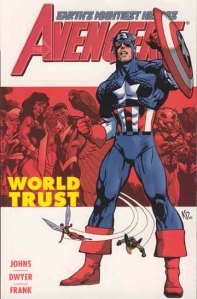
Geoff Johns was gaining traction, and got noticed by Marvel Comics. He had a brief run over on the flagship title The Avengers, as well some other miniseries such as The Vision and The Thing. He did as well there as expected – he was perfectly suited to Captain American in particular. Sadly, it was over all too fast and Johns signed on to be exclusive with DC and the run abruptly ended after a mere 20 issues. Avengers after that became New Avengers by Bendis and I was no fan; that was point I cut off all Marvel and focused only on DC.
Geoff Johns kept going. Teen Titans debuted, fusing the 80s Titans fused with Young Justice. I didn’t love the art and I kinda missed Peter David, but it was very much worth reading. Robin, Superboy (now revealed to be… spoiler ahead… Lex Luthor’s clone!), and Impulse took up the mantle of Kid Flash.
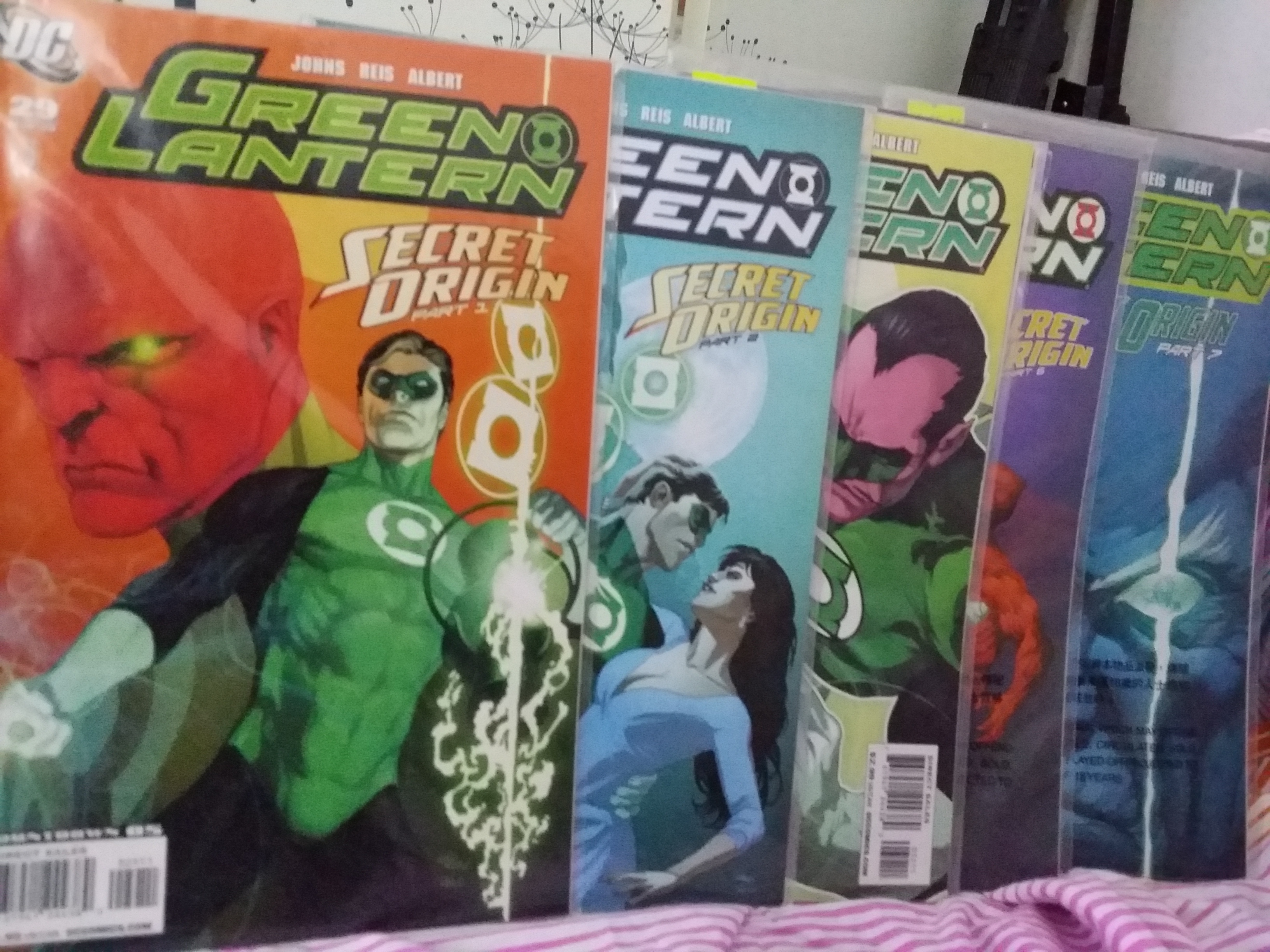
This would not be a post about Geoff Johns however, if I did not speak of his epics of epics: Green Lantern!
(Note many of the pics below I simply took myself, as I thought these comics worth saving in my China apartment right now)
In 2005 or 2006 I met comic book writer Grant Morrison at a music festival in Los Angeles. It was an odd event in Echo Park, with many experimental bands playing at various stages, and at the same they had a workshop on the occult. Sadly, most people weren’t concerned about the workshop part.
I was ecstatic to hear that Grant Morrison would be there. He gave a fascinating interview. Seriously, you must youtube some videos of him immediately. Low-key event that it was, we got to chat personally for a few and he was nice enough to take a picture with me. I met his wife too.
I met him at Comic Con the following year as well, at events far more crowded, and he was still very nice. I won’t inundate with more pictures, however, I’m not that much of a fanboy.
For more here’s an particularly awesome video from 2000’s DisinfoCon introducing the tenants of chaos magic and how to do a masturbation sigil:
Note he’s Scottish.
And now my blog begins. Presenting the master of the Postmodern Superhero. The punk rock star of comics. My personal all-time favorite.
First things first, comparisons with Alan Moore are inevitable. They are both absolutely brilliant. They are both magicians. They both deconstruct the nature of the superhero like no other.
Yet, one is a mess of hair and the other is bald. One seems to be a misanthropic old man, and the other apparently has lot of fun as a writer. One hates all things mainstream, and the other is just fine with utilizing corporate characters as tools to tell the important stories.
Unfortunately, if you’re a Grant Morrison fan then you must be an Alan Moore fan as well but the reverse isn’t necessarily true. There’s a lot of overlap in themes, yet if you want to be an anti-mainstream purist you can skip Morrison. I think you would be missing out if you did that.
Anyhows, I am a great fan of both so what’s wrong with that?
As for me, I personally first came across Grant Morrison in my teens (though the story gets more interesting in my twenties), because of the huge phenomena that was JLA in the 90s. I was marginally interested, being that I followed everything important that was DC at the time, and the first volume was okay. Superman with a mullet notwithstanding. When I got to the Rock of Ages graphic novel, I was astounded. Then the following arc about the 5th dimensional beings left me well and truly mindfucked.
To me, the peak was the One Million crossover about time travel to 853rd Century. Great high-concept science fiction.
Grant Morrison has since further written Superman in such titles as All-Star Superman, Action Comics, which you can see my opinion thereof by following that link .
One of the random things I was into seeking back in the day was Flex Mentallo, a strange Vertigo piece about a corny superhero. I found issue 3 at discount, and spent years hunting down the full story.
It had everything: deconstructionism, metafiction, with groundbreaking art by frequent Morrison collaborator Frank Quitely.
I contend that Flex Mentallo is superior to Watchmen. It takes a dissection of the superhero genre even further. And it’s funnier, wittier, with treatises on childhood trauma and cosmic abduction, and contains the classic line “Fredric Wertham was fucking right!”
It was so hard to get all four issues. The problem was that Flex Mentallo was a satire of the ‘hero of the beach’ and with republication risked getting sued by those old strongman ads. DC wouldn’t reprint a graphic novel for years. Back then, I bit the bullet and paid high prices on ebay and it was well worth it. Now, of course, there’s a trade.
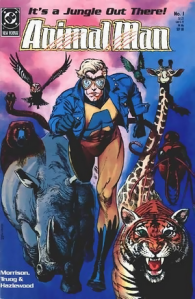
Let’s go a bit more backwards, with Animal Man. The saga of Buddy Baker was one of Grant Morrison’s first forays into DC during the 80s British Invasion. This obscure hero was given a modern reboot, that quickly went from an essay on animal rights to some weird routes onto the nature of fiction. Combining Wile E. Coyote with Native American mythology, by the end it went full on metafiction. Most haunting of all was when Animal Man broke the fourth wall and looked directly at the audience, shouting “I can see you!”
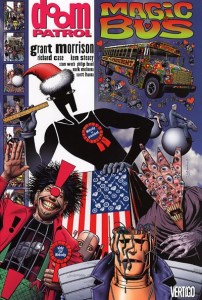
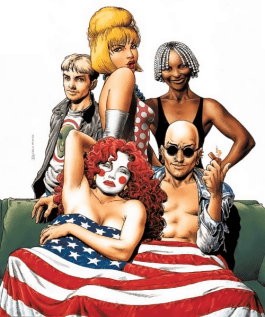
Concurrently, Doom Patrol was a very interesting take on outcast heroics. The patrol were always a bit odd, a tad off, and Grant Morrison knew how to play to the strengths of that. Robotman as eunich, transgendered street characters, and most of all were the villains based off art history. Brotherhood of Dada anyone?
Not to mention Flex Mentallo first appeared in Doom Patrol.
These were all well and very, very good. However, Grant Morrison’s true opus came in the 90s with the Invisibles. By the time I got caught on, well after it was completed, I was generally getting into more esoteric subject matter. I was reading P.K. Dick and Robert Anton Wilson. I was collecting Disinfo books. I was coming across these strange interviews with one Grant Morrison comic writer, on the subjects of chaos magic and higher consciousness. It was time to read more.
I ordered the entire set, and read on. Then I read them again, and a few more times at differing stages of my life. I’m about ready for a reread again.
The Invisibles is an epic take on Gnosticism and conspiracy theories, through the lens of an action comic, published by Vertigo. About a team of anarchists fighting the good fight against the forces of control in this world. It incorporated all kinds of references to psychedelic mythologies. All came to a head in that Singularity futuristic year of 2012.
It felt somewhat cathartic that my burgeoning spiritual path was overlapping with my love of comics and superheroes. I was doing it right all along. Much can truly be learned about human growth via the metaphor of the Superman. Thanks, Grant Morrison.
And, I may share that reading interviews on how Grant Morrison took LSD and other various chemicals for the sake spiritual experiences, that had an impact. Helped to encourage me with my own experiments utilizing psilocybin and dimethyltryptamine, legal or otherwise, rewiring some synapses within my nervous system in some arguably positive ways.
As always, reading books (and comics) can be such a bad influence!
When it comes to literary comic icons, no man comes before Alan. So much has been written about the unofficial leader of the 80s British Invasion, who heralded the coming of Vertigo and then disavowed DC and all mainstream publishing. The mortal enemy to Hollywood who has had at least half-a-dozen films adapted against his wishes, unlike Neil Gaiman who always seems to rather enjoy his celebrity. Mr. Moore, the proverbial purist artist always refusing to compromise. The mad occultist who refuses to shave. The genius we all aspire to be and will always fail to live up to.
Documentary: The Mindscape of Alan Moore
I shall start with Watchmen, as most people have started with that famed tome. Though, please note I think Moore’s legacy is far bigger than that one superhero deconstruction — perfect work of controlled storytelling it may be — and I think he has since surpassed his early work time and time agian. More on that below.
I was about 14 when I read the full Watchmen in graphic novel form, having missed the original issues in 1986 as a small child. A reputation had long preceded it at this point and I was getting into comics on a deeper level at the time, so I was looking forward to reading and seeing what all the fuss was about. I had a whole Saturday afternoon to kill at detention, they made you sit around for 4 hours; I was not a good student at the time. I read the entire work in one sitting. I was, of course, blown away. And I did a book report.
Watchmen came about when DC Comics purchased the Charlton library characters, Blue Beetle and Captain Atom and The Question, and Moore put together a proposal called Who Killed the Peacemaker? DC realized the status quo would be torn asunder, and they were going to incorporate them post-Crisis on Infinite Earths anyhow, so he was told to keep the plot but make up new characters.
Illustrated with precision by Dave Gibbons, it grew bigger than the usual story. Blue Beetle became the cheesy Batman-esque Nite Owl, Captain Atom as the one Superman of this world became the omnipotent Dr. Manhattan. They were archetypes as well as individuals.
Not only did Watchmen win the coveted science fiction Hugo Award, after that they changed the rules so comics could no longer win.
What struck me most of all were the extras between each chapter. Newspaper clippings, magazine interviews, notes, all the the world-building to show the authenticity of a hyper-realistic setting.
Also, the usual Alan Moore themes of rape and the illusion of time.
Watchmen has since become passé. Gritty realistic superheroes have been done to death, and Moore has specifically said in interviews he regrets causing that trend.
Personally I never watched the movie all the way through, and I don’t intend to. Mr. Moore is famously against all Hollywood adaptations, and some people find him a cranky old man. I moreover stand with him on that.
With that, let’s go some earlier Moore.
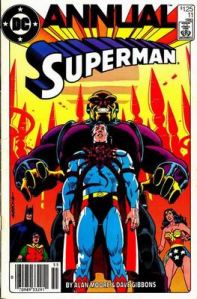
His mainstream days were relatively sparse, but every single one had an impact. There was Captain Britain, with Alan Davis. There was a bit of Superman, such as the classic birthday tale For the Man Who Has Everything, also illustrated by Dave Gibbons. And that final imaginary tale (aren’t they all?) previously mentioned, Whatever Happened to the Man of Tomorrow?
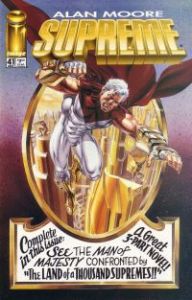
Speaking of Superman: Supreme. In the 90s, Moore was invited to work for Liefeld’s creator-owned imprint over at Image. Supreme was a very obvious riff on you-know-who. It quickly became a brilliant satire/homage/deconstruction on Silver Age superheroics. The ‘Man of Majesty’ was both corny and endearing, engaging within a complex plot involving multiple realities and retroactive timelines.
I should say that Moore’s American work really started with Swamp Thing, of which I’ve only read the first two volume. I know, I know, very late in the game on this. If I’m supposed to be completist the I better get to it. The Green, The Green…
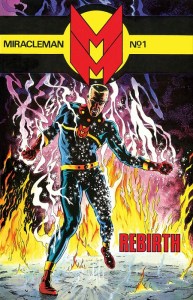
Going back a bit further, there’s Miracleman. Now, the backstory of that character is Baroquean inof itself. The British knockoff of Captain Marvel was originally Marvelman, given a reboot in the 80s and published on the American side by Eclipse comics. However, in fear of being sued by Marvel Comics they changeed the name to Miracleman. And then it was abruptly canceled, with the legal ownership thereof in legal limbo for decades.
This made the series very hard to read before the digital age. I did order the first arc on ebay and it was a great read. Finally, I read the entire series online. Don’t ask questions about the legality of that, please.
Neil Gaiman’s brief run was interesting as well. A funny thing, now Miracleman of all things is owned by Marvel and they say they’re finally going to reprint the classic issues as well as let Gaiman complete his unfinished story! Guess I’ll believe that when I see it.
Meanwhile, Alan Moore in the 80s. There was the dystopian V for Vendetta, currently in print under the Vertigo banner, one of the first of his major comics that defied classification.
On the subject of V for Vendetta, this is very much the reason that I agree with Alan Moore on all things Hollywood. The film was an atrocity. It completely misses the point of the original, pretending to be a deep critique of American post-9/11 politics — taking place in the U.K. for no reason and badly done at that. It was supposed to be about Thatcherism. Moore was absolutely treated wrongly by the pretentiously stupid Wachowski Brothers. He was 100% right to disavow the film and have his name taken off.
In the end, the legacy lives on with those Guy Fawkes masks.
Another mediocre movie based off brilliant source material, From Hell is a literary masterpiece like no other. This riff on Jack the Ripper conspiracy theories doesn’t really aim to solve it, there are deeper takes on the nature of reality at play.
I remember when I read much of these graphic novels, I was living in L.A. during my starving artist period. How did I afford to read, you ask? I went to the library in hipster Silverlake and they had an extensive archive.
Back in the 2000s, Moore had started his own America’s Best Comics (ABC) with a host of deconstructionist characters. Tom Strong, among many others.


























 Ray-Comics