Ray-Comics

Drawings and Writings

Ray-Comics

Beijing Chinglish

Hello readers,

My tour continues in Beijing and beyond to Chengdu, and more on that soon enough. (And more on the security situation in Beijing, on a serious note…)

But first, via Instagram, some Chinglish in Beijing. Including disgusting meat. And a just plain weird candy.

Without further ado:

Interview with Glen Cornell

PastedGraphic-1


Glen Cornell is a local friend, and heads the ChinaSquat language & teaching resource website for expats. He lived in China for a total of five years, starting out as an English teacher in Dalian and finishing up in Shenzhen for three years working for a manufacturing company while simultaneously working as a freelance teacher. He also started up the Shenzhen Book Exchange, an amateur library of sorts for expats to find books in their own language. He recently returned to America and I thought we could catch up via blog…


Hi Glen, how’s the transition back home been? Where are you living now?

I was very ready to move back to the US, but to be completely honest it’s been a bit of a whirlwind the past month, but that’s what I expected. I left China in a bit of a hurry going after a job opportunity that I really couldn’t pass up on. Part of me had hoped things could have gone more smoothly, but normally the transition for expats from China to the U.S. can be a really tough one, with weeks of unemployment, so I’m really glad that I was able to avoid that.

I’m now living in Boston, Massachusetts, working in sales for a marketing software company called HubSpot.


Can you go over about your decision to move to China? Where were you in your life when you made the choice? Why China?

I first decided to come to China about six months after graduating. It was 2010, and the recession still felt like it was in full swing. My “dream job” after college fell through and I was working at a steakhouse living with Mom and Dad. It wasn’t ideal. However, two of my good friends, one from childhood and the other college, were living in China and pushing for me to come check out that side of the world. On my end, I was just happy to get out of my current situation and see a new country. I was also thinking that learning Mandarin would be a good career move, as China and Chinese were becoming more important in the world.


How exactly did you actually get to China? Did you have a job lined up?

So I took a pretty risky move and just came on my own. My friend Eric Lewandowski was currently living in Dalian and he encouraged me to just get myself there with a tourist visa and then I’d find something. In retrospect, that was probably a dumb move, but luckily for me it worked out. I flew in to Chengdu and did some “sightseeing” for a week, and then moved to Dalian to crash on Eric’s couch while looking for work. I found a job my first day in Dalian, and moved into a new place within 5 days.


So clearly you’re not afraid of making big decisions in a hurry.

I guess one could say that.


Without getting into too many specific details, how would you generally summarize your time living in Dalian and working as an English teacher? And how did you get to Shenzhen?

Actually I lived in Xiamen too before I moved to Shenzhen. Haha, it’s a pretty important part to my personal story, but I’ll get to that later.

Continue reading

My experience being rounded up by the Chinese police at the big Shenzhen drug raid

[In the early hours of February 21, 2016, there was a major drug raid at a Shenzhen rave party. It has since become international news, reported on by The Guardian and Vice. I was rounded up along with hundreds of other people, and this is my story.]


One of the surprising things I discovered upon moving to China all those years ago was that illegal drugs are remarkably easy to come by.  Before arriving, one would assume that wouldn’t be the case in a pseudo-Communist country. Yet, the party scene introduced itself to me almost immediately and I saw that often times drugs among expats were no big deal. Perhaps it’s the chaos that comes with rapid economic expansion, but for whatever reason that’s the way it’s generally been.

To be specific, expat stoners I know seem to usually find a source and easily keep up their stoner lifestyle. It’s only marijuana, and it’s becoming legal in America nowadays anyway, so what’s the big deal?

Besides that, there’s MDMA in the club scene. From what I’ve observed, psychedelics such as LSD are almost unheard of unless one has a very good source –  as that kind of psyche-spirituality vibe is not apparent here. Opiates rarer still. I have heard tales of cocaine and ketamine, and newspapers do report that methamphetamine is a growing problem in China.

Based upon my admittedly anecdotal evidence, among foreigners in big cities at least, it’s mostly a bit of MDMA at clubs and the usual marijuana hit if you are into that kind of thing.

Not to mention, like almost everywhere else in the world, the main drug of choice is a certain legal narcotic which is definitely the most destructive of all: alcohol.

Personally, I am not into most that. I think I’ve done the normal amount of experimentation in my life, and politically I am quite against prohibition. But marijuana doesn’t do it for me. It’s not to say that I am morally opposed, the THC chemical reaction simply makes me feel extremely anxious and uncomfortable and I’m not a fan. I don’t particularly like alcohol either, to be honest.

The unfair thing about the world is that the random chemical reactions specific to my brain and genetics more or less keep me clean. It’s not like I’m making any major effort to “just say no.” There is nothing at all fair about functional people who enjoy smoking being punished so harshly in society, while I am not. It’s nothing but luck. And when the police came to drug test me that night, I got to go home, while some of my friends weren’t so lucky…


mmexport1456324418135.jpg

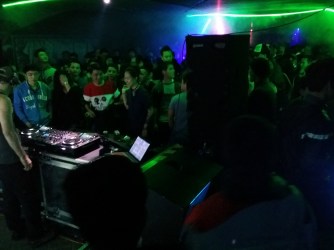
The Real Deal is a group of partygoers in Shenzhen who organize underground outdoor parties with electronic music – raves, if you will. I’ve been going to their parties for years. In fact, the big party that got raided was their 4th year anniversary. They advertise openly, book famous Hong Kong DJs, and have been a fixture on the community for quite some time. It never felt subversive to enjoy their events. I for one appreciate the efforts of the organizers to create a fun place for people to listen to music and find something different to do in Shenzhen. Certainly beats overpriced drinks at pretentious nightclubs.

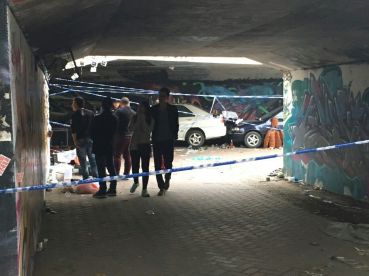
On the night of February 20th, I decided to go to the tunnel party with my girlfriend. It happened to be near the Ikea, in walking distance from my home in the Baishizhou neighborhood. Several of my friends were there, and I expected we would all enjoy ourselves. Me and my girlfriend arrived at about midnight, met up with some buddies, had some drinks, danced, and so on. I did note that the anniversary party was quite crowded. Still, it seemed legit to me.
20160221_004842.jpg

Don’t get me wrong. The Real Deal organizers, from my understanding, don’t go farther than make deals with local security guards.  Being that it’s outdoors and unlicensed, it’s still pretty much a “rave,” isn’t it? Yet the worst that ever happened in the past is that there’d be noise complaints and some police came to shut down the party. Normal risk, right? Or so one would think.

Without naming names, I did notice LSD and nitrous oxide around. (Are those chemicals even illegal in China?) Pills appeared to be harder to come by, ever since the two unfortunate overdoses back in December most people had been avoiding that sort of thing. No, as usual, the normal culprit was the noticeable smell of marijuana.

I don’t know what made this time so special, why there had to be a crackdown that day. I have no doubt the police knew about these parties for years but never cared. Why now? Was it because of those two overdose deaths that they felt they needed to protect us from ourselves? Was it that the crowds were getting too big and China doesn’t like big, potentially protest-y, crowds? Was it, as currently noticeable from Beijing to Hong Kong, the general atmosphere of authoritarianism which has been growing of late under Xi Jinping…?

In any case, at about 3:45 a.m. a whole lot of shit went down. I remember it clearly because my girlfriend and I had previously discussed that we should leave at 3:30 in order to not to stay out too late. When the time came, she suggested we dance a little more, and I said okay. We tried really hard to not wallow over that decision after the shit went down.

It was totally surreal. I was sitting on a curb catching up with a few pals, and suddenly saw a few police officers run down the hill. I took my girlfriend’s arm and everybody walked away at a brisk pace. Then, the abrupt end to the music caused a weird shift in scenery. The silence came with a sense of panic, and everyone started dashing toward and exit. There was a serious danger of trampling at that point. My first thought was that people were overreacting and it couldn’t be such a big deal, but I soon noticed there was something different about the closure of this party.

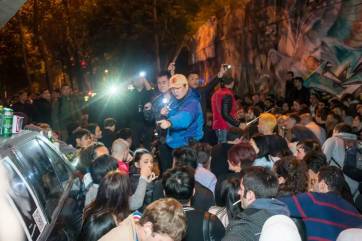
We got to an exit and a line of riot police with shields and batons had completely blocked the way. I have never experienced anything like that before. I couldn’t even see behind me because of the crowds, but nobody could move and it must have been blocked on every side. A bilingual, senior looking cop started yelling in English and Mandarin. “Turn off your phones! Sit down! Stay still!” It was a very confusing moment.
mmexport1456120953563.jpg

The weirdest thing was not knowing what to do next. Although this was an extremely coordinated attack — Shenzhen Daily reported “the Nanshan District Public Security Sub-bureau confirmed the raids had happened and that they had been planned for ‘quite a bit of time.’” — all those hundreds of officers working through the night seemed to be out of their element. We sat around for about an hour. People stood up, and were told to sit down. There wasn’t much room to sit. I saw my friends in various piles, and we tried to keep each other’s spirits up.  I had my arm around my girlfriend. On another side, I saw some expat guys getting rowdy and then handcuffed.  I saw cops with streams of plastic cable tie handcuffs, yet thankfully they were never used. All in all, in retrospect, it was pretty peaceful. At the time there was just so much speculation; we didn’t know what was going to happen.

Finally, small groups were formed and were told to walk to the nearby parked police buses. We lined up and put our hands on each other’s shoulders like a cheesy conga line.  Mine was the second or third group and I was glad to get it over with. I wanted the next step to be done with already.

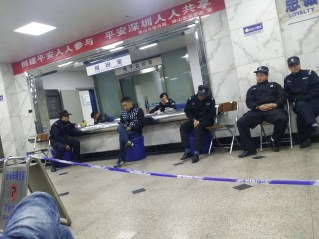
Once piled into the police bus, we driven around for a while. I had no idea what kind of route they took, but I later learned that it wasn’t even that far; still walking-distance from my home. All different police stations in Nanshan District were working in tandem, and luckily the Taoyuan station was nearby. Along with my girlfriend, two other American friends also joined me in that police station. Along with about fifty people in total. I know that because we were given numbers drawn in sharpies on our hands. I was number 43, and I’ll never forget it.
20160221_073523.jpg

I had to pee so badly! That was the most painful part of the process. There would be more urine-related activity to go around, and they gave us plenty of water. After things were eventually organized and settled down, the station waiting room was full of chairs and we weren’t allowed to leave and then the real waiting began. The boredom was the absolute worst. No music or anything.

As the sun came up, one-by-one we had to take urine tests. I heard that women had to be watched by a female officer, which is rather humiliating. Men could turn their back while being watched, though I did notice the toilet had a camera positioned above.

Somehow, it occurred to me that it would be appropriate to joke as much as possible. What else could I do but try to laugh it off? I tried to make my friends laugh, and said ganbei! (“cheers”) to the cops as I held my own steaming cup of urine. That got some smiles. I asked if they had Wi-Fi, I declared that I would pee sitting down in solidarity with the women, I sang Taylor Swift songs, I told bad jokes about horses in bars with long faces, and I suggested that I ought to call the police after such treatment. Lastly, when they put the testing device in my cup I asked if it showed I’m pregnant. Get it?

mmexport1456114924925.jpg

Although I tried to be on everyone’s good side, deep down I felt a lot of animosity for being treated this way. Obviously, the police officers I met are only cogs in a greater machine. Yet they are willing cogs, and cannot approve. Early in the morning they brought some steamed buns for people to eat – struck me as a good cop/bad cop ploy – and I refused to eat any.

Actually, to be fair, our station wasn’t bad compared to what I heard about others. People were made to sit outside on the floor in the cold. Victims were told that the Chinese government has a right to detain anyone innocent for 24-hours without any arrest. Some weren’t allowed to talk. Many weren’t allowed to leave until many hours later than my group.

mmexport1456051147978.jpg

Of the four of us in my own personal set, only three were to leave that morning. Sadly, one of my friends, of the stoner sort, was sent somewhere else after the drug test. Briefly, I had witnessed some people in a cell in the back; sad scenes of men crying and couples cradling each other. It was very worrying that a friend could be hanging out with us one minute, and then taken somewhere else the next.

After all this grueling time, just before 10:00 a.m., they started letting people out. First a Spanish woman complained until they processed her information and she was allowed to leave. Then a Chinese woman left. I crossed the barricade a few times to complain and plead and just learn what the situation was. Turned out, when I didn’t give them my passport number before (I feigned that I had forgot), they wouldn’t let us leave until everyone gave their numbers so the authorities could check our visa status. Fine. I gave in and gave my number. Then waited another hour or two. How long could it take to look up? I had even crossed the border from Hong Kong the day before. What was the big holdup?

There was one drunk, half-passed out gentleman who couldn’t be bothered to give a real passport number. People were getting angrier and angrier, turning on each other. Interesting to see how easily sleep deprivation can affect people, and on the other side to see how freedom can have the opposite effect. At last, when they had called out numbers and one-by-one we were allowed to leave, we clapped and cheered in joyous relief. “44.” “43.” “42.” Even the cops smiled as us newly freed detainees applauded.

20160221_073453.jpg

My phone was out of power. My stomach was empty. In minimalist attire, without sunglasses to protect from the morning light, we all went home. That Sunday was a write-off day, like jet-lagged with sleep patterns all askew, and I didn’t get much done. I am getting too old for all-nighters.

In a sense, I was relieved after the experience. A part of me always wondered what would happen if I was got in trouble with the police in China. I feel vindicated now. They didn’t interrogate me or anything, they simply checked my visa status and after a long while let me on my way.

According to a translated press release, the numbers were surprising. 491 people were detained that night. 118 had tested positive for drug use, majority marijuana of course, and 93 held. (It’s not clear why 25 people weren’t held. Connections, corruption?) Of those 93, 50 of them being foreigners. Perhaps they caught like two drug dealers, but most were released after 4 or 5 days. It was called “administrative detention” or “violation.” Not arrest.

“They were after the dealers…” my detained friend later reported back to me. “Everyone else is a pawn to them.”

Those limbo days were rather terrifying. Rumors abounded, and those of us left free all scrambled to figure out what was going to happen to our friends. Moreover, there was the great question of what was happening to the community within China. Simply put, is it worth it to live here anymore?

It has now been confirmed to me that nobody (at least not the vast majority of non-drug dealers) is getting deported. Chinese and foreigners alike, they don’t even have to pay fines. All that fear, and what was the point? The city of Shenzhen undertook this massive operation, apparently all in the legal grey zone haze that is the China system, and just what was the real purpose?

With 80 percent of the detainees drug-free, and only half foreigners: The question remains, what possibly could have been the point of all that?

Whatever the point is, some kind of message has been received. Shenzhen is no longer what it once was. The expat and party scene will get past this, but something has changed. A threatening cloud of authorities now hovers over the community, and somehow China doesn’t seem as welcoming as it used to be.

The party is over.
 

mmexport1456051015487.jpg

Excerpt: South China Morning Blues

Now that New Year celebrations are over with, I’d like to share an excerpt of my novel South China Morning Blues published by Blacksmith Books.

You can read the embedded piece below, or download the PDF via this attachment:

South China Morning Blues – Shenzhen: Prologue


It is the very beginning of the story, a prologue to Book I’s setting of Shenzhen. Opening in media res with one character represented by the Chinese Zodiac animal 虎 (Tiger), the story then jumps back and forth with the point-of-view of 兔 (Hare), and finally gets to the introductory character 牛 (Ox). I hope it isn’t too difficult to keep track, hope it’s worth the effort.

These tales represent my attempt at capturing the jagged essence of the modern cityscape experience, as expats and locals try to make sense of this rapidly-changing setting. These people are flawed, don’t always do the right thing, but maybe just maybe they come across as somewhat realistic humans. There are all kinds out there. At least, there are 12 knds out there…


If you’d like to read more, feel free to order on Amazon or directly from the publisher

http://www.amazon.com/South-China-Morning-Blues-Hecht/dp/9881376459

http://www.blacksmithbooks.com/books/south-china-morning-blues

unnamed


Chinglish 2016

Not much Chinglish to occupy my eye these days, but I do have a few to start off 2016 while it’s still January:


While I’m at it, here’s some more funny China stuff in the form of bootleg Star Wars toys! Followed by my own small Lego Star Wars collection, and you can guess which ones are fakes…

Book Review: South China Morning Blues

Why I Write

http://www.whyiwrite.net/2016/01/ray-hecht/


Ray Hecht

South China Morning Blues 

Ray Hecht is an American author based in Shenzhen, and blogs at rayhecht.com. Raised in the American Midwest, he studied film in Long Beach, California before moving to China in 2008 where he divides his time between fiction writing and freelance journalism. South China Morning Blues (Blacksmith Books, 2015), a story of depraved expats within the hypermodern southern Chinese sprawl, is his debut novel.


Why I write

That is the ultimate question, isn’t it? I don’t truly know the answer. Perhaps because I am a lonely person and I got into certain habits and now after years of this I am compelled. I want to express myself, I have enough ego to believe that others should read what I write, and it’s just a part of what I do and who I am. I have these things in my head and this compulsion to write it down and I hope beyond hope that people would like to read.


How do you go about writing?

I try to write every day. When a long-term project is going, I write about four days a week on a decent week. Good weeks more, bad weeks less. To me, it’s not about hours so much as word count. Five hundred works at least, or a thousand words on a very productive night. That may take hours or it may take 30 minutes.

I like to stay up late, because that’s the time when everyone leaves me alone. That magic time from midnight to about 2 a.m. I used to write later, but it’s getting harder and harder to keep up with a night owl lifestyle these days. That’s when all the original words come to me, and the next afternoon I tend to do rewrites.


Where do you write?

I like to lay down in my bed in my underwear with the laptop. I remember the old days when I had a big PC, it was much harder to motivate myself. The laptop is the most perfect invention ever…


Worst distraction?

…excepting, of course, that the Internet is the absolute worst distraction ever. If left to my own devices I tend to constantly check my email, Facebook, news sites etc. Porn isn’t even as bad as social media. Sometimes though you just have to unplug and force yourself to finish a deadline. Unless there’s research to be done.


Best inspiration?

I suppose I’m inspired by various things. A good song can inspire. A book, a show. A crazy life experience can especially inspire. Most of all, combing through my own memories of complex life issues and mix and match it into new combinations; somehow that give me ideas about what to write.


How often do you get writers’ block? Do you ever doubt your own ability?

I don’t really believe in writer’s block. However, I doubt my own ability all the time. When I compare myself to the major authors whom I respect, I am not in the same league at all. But I’ve chosen to write and even if it’s shit I have vowed to finish what I started.

The thing about writer’s block is that I always have more ideas than I have time to write them down. It should always be that way. Instead of being choked by the blank page, I suffer more from sheer laziness. Writing can be mentally exhaustive, and although endless ideas are swirling around in my mind, sometimes I don’t have enough energy to record and tinker with those ideas.


Contemporary writer you always read?

I always read new Haruki Murakami and Neal Stephenson. Murakami isn’t as good as he used to be, frankly, in my humble opinion. Stephenson is such an insanely prolific writer that it takes me longer to catch up with his latest thousand-plus tome then it does for him to write, yet I always do try to catch up.


Favorite book on China?

Speaking of which, Reamde by Neal Stephenson is a great book that takes place in China, full of hackers and gold-farming. He really gets it right.


Favorite Chinese author?

My favorite may be Su Tong, and especially his novel My Life as Emperor. Written very matter-of-factly and full of cruelty, it rather haunted me.


Favorite book?

There are several books that have supremely influenced me. I’m going to keep it in the realm of fiction: Snow Crash by Neal Stephenson is the ultimate irreverent yet smart novel, with so much energy. I know I’m not smart enough to write science fiction, and cyberpunk in particular, I am purely a fan with no desire to emulate.

I have to mention The Illuminatus! Trilogy by Robert Anton Wilson and Robert Shea which sent me on a lifelong journey to figure out what the hell is going on in the world.

As for literary inspiration, Irvine Welsh’s Trainspotting and Bret Easton Ellis’ Glamorama are works that have directly influenced how I string words together…


Favourite writer?

As for other mediums, I would like to say that comic book writer Grant Morrison is one of my absolute favorites. Able to write mindfuck profound postmodern comics, as well as fun superheroes, and I am very envious of his abilities.


The book you should have read but haven’t?

I am currently trying to find the time to start Gravity’s Rainbow by Thomas Pynchon. I have a feeling it’s going to be a tough one.


You look back at the first thing you had published and think…

Wow I was lucky!


How did you get started writing?

I scribbled on occasion when I was a kid, more interested in drawing than writing. When I was in school I decided to study film on a lark, and I didn’t really finish, but I decided I like prose more than screenplays because you can be alone. I decided to write novels when I was twenty-three years old, wrote several, and then almost 10 years later it worked out.


Does writing change anything?

I suppose it changes your social life, because friends and loved ones can’t understand why you are always avoiding the outside world. It’s worth it though, I hope.


What are you working on now and when is it out?

Well, I’m still working on promoting South China Morning Blues which is currently out in Hong Kong and beyond.

I have another novel in the works, a full draft is finished, and it’s not about China. It’s about how technology effects relationships and I got the idea from last time I visited America and observed as an outsider the whole Tinder dating thing. If I’m incredibly lucky it will be published in less than a year. A lot has to fall into place. I believe it will be published eventually. Wish me luck!


Continue reading

Bookish.Asia Review: South China Morning Blues

South China Morning Blues • Ray Hecht

http://bookish.asia/south-china-morning-blues-ray-hecht/

The Pearl River Delta is home to Guangzhou, Hong Kong, Macau, Shenzhen, and cities of millions – such as gritty workshops to the world Dongguan and Zhongshan – that you’ve never heard of. Despite being the powerhouse of the country’s decades-long economic boom, China’s southern cities have been largely ignored by English-language novelists for the more glamorous settings of Shanghai and Beijing. When stories are set in the south, they are usually period pieces taking advantage of the region’s rich historical backdrops of war, revolution, and the treaty port clash of cultures. It was a welcome change to come across a novel set in modern-day Guangdong.

South China Morning Blues is divided into three sections, each named after a city in the region. The multiple storylines begin in Shenzhen, move to Guangzhou, and end on Lamma Island in Hong Kong. The novel provides a kaleidoscopic view of urban China as seen through the eyes of a dozen mostly twenty-something Chinese and foreign characters. There’s Marco, a macho American businessman looking to get laid at every opportunity; Danny, an English teacher finding his feet; intellectual stoner Eric; artist Ting Ting; American-Chinese journalist Terry; and… I’ll stop there. Twelve is too many to run through, which raises the question of whether that number of characters makes for an overcrowded cast.

Although there’s no consensus on the maximum number of main characters a novel should contain, it’s generally thought that eight or nine is the upper limit for a medium-length work. Irvine Welsh’s Trainspotting, for example — which, with its multiple narrator structure, was one of Hecht’s inspirations — has perhaps seven main characters. When I opened SCMB, and realized that Hecht had chosen twelve because he wanted one character for each animal sign of the Chinese zodiac, the approach seemed like a recipe for disaster.

Surprisingly the big cast works. Credit goes to the author for how he does this by adding a couple of characters at a time, building up layers, and coming back to earlier people as some of storylines are threaded together. The effect is an unusual but engrossing reading experience, an immersive feel of varying waves of engagement. The number and range of characters, subplots, and places gives the novel an epic flavour; it’s a big canvas which contrasts with the mundane considerations of daily life that the characters describe.

South China Morning Blues is written in a stream-of-consciousness, first-person narration. Unavoidably, this is sometimes inane and slow moving; but it’s also often funny and, above all, honest. The novel is painfully true to life: how we actually were when young and finding our way, rather than how we would like to remember ourselves. I laughed aloud in numerous places, perhaps most often for Danny, the non-descript English teacher andlaowai newbie who is soon playing the veteran. In one such scene, a fellow English teacher – young, fresh off the boat, and completely clueless – asks Danny how long he has been in China.

“Well,” I say. “I’ve been in Shenzhen for a year now, but in China almost two years. Before here I lived in a town you’ve never heard of up north.”

“Wow,” he says, easily impressed. I feel cool, sophisticated.

One of the pleasures of SCMB is seeing how characters grow up (or don’t) over the two-year period of the novel. Eager to know how things worked out for them, I raced through the book in three days, pleased with the ending and yet sad the story had come to a close.

SCMB contains a lot of drinking, drug-taking, and sex, but not unrealistically so. Alcohol and drugs are a social lubricant and stress-relief for people in a new place. Likewise, business entertaining in China involves heavy drinking and frequently a side-dish of whoring, so it’s not unnatural that when Marco, the self-styled Casanova, is on a business trip to Dongguan, he should partake of the city’s infamous delights. Marco takes two hookers back to his hotel and is working his magic while the women watch television:

In front of me, I have two bare asses. They cost me only a grand each. That’s in RMB.

Enthusiastically, I slap the one on the left and pound away against the other one. She insisted that I wear a rubber. That part never gets lost in translation. This experience would have felt better without, but whatever….

I wish that I could persuade these girls to perform some lesbian shit. I push their heads together. They kind of kiss for a second, but then smirk and turn away. Don’t these bitches watch porn, or what?

My cock feels ready to explode out from under me, almost like I should call in a bomb threat to the hotel or something.

At times SCMB can be a bit depressing in portraying the shallowness of many Chinese–foreign interactions, but once again it rings true. In fact, I’ve met people like all twelve of the story’s characters. Much of the realism comes from author Ray Hecht writing about what he has himself experienced or seen, having lived in the novel’s two main locations, Shenzhen and Guangzhou. Hecht, who was born in Israel but grew up in the American Midwest, arrived in China in 2008 at the age of twenty-six. He works in Shenzhen as a writer and teacher, and has written two previous novels: The Ghost of Lotus Mountain Brothel and Loser Parade.

South China Morning Blues deserves to sell well. It’s easy to see the novel becoming a big hit among the expat population in China, but it should also appeal to general readers. Hecht’s Pearl River Delta tapestry is at heart a racy drama exploring universal themes, so no knowledge of China is required to enjoy it.

* * *

South China Morning Blues is published by Blacksmith Books. It’s available from the publisher’s website, Amazon, and bookstores in Hong Kong.

Author Ray Hecht has a website chronicling aspects of his writing and life in Shenzhen.


By  December 11th, 2015

South China Morning Blues book review by Nicki Chen

http://nickichenwrites.com/wordpress/china/south-china-morning-blues/

Book Review of South China Morning Blues

When I look back on my twenties, I’m amazed at how much I crammed into that decade—and also at how far-reaching the consequences of my decisions were. I shouldn’t be amazed. We’re meant to choose our path in life during those years. And even though we can reinvent ourselves to some extent later, there’s no getting around it, it’s usually during our twenties that we at least make a good start in figuring out who we are and where we’re going.

The characters in Ray Hecht’s new book, South China Morning Blues, are all in their twenties. And to make matters even more challenging, they live in what may be the fastest changing region of the fastest changing country in the world, the Pearl River Delta region in southeastern China, a megalopolis that the World Bank Group considers the largest urban area in the world in both size and population. Hecht, an American, has lived there, mostly in the city of Shenzhen, since 2008. He knows the area well.

The twelve young men and women who tell their stories in South China Morning Blues, live and work in Shenzhen, Guangzhou, and Hong Kong. They’re Chinese, American, Canadian, and African. None of them are quite clear on what they want or how to get it.

The first character we meet, Marco, is a sleazy American businessman who likes to show off and pick up girls. Since he can’t be bothered to learn Chinese, his Chinese protégé, Jackie, takes advantage of him and steals his clients. After losing his job, Marco starts a new business, a club that caters to expats. When he falls in love with and marries a Chinese woman, he’s challenged to become his better self.

Sheila’s parents are from another generation. They don’t understand a modern Chinese career woman like her. Eventually Sheila will realize that even though she’s modern in some ways, the Chinese duty to sacrifice for family obligations is still deep inside her.

Terry is an American-born Chinese, a writer, and an alcoholic. To impress his Chinese girlfriend, Ting Ting, he finally cleans up his disgusting apartment. We can only hope that Ting Ting will inspire him to clean up his act too.

These are only five of the twelve characters in South China Morning Blues. They speak in their own voices about their longing, loneliness, and confusion. They tell us about their hunger for adventure, money, love, and sex, and their desire for success and meaning.

Each of them represents an animal in the Chinese zodiac. Marco, for example, is the tiger; Jackie is the rat; Sheila is the hare; Terry is the monkey; and Ting Ting is the Dragon. The author uses the Chinese character for each animal to indicate a change in point of view. If you don’t read Chinese and you want to be sure who is speaking, you might want to make a cheat sheet.

Ray HechtHecht doesn’t sugar coat the seamier side of life, and some of his scenes are sexually explicit. As he said in an interview with Jocelyn Eikenburg, “I want to show all sides of real life. Using illegal substances, having irresponsible sex, pushing the boundaries, and making mistakes; these are all things that human beings actually do. And they are interesting things. I believe they are things worth writing about.”

Whether you’ve ever traveled to or lived in China, I think you’ll find something new and interesting in South China Morning Blues.

Available for pre-order on Amazon.

SZ Daily: Eat, Pray, Love: local expat authors share their books

http://szdaily.sznews.com/html/2015-11/19/content_3392210.htm

res03_attpic_brief


THREE local expat authors recently shared their books with readers in Shenzhen at an event sponsored by the Shenzhen Women’s International Club (SWIC) and the SWIC Book Club. Amanda Roberts, author of “Crazy Dumplings Cookbook,” Lom Harshni Chauhan, author of “Visa, Stickers and Other Matters of the Soul,” and Ray Hecht, author of “South China Morning Blues,” shared their experiences in China and the stories behind their books.

All of the books are available on Amazon.


Eat — ‘The Crazy Dumplings Cookbook’

Roberts moved to China from the United States in 2010 and ended up in northern rural Hunan. “Life there was so much different than life here in Shenzhen,” she explained. “I had to completely relearn how to cook.” Her book “Crazy Dumplings” is a food fusion cookbook, one that uses a traditional Chinese dumpling wrapper on the outside, but the filling recipes mimic cuisines from all over the world.

“You can make any food you love and miss by using local ingredients, you just have to be flexible and adaptable and not afraid of trying new things,” Roberts said.

About the book

Dumplings. Wontons. Jiaozi. This remarkably simple food is found throughout Asia and in Chinese restaurants and kitchens around the world, but have you ever filled a dumpling wrapper with chicken? Lobster? North American Plains Bison? Hardly anyone has! “The Crazy Dumplings Cookbook” features over 100 recipes with some of the craziest and most delicious dumpling filling recipes you will ever see. From Chicken Taquito Dumplings to Timey-Wimey Dumplings to a dumpling for your dog, “Crazy Dumplings” will show you all the crazy things you can stuff into a dumpling wrapper for an easy meal or snack.


Pray — ‘Visa, Stickers and Other Matters of the Soul’

Chauhan moved to China from northern India in 2002. In 2005, her daughter was born, and Chauhan was faced with the question all parents abroad face — how do you parent your child with a connection to their homeland and encourage them to embrace their adoptive country?

Chauhan explained that she grew up in a proud Rajput family and often remembered her life growing up in the Himalayas. However, her daughter does not have the luxury of knowing her place in the world. “I wondered, how much reinforcement of her cultural identity is adequate for a child who is growing up far from any of those concepts?” Chauhan explained.

Chauhan focuses a lot on the spiritual rearing of her daughter, something that is not easy to do in a place with such a small Hindu population. All parents of “third culture kids” can relate to Chauhan’s book.

About the book

One of the major concerns of Indian parents is how best to pass on to their children the time-honored traditions of Indian culture and spirituality, even as they try to raise global citizens.

“Visa, Stickers and Other Matters of the Soul” is a delightful and endearing account of a young mother’s experiments with raising her daughter in the Indian spiritual way while living in atheist China. As she begins to educate her daughter, she is surprised by her daughter’s sense of understanding and realizes that parenting is her biggest life lesson, with her daughter as her teacher.


Love – ‘South China Morning Blues’

Continue reading

Interview with Ray Hecht on His New Novel “South China Morning Blues”

(Originally posted on: http://www.speakingofchina.com/bookreviews/interview-with-ray-hecht-on-his-new-novel-south-china-morning-blues/)


People have called China endlessly fascinating. But you could say the same about the expat scene here. In the seven-plus years that I’ve lived in this country, I’ve come across some real characters here – people I could have sworn were straight out of a novel.

I’m reminded of many of them after reading Ray Hecht’s new book South China Morning Blues, which features a motley cast of young expats and Chinese locals living across Shenzhen, Guangzhou and Hong Kong, including:

…Marco, a crooked businessman with a penchant for call girls; Danny, a culture-shocked young traveler; Sheila, a local club girl caught up in family politics; Amber, a drug-fueled aspiring model; Terry, an alcoholic journalist; and Ting Ting, a lovable artist with a chip on her shoulder.


SouthChinaMorningBlues_800

Through 12 distinct viewpoints, South China Morning Blues takes readers on a tour of the dark underside of the expat scene in China, culminating in a dramatic life-and-death situation that brings everyone together. It’s a fresh take on life in 21st century China and definitely worth a read.

I’m happy to once again feature Ray Hecht on the blog and introduce South China Morning Blues to you through this interview.


wpid-20151014_092815 SQ

Here’s Ray’s bio from his website:

Long story short, raised in America from the Midwest to the West Coast on a starchy diet of movies and comics and science fiction paperbacks. There’s a Mid-East connection in there too. I like to write fiction about such states as California and Ohio, and such provinces as Guangdong. Japan being an interesting topic as well. Lived in Shenzhen, China since 2008 (has it really been that long?), a lovely Special Economic Zone Hong Kong-bordering chaotic city that has given me so much. I occasionally partake of some freelance journalism for various local publications.

You can learn more about Ray Hecht and South China Morning Blues at his websiteand buy a copy at Amazon.com, where your purchase helps support this blog.

—–


What inspired you to write this novel?

Good question to start out with. A few things come to mind: After living in China in those earlier years, I found the country to be absolutely fascinating, and I wanted to share the experience of the land by telling stories.

Also, I’d long been a fan of Irvine Welsh’s Trainspotting and had a lot of respect for his system of multiple narrators that all have distinctive versions of experiences,and being more interlocking short stories than one big narrative. I think one of the philosophies that fiction can teach us is the subjective nature of reality. The way some people, say, move to Guangzhou and complain how they hate it while other people see it totally differently and love it.

Another inspiration, I must say at the risk of sounding pretentious, was James Joyce’s Ulysses. Not that I’m smart enough to write something like that — or even smart enough to truly understand the famously-dense book. But the way the novel utilized mythological metaphors, as per the Odyssey resonating in early 20th Century Dublin. I wanted to try something like that. The ancient mythologies of the world will forever be able to inspire modern stories.

Well, for me, characters are most important. A character needs unique personality traits, archetypes that make them stand out, something interesting about their histories and personas. After that’s established, a plot begins to form… And so the idea evolved to use the Chinese Zodiac to structure the characters of a novel…


Your novel is told through the perspective of 12 main characters as they live in or visit three major cities in South China — Shenzhen, Guangzhou and Hong Kong. How did you decide to structure your novel like this?

As said, I had the idea to base characters off the Chinese Zodiac in order to tell stories about modern China. Seemed to make sense at the time.

I’d already ended up living in Shenzhen, which is a major city most people around the world have never heard of. The city is next to Hong Kong, and I spend a lot of time there. For the sake of literary research (also because I wanted to research a historical novel about Canton circa revolutionary 1911) I moved to Guangzhou for an off year in 2011. I find all these cities fascinating in their own unique ways. I mean, Beijing and Shanghai are great, but I ended up in the southern Pearl River Delta region and I am glad I did. No place on Earth has more stories.

It seemed obvious that my novel about the soul of present China would have to incorporate those three cities.


Like your memoir, South China Morning Blues features quite a bit of sex and recreational drug use. How much did your personal experiences influence your writing in this book?

Ah, an embarrassing question. Hmm, how can I put this…?

First of all, my biographical writings may have some sex but I don’t think there’s much to brag about. Outside of a handful of tell-all dramatic episodes, by far it mostly concerned online dating and several serious relationships. Not too crazy, right?

The sex scenes in SCMB are, shall we say, meant to be more literary. At least more literary in the sense of literature I like to read. Being more extreme than real life in most cases. Many of those scenes were inspired by way of hearsay of other people I know, my own imagination, and a bit of research online. Not really based off my own personal experiences very much.

(Hey, I did say that Trainspotting was an inspiration.)

As for recreational drugs, I experimented a bit in my youth — and by youth I mean my mid-to-late twenties, I was very boring as a teen — and I think I was always responsible about it. To be honest, I’m often shocked when I observe how extreme drugs and alcohol are in the China party scene. It is something that needs to be depicted, whether glamorized or not. No outright spoilers here, but if you read to the end there are consequences for the characters who abuse themselves and I think it’s important to showcase that side.

All in all though, I want to show all sides of real life. Using illegal substances, having irresponsible sex, pushing the boundaries, and making mistakes; these are all things that human beings actually do. And they are interesting things. I believe they are things worth writing about. Worth portraying, without too much judgment. More or less, presented as is. That’s writing.


Tell us about one of your favorite characters from the novel and why you like him or her. Continue reading

Book Review: Tiger Tail Soup

51AVOPZ5vRL._SX331_BO1,204,203,200_

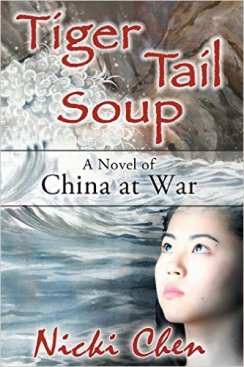
Tiger Tail Soup by Nicki Chen is a historical novel of the Pacific War, from the point of view of a Chinese woman. Author Nicki Chen is an American who gained a Chinese surname by way of marriage, and any reader will fully sense her fascination with China. She has done the proper research for such a novel. She takes the voice of An Lee, a strong-willed woman who gets left behind to raise children and live with her mother-in-law when her husband goes off to war.

The novel opens in 1946, then jumps back to 1938 and slowly goes through the war years until the epilogue rounds out back to the original year. Full of fanciful language and observations on gender roles in traditional societies – from the Qing Dynasty to the Republic era – and conflicts start off with simple things like getting a perm to look modern and soon grow to horrifying proportions.

Basically, the narrative takes place within the mind of the introspective narrator. Early on, darkness looms from afar. She carries a son in the Year of the Tiger, and is given fortunes of greatness. Then her engineer husband Yu-ming is conscripted as an officer, and most of the novel is about what happens to the war-weary women who are left behind.

At times, the narrator gets too lost in her own thoughts, endlessly reflecting and repeating herself as she dwells on her family and lot in life. The flow suffers for it, but that is the nature of this kind of story.

When the bombs begin to drop, the tone changes dramatically. The violence becomes very real, and that is of course the nature of war.

The chapters of the book are divided into seasons and year, and tales of pregnancy and childbirths and contrasted against the distant war. Themes of life and death. A son is born, a father seldom seen. There are attempts to let life go on, as schools remain open. An Lee’s husband’s letters are very important, describing being in the midst of the war. Yet overall it’s still a tale of women. And the emotions always outweigh any action. Time moves on and children age, with snippets of tragedy throughout. Some of the most powerful imagery in the novel concerns simply going to the beach and seeing Japanese battleships. And the suffering grows.

Tiger Tail Soup is not an objective overview of the war, but simply one deep character’s perspective. The hatred against the Japanese even seems one-sided, although in this context it is certainly well-deserved. The reader must remember that it is first-person narrated novel, not a textbook.

The historical aspect stays interesting as the book goes on, with references that range from the Gone With the Wind film to the attack on Pearl Harbor in 1941. Halfway through the plot does thicken, and An Lee joins a resistance league which engages in street theater performances. There are arguments, politics, more conflict. When she does finally meet her husband again, and one son meets for the first time, war has changed and hardened the man. Hardened everyone.

Bringing another child into this war-torn world proves to be the greatest tragedy of all in the end. When the worst most possible violence happens near the end of the novel, it is very jarring.

The theme above all is survival, and is best summed up this quote: “It was my fate to live in a time of war, and I bloody well was going to be one of the survivors.”

Tiger Tail Soup comes recommended for readers interested in this period of China, and for anyone who might wish to learn about the human cost of war. Available on Amazon.

South China Morning Blues: Promotional Update(s)

Hello readers and prospective readers, time for an update.

(Because it went so well in my last Chinglish post, I have decided to just link to my Instagram instead of reuploading pictures. Feel free to heart!)

I have been through a lot since my book was finally published for reals. It’s been quite the busy time, organizing event after event, hoping that people will be interested in said events, and generally promoting myself. Self-promotion often being as shameless as possible.

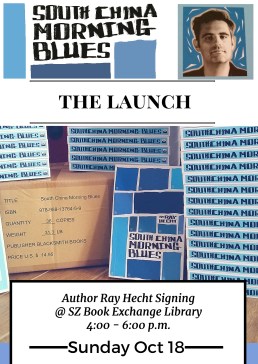
The first weekend after the book I had a launch party and signing here in Shenzhen, and the Book Exchange group in which expats meet up to exchange hard-to-find English language books.

I think the flyer turned out very well, if I do say so myself 🙂

1

I had a reading, and even sold a few.


Let me state, that my book is officially published in Hong Kong and future Western outlets to come. You know all the Hong Kong bookstores that carry it.

The mainland, however, is a different story. Legit publishers tend not to deal with undeveloped countries like so. Therefore, if I want distribution in cities like Shenzhen and Guangzhou, I need to do it myself. Treat it as an import, if your wondering about censors, and it is doable. Obviously, this is not an English-speaking country — unlike Hong Kong — but I think it’s worth doing.

Hence, I arranged a meeting with the bosses at Old Heaven Books in the hip OCT neighborhood of Shenzhen and they bought a good number of copies. My first for sale in China. More to come.

Felt good to see it on a bookshelf.


Then came the big time.

This very week begins the Hong Kong International Literary Festival, and on Sunday @ 3:30 yours truly will be in a panel on the topic of cross-cultural love with several other great writers…


http://www.festival.org.hk/program/cross-cultural-love/

Over the last decade, there has been an explosion of expat memoirs set in China, however many of these fail to depict romantic relationships.

But when foreigners arrive in China and Hong Kong, these amorous connections are often a central part of setting down new roots– and they are becoming more and more common. Susan Blumberg-Kason, Ray HechtShannon Young and Marshall Moore address writing about cross-cultural relationships from all angles.


Last Friday I was invited to an opening party for writers affiliated with the festival, and had an excellent time! Although a bit intimidating to be around such well-regarded authors, I made the best of it and hopefully left a good impression. I met Shannon Young in person, author of Year of the Fire Dragons. Susan Blumberg-Kason, of Good Chinese Wife fame, wasn’t in town yet but I look forward to seeing her at the panel next week. Please check out the link above and I hope you can make it.

And it was great to see my humble book stacked up against these great works in such an official capacity:

Continue reading

Dad came to visit me!

Previously: Dad is coming to visit me

Well, after years of living abroad, I finally got my dear dad to visit China. He has came and went and I survived. A week and a few days, and I hope I was a good host.

He came to meet him Hong Kong, and we had the whole airport hug moment. Jetlagged, he was somewhat out of it and I led the way by double-decker bus to Causeway Bay. I know my way around there by now.

Actually, I still don’t totally know my way around. There was some initial bickering, I admit. For some reason he thought the hotel wouldn’t be a forty-five minute ride from the airport, and fair enough I did get lost after that…

Carrying all the luggage, trying to figure out the map app on my phone, I finally found the hotel. What a beautiful view from the 37th floor

wpid-20150826_234450.jpg


I didn’t think the journey to the hotel was that bad, and it was merely the first of several arguments. And yet, the biggest challenge was simply that he’s getting older, and didn’t have as much energy as I’d hoped. If it wasn’t one thing it would have been another.

“I came here to see you,” he kept saying. Then getting mad at me for dragging him around too much. Hey it’s cool!

Also he wasn’t much interested in the food, which makes me wonder what the point is of going to China, but eh to each their own.


The next day my tour began with a ferry to Kowloon. Ate Indian food at Chungking Mansions, of course, and starting busying souvenirs.

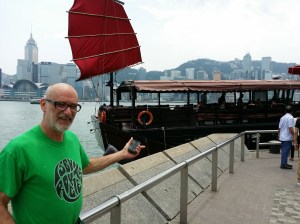
Unfortunately, modern China is not quite like what he imagined in the Bruce Lee movies. Not so many rickshaws, but here’s one junk.

wpid-20150827_125424.jpg


There would be lots of Bruce Lee-themed wandering. My dad’s number one interest when it comes to China. Here’s the Bruce Lee statue from the Avenue of Stars in Tsim Sha Tsui.

wpid-20150827_130942.jpg


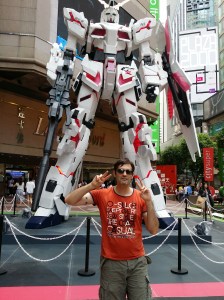
Personally I’m far more interested in the installations they set up at Times Square,  Gundams!

wpid-20150827_142922.jpg


More importantly, back to regular tours, we took the tram up to Victoria Peak. Absolutely incredible at nightfall.

wpid-20150827_193735.jpg


wpid-20150827_193202.jpg


Again, while China/Hong Kong didn’t have as much martial arts-themed sights has he’d hoped, we did find an exhibition at the Heritage Museum for our last day in Hong Kong.

wpid-20150828_095107.jpg


When we crossed the border into the mainland — my city of Shenzhen — I realized that on the second leg of the trip we were to take it much easier. More lazing about, less scurrying from one place to the next. I indeed wanted to do more scurrying, but what are ya’ gonna do?

(Just like when I was a kid we’d go on vacation and spend more time watching TV in the hotel room than out and about..)

Continue reading

Chinese Film Review: Monster Hunt 捉妖记

“Monster Hunt” An Enjoyable CGI Romp Impressive for China

But beware of the Disney-esque song and dance numbers


https://thenanfang.com/monster-hunt-enjoyable-cgi-romp-impressive-china/

Monster Hunt


If you happen to live in China, unless you’ve been hiding under a rock, you must have seen some of those endless advertisements showcasing adorable monsters. That would be the phenomena of Monster Hunt (捉妖记), the now highest-grossing domestic Chinese film of all time. Directed by HongKonger and animator Ramon Hui, who also co-directed Shrek the Third, the film has captured the hearts of millions and paved the way for new Hollywood-style budgets in Chinese film.

Better late than never, I decided to finally see it. With English subtitles. Monster Hunt is an enjoyable adventure that utilizes the Hong Kong-style of action comedies, and mixes it with a mainland’s aesthetic for ancient China settings. Mostly family friendly, the film does include a few racy jokes including a male pregnancy and “birth” scene.

While the plot is fairly predictable if you think about it too much, there are enough surprises to entertain. Baihe Bai plays well as an up-and-coming monster hunter, although of course it turns out that the monsters aren’t all evil and new sides must be chosen. Boran Jing is adequate enough as the comic relief partner.

Warning, there are a few Disney-esque song-and-dance numbers which strain credulity even for this film, and gives it more of a childish tone than audiences might expect.

He only comes in halfway through, but the cute monster Huba is the true star of the film. The plot revolves around the monster being rescued and his royal lineage bringing new peace to human-monster relations. And, obviously, he makes a great mascot to sell toys. The CGI special effects portraying this character work well, especially impressive considering it’s a mainland China film.

On a more interesting and deeper note, the film does seem to have a valid message in all that. Specifically, it critiques the unethical Chinese practice in which the wealthy eat endangered species. When the villains make dubious claims that eating monster meat will bring youthfulness and vigor to shallow snobs, one can definitely see the same thing as relating to the cruel poaching of tigers and rhinoceroses and so on. Questioning and mocking such pseudo-medicinal practices is a very positive message to teach the Chinese youth.

Overall, it’s a good thing for Chinese cinema that they are able to make these kinds of films. It will remain to be seen how they’ll do competing with the West in the future, but it is a good start if nothing else. And, the story was left open for a sequel…

Monster Hunt/捉妖记 is now playing in Chinese theaters with English subtitles.