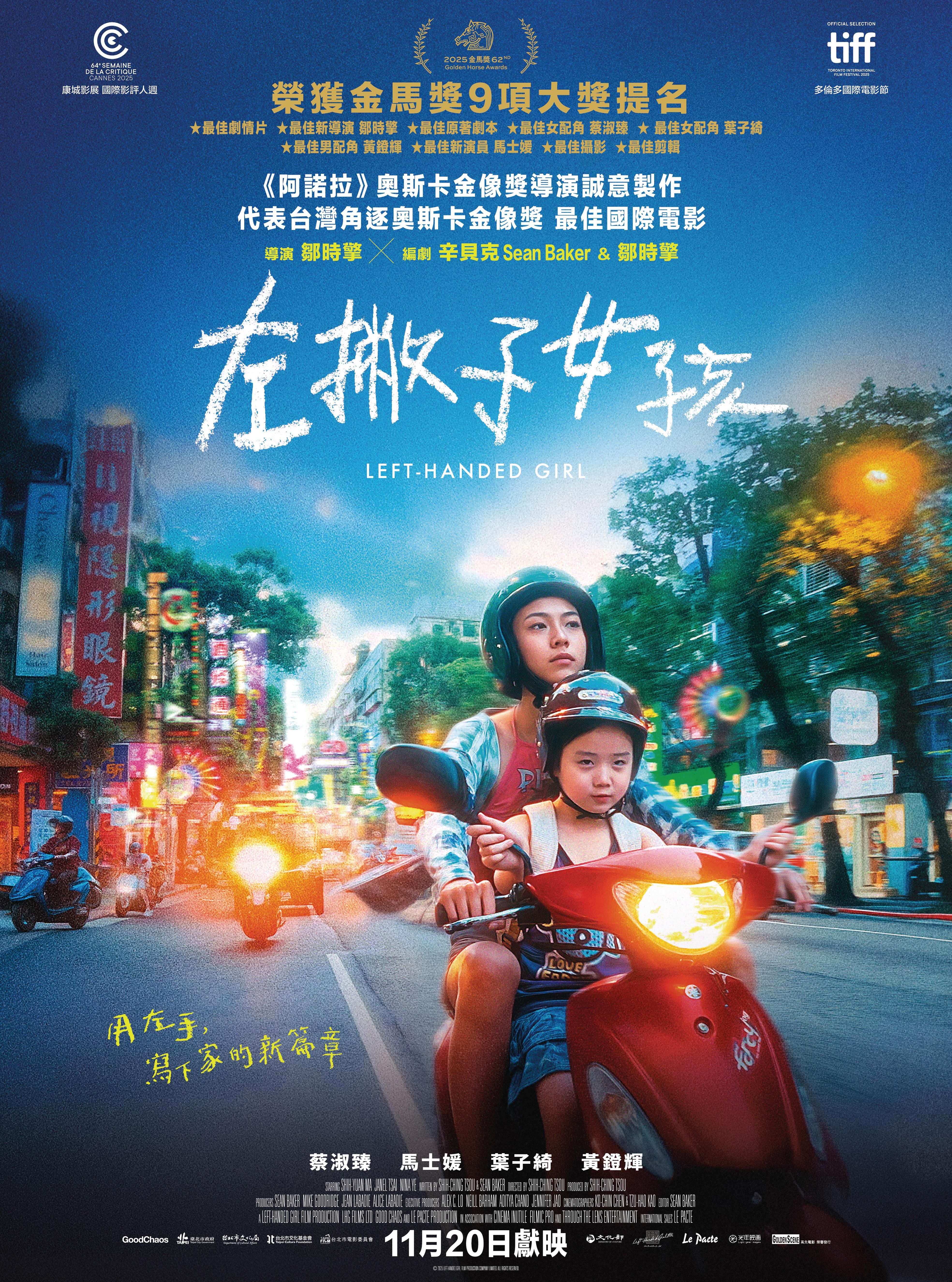
Left-Handed Girl (左撇子女孩), directed by Shih-Ching Tsou, is a movie you should have watched already. It was released last November on Netflix, at least in America. However, the theatrical run took longer in Taiwan and it was only recently released in its country of origin for streaming. Therefore, this review has come a bit late. But considering it is now the Lunar New Year holiday in Taiwan, a good time to catch up on movies at home, I think it’s a fitting time to share my view.
With gorgeous visuals, Left-Handed Girl takes the audience on a tour of the city of Taipei. The crowded night markets, the flurrying scooter rides, the steaming servings of noodles—all make for a wonderful setting that feels authentic to locals and a fascinating introduction to anyone who hasn’t been before. It’s quite something to learn that it was all shot on an iPhone.
Director Shi-Ching Tsou (鄒時擎) is a frequent collaborator with Sean Baker, who directed last year’s Academy Award-winning Anora. Baker, who also co-wrote Left-Handed Girl, is of the Dogme 95 movement which espouses naturalistic filmmaking without special effects and studio interference. Baker and Tsou make a powerful team fulfilling the ethics of that movement. She’s produced many of his films, but hasn’t directed since Take Out in 2004 which was Baker’s first film which they co-directed together. Left-Handed Girl is shot with lots of confidence, and one would assume the director must have had ample experience.
The story centers around I-Jing, the titular main character, who is a naïve little girl surrounded by adults with problems that she can’t understand. Her single mother struggles with money as the family starts up a noodle stand in Linjiang Night Market, while her rebellious older sister I-Ann works at a betel nut shop.
Sean Baker’s films are often about sex workers, such as the aforementioned Anora, and working at a betel nut shop is at least adjacent to this line of work, although that may not be clear to those who don’t know as much about Taiwan. It’s a semi-sleazy job, known as a “betel nut beauty,” who dress provocatively to sell a kind of stimulant. But they don’t necessarily do offer any other services. Seeing the personal lives of the girls who work at such a place is very humanizing, and of course makes for drama in the larger plot.
There is a multi-generational theme throughout the film, with four generations in all but to say more would spoil the main revelation in the end. The grandparents are also central to the story, as the grandfather insensitively tells little I-Jing that it’s sinful to use her left hand, causing the poor girl to have a crisis of her own. The climax of the film takes place during the grandmother’s 60th birthday party, where terrible family secrets come out and there is much losing face. Even for Western audiences, it’s a cringe scene and the drama is pure cinema.
There’s lots of tragedy, but there’s also lots of love. When I-Ann steps up to take care of I-Jing, it’s very heartwarming and moving. There’s also a certain strange, almost surreal atmosphere in the world of this struggling family. For a while, they have a pet meerkat of all things. Apparently, the director is left-handed and was shamed by her own grandfather about using the wrong hand. In some criticism of the film, it’s been said that no one in Taiwan today, even the elderly, would demonize left hands anymore and that’s from a long-gone era. But in the world of Left-Handed Girl, where everything is a little weird and hard to understand from the point of view of a child, it works well and feels fitting.
Left-Handed Girl will be the Taiwanese entry for Best International Film in the forthcoming 2026 Academy Awards, and I wish the movie great luck. It’s good exposure for Taiwan, and it’s also good exposure for artistically dynamic films about real people in the real world. Definitely worth watching.

 Ray-Comics