Ray-Comics

Drawings and Writings

Ray-Comics

Letters From China… Cold Reading in Guangzhou

12540756_10207474402091770_8562495052131559806_n

Last weekend, I was honored to have been invited to the Letters From China bilingual poetry event in Guangzhou courtesy of GZ-based poet Aaron Styza. It was at Yi-Gather, one of my favorite places in the city, and the turnout and conversation were excellent. I, of course, read from my novel South China Morning Blues.

Unfortunately, it was one of the coldest nights of the year and the place doesn’t have heating! This happens when living in the tropical southern regions; all year you’re sweating and you never know what week is going to be actually cold… and you are not at all prepared for it. Seriously, even though it doesn’t get below freezing (and I did grow up in a place with four seasons), the combination of humidity and winds makes for some very harsh conditions.

The next day, something magical happened that made the weather more than worth it! It actually SNOWED. It was about two or three degrees Celsius and by some miracle small pellets of frozen water (maybe technically hail, but looked enough like snow) softly fell to the ground and immediately melted. Brief and ephemeral, we couldn’t believe our eyes. Not that it was a polar vortex like elsewhere, but in the context of this tropical environment it was amazing. Sadly, wasn’t really photographable.

I heard it’s the first time the weather had been this low in the region in some fifty-sixty years. And, a month ago was the warmest year’s winter ever. Not going to get into climate change or anything, just sayin these temperature extremes are interesting.


Anyway, here is an Instagram picture followed by Youtube video concerning the event:

[Yes I know I do not look good nor sound good but the self is an eternal process and I shall work on it]

Book Review: South China Morning Blues

Why I Write

http://www.whyiwrite.net/2016/01/ray-hecht/


Ray Hecht

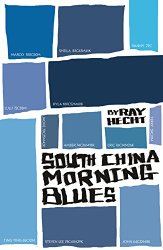
South China Morning Blues 

Ray Hecht is an American author based in Shenzhen, and blogs at rayhecht.com. Raised in the American Midwest, he studied film in Long Beach, California before moving to China in 2008 where he divides his time between fiction writing and freelance journalism. South China Morning Blues (Blacksmith Books, 2015), a story of depraved expats within the hypermodern southern Chinese sprawl, is his debut novel.


Why I write

That is the ultimate question, isn’t it? I don’t truly know the answer. Perhaps because I am a lonely person and I got into certain habits and now after years of this I am compelled. I want to express myself, I have enough ego to believe that others should read what I write, and it’s just a part of what I do and who I am. I have these things in my head and this compulsion to write it down and I hope beyond hope that people would like to read.


How do you go about writing?

I try to write every day. When a long-term project is going, I write about four days a week on a decent week. Good weeks more, bad weeks less. To me, it’s not about hours so much as word count. Five hundred works at least, or a thousand words on a very productive night. That may take hours or it may take 30 minutes.

I like to stay up late, because that’s the time when everyone leaves me alone. That magic time from midnight to about 2 a.m. I used to write later, but it’s getting harder and harder to keep up with a night owl lifestyle these days. That’s when all the original words come to me, and the next afternoon I tend to do rewrites.


Where do you write?

I like to lay down in my bed in my underwear with the laptop. I remember the old days when I had a big PC, it was much harder to motivate myself. The laptop is the most perfect invention ever…


Worst distraction?

…excepting, of course, that the Internet is the absolute worst distraction ever. If left to my own devices I tend to constantly check my email, Facebook, news sites etc. Porn isn’t even as bad as social media. Sometimes though you just have to unplug and force yourself to finish a deadline. Unless there’s research to be done.


Best inspiration?

I suppose I’m inspired by various things. A good song can inspire. A book, a show. A crazy life experience can especially inspire. Most of all, combing through my own memories of complex life issues and mix and match it into new combinations; somehow that give me ideas about what to write.


How often do you get writers’ block? Do you ever doubt your own ability?

I don’t really believe in writer’s block. However, I doubt my own ability all the time. When I compare myself to the major authors whom I respect, I am not in the same league at all. But I’ve chosen to write and even if it’s shit I have vowed to finish what I started.

The thing about writer’s block is that I always have more ideas than I have time to write them down. It should always be that way. Instead of being choked by the blank page, I suffer more from sheer laziness. Writing can be mentally exhaustive, and although endless ideas are swirling around in my mind, sometimes I don’t have enough energy to record and tinker with those ideas.


Contemporary writer you always read?

I always read new Haruki Murakami and Neal Stephenson. Murakami isn’t as good as he used to be, frankly, in my humble opinion. Stephenson is such an insanely prolific writer that it takes me longer to catch up with his latest thousand-plus tome then it does for him to write, yet I always do try to catch up.


Favorite book on China?

Speaking of which, Reamde by Neal Stephenson is a great book that takes place in China, full of hackers and gold-farming. He really gets it right.


Favorite Chinese author?

My favorite may be Su Tong, and especially his novel My Life as Emperor. Written very matter-of-factly and full of cruelty, it rather haunted me.


Favorite book?

There are several books that have supremely influenced me. I’m going to keep it in the realm of fiction: Snow Crash by Neal Stephenson is the ultimate irreverent yet smart novel, with so much energy. I know I’m not smart enough to write science fiction, and cyberpunk in particular, I am purely a fan with no desire to emulate.

I have to mention The Illuminatus! Trilogy by Robert Anton Wilson and Robert Shea which sent me on a lifelong journey to figure out what the hell is going on in the world.

As for literary inspiration, Irvine Welsh’s Trainspotting and Bret Easton Ellis’ Glamorama are works that have directly influenced how I string words together…


Favourite writer?

As for other mediums, I would like to say that comic book writer Grant Morrison is one of my absolute favorites. Able to write mindfuck profound postmodern comics, as well as fun superheroes, and I am very envious of his abilities.


The book you should have read but haven’t?

I am currently trying to find the time to start Gravity’s Rainbow by Thomas Pynchon. I have a feeling it’s going to be a tough one.


You look back at the first thing you had published and think…

Wow I was lucky!


How did you get started writing?

I scribbled on occasion when I was a kid, more interested in drawing than writing. When I was in school I decided to study film on a lark, and I didn’t really finish, but I decided I like prose more than screenplays because you can be alone. I decided to write novels when I was twenty-three years old, wrote several, and then almost 10 years later it worked out.


Does writing change anything?

I suppose it changes your social life, because friends and loved ones can’t understand why you are always avoiding the outside world. It’s worth it though, I hope.


What are you working on now and when is it out?

Well, I’m still working on promoting South China Morning Blues which is currently out in Hong Kong and beyond.

I have another novel in the works, a full draft is finished, and it’s not about China. It’s about how technology effects relationships and I got the idea from last time I visited America and observed as an outsider the whole Tinder dating thing. If I’m incredibly lucky it will be published in less than a year. A lot has to fall into place. I believe it will be published eventually. Wish me luck!


Continue reading

Happy 2016 as South China Morning Blues is live on Amazon

unnamed

Hello all, wish you a happy 2016!

As the new year comes, I would like to announce that my novel South China Morning Blues is *finally* distributing on Amazon in the States, and hence now available for readers to write reviews on the web page:

http://www.amazon.com/South-China-Morning-Blues-Hecht/dp/9881376459


Amazon isn’t perfect of course, but it is nice for me to get reviews on the ubiquitous bookselling website. I have been very humbled by the positive reviews on Goodreads.com, as well as by various articles and blogs I’ve linked to here before (check out ‘Reviews’ and ‘SCMB’ at the menu above), and am now looking forward to seeing some of those reviews and more on Amazon. Feel free to share what you think of my novel therein…


And while I’m at it, don’t forget to check my other eBooks from the past which are still as readable as ever 🙂

http://www.amazon.com/author/RayHecht


Happy well-read new year!

theNanfang.com: SCMB a Glimpse Into Expat Life in a Fast-Changing PRD

South China Morning Blues a Glimpse Into Expat Life in a Fast-Changing Pearl River Delta

https://thenanfang.com/south-china-morning-blues-a-glimpse-into-expat-life-in-a-fast-changing-pearl-river-delta/

Luigi Mondino , December 21, 2015

Luigi Mondino


Ray Hecht’s debut novel is a detailed and sincere depiction of what life is like in the Pearl River area. Divided into three main sections (one for each major city: Shenzhen, Guangzhou and Hong Kong), the book follows the life of several characters, both foreigners and locals, as they try (or struggle) to find their way without losing touch with reality. Rather than being a simple collection of short stories (very loosely entwined), Hecht chooses to shape his book into a canvas where the expat lifestyle is the effective trait d’union.

unnamed-3

Hecht obviously knows what he’s talking about as, being himself a long-term expat in the area, he has drawn from his own personal experience (as it can be inferred from his own personal blog) ideas and stories that lay the foundations of his book, and it shows well: characters look real and relatable, grounded in reality, vivid and rich in their motivations and background. Characters are teachers, journalists, young artists, businessmen, all people that populate bars and clubs in the downtown of each city. Ray Hecht has collected and transformed some of the stories he heard (who knows how much autobiography might be in the book?) into a constellation of small existences that, although bordering on the stereotypical sometimes, often emerge as true in their own need of self affirmation.

Whoever experienced life in the Pearl River Delta can understand or relate to the urgency to be heard or to stand out that everyone in the book seems to display: life is too fast-paced and often people focus on their careers, while everything else slips into the background. If the 12 main characters all have something in common, it is a sense of isolation that compels them to question their own choices and fast-forward life to the next, hopefully safer, stage.

The three sections the book consist of several mini-chapters, each following a different character (some of them recurring from section to section, thus closing the circle and giving the idea of a mini universe where people can’t stop running into the same faces again and again). All stories are narrated in the first person and they read as confessions that break the fourth wall and ask the reader to participate in something private and meaningful that otherwise would be lost.

Each section of the book has its own different nuance that reflects the three different cities in which everything takes place:  Shenzhen is a new and fast city, Guangzhou is the old capital, Hong Kong is a hybrid city looking for a balance in its own internal differences. “Shenzhen” opens the book and throws us in the middle of the action: two foreigners, newcomers to Shenzhen, try and mostly fail to integrate in a city with no identity and history. Looking forward with no regrets is the key, even if something gets lost along the way. Marco, the businessman, and Danny, the English teacher, whether they are looking for instant gratification or for some meaningful experience, are constantly semi-detached from reality as they can’t help to feel their presence in the city is temporary, a sensation shared by all the characters in this first section. Life is so fast and opportunities so rich, there is no need or time to look back or to make detailed plans about the future.

“Guangzhou” offers a new take on the expat life in China. Guangzhou, the city, is the old Guangdong capital, an established city with its very own rhythm and style. Whereas Shenzhen’s no identity is reflected in its individualism and fast pace, Guangzhou’s somewhat quieter pace is mirrored by a sense of isolation that is sometimes difficult, or almost impossible, to break. Amber, the Canadian English teacher, Ting Ting, the aspiring artist, and Terry, the Asian American journalist, represent the struggle to find themselves in a vast and disperse city: whether you are looking for a professional achievement or to find people to hang out with, Guangzhou is a giant maze that needs to be crossed.

“Hong Kong” is the last section, the shorter and the most crowded: most of action occurs at a rave party on Lamma island, where we re-encounter many of the characters from “Guangzhou”. The party is where individual stories come to an apex and some of the loose ends are tied up (but not completely, we just manage to say goodbye to the characters we have been following so far). Chapters are shorter and there is more interaction than before between characters, so rather than focusing on individual stories, Hecht chooses to let all the tension explode at a party that can be read as a turning point in everybody’s life.

Hecht writes his characters in need of sexual gratification and infuses them with a need for drugs of any type. I admit this sounds like a stretch sometimes, since the high recurrence of such behaviors flattens out diversities rather than creates an invisible bond between characters. This detail represents one of the flaws of the book, flaws that don’t hinder its effectiveness, but reveal Hecht’s somewhat beginner’s naivete: characters seem to all convey the same emotional range, as well as same ambitions and doubts. That is a forgivable since their backgrounds and environments help in giving each character his or her own flavor, but Hecht doesn’t seem totally in control of his own voice (but 12 different characters, one for each sign of the Chinese Zodiac, is a huge challenge for a novice).

As one of the first attempts to describe the expat life of common people, both foreigners and locals, SCMB succeeds in capturing a particular moment in time and space in which we are allowed to peek in. Hecht’s prose flows smoothly (style is simple, but not bland) and although the reading experience is always rich in details and facts, less characters and more plot would have given the book a more solid texture. Looking forward to Hecht’s sophomore effort is from now on something worth doing.

South China Morning Blues is published by Blacksmith Books. It can be purchased from Amazon or at select bookstores.

Bookish.Asia Review: South China Morning Blues

South China Morning Blues • Ray Hecht

http://bookish.asia/south-china-morning-blues-ray-hecht/

The Pearl River Delta is home to Guangzhou, Hong Kong, Macau, Shenzhen, and cities of millions – such as gritty workshops to the world Dongguan and Zhongshan – that you’ve never heard of. Despite being the powerhouse of the country’s decades-long economic boom, China’s southern cities have been largely ignored by English-language novelists for the more glamorous settings of Shanghai and Beijing. When stories are set in the south, they are usually period pieces taking advantage of the region’s rich historical backdrops of war, revolution, and the treaty port clash of cultures. It was a welcome change to come across a novel set in modern-day Guangdong.

South China Morning Blues is divided into three sections, each named after a city in the region. The multiple storylines begin in Shenzhen, move to Guangzhou, and end on Lamma Island in Hong Kong. The novel provides a kaleidoscopic view of urban China as seen through the eyes of a dozen mostly twenty-something Chinese and foreign characters. There’s Marco, a macho American businessman looking to get laid at every opportunity; Danny, an English teacher finding his feet; intellectual stoner Eric; artist Ting Ting; American-Chinese journalist Terry; and… I’ll stop there. Twelve is too many to run through, which raises the question of whether that number of characters makes for an overcrowded cast.

Although there’s no consensus on the maximum number of main characters a novel should contain, it’s generally thought that eight or nine is the upper limit for a medium-length work. Irvine Welsh’s Trainspotting, for example — which, with its multiple narrator structure, was one of Hecht’s inspirations — has perhaps seven main characters. When I opened SCMB, and realized that Hecht had chosen twelve because he wanted one character for each animal sign of the Chinese zodiac, the approach seemed like a recipe for disaster.

Surprisingly the big cast works. Credit goes to the author for how he does this by adding a couple of characters at a time, building up layers, and coming back to earlier people as some of storylines are threaded together. The effect is an unusual but engrossing reading experience, an immersive feel of varying waves of engagement. The number and range of characters, subplots, and places gives the novel an epic flavour; it’s a big canvas which contrasts with the mundane considerations of daily life that the characters describe.

South China Morning Blues is written in a stream-of-consciousness, first-person narration. Unavoidably, this is sometimes inane and slow moving; but it’s also often funny and, above all, honest. The novel is painfully true to life: how we actually were when young and finding our way, rather than how we would like to remember ourselves. I laughed aloud in numerous places, perhaps most often for Danny, the non-descript English teacher andlaowai newbie who is soon playing the veteran. In one such scene, a fellow English teacher – young, fresh off the boat, and completely clueless – asks Danny how long he has been in China.

“Well,” I say. “I’ve been in Shenzhen for a year now, but in China almost two years. Before here I lived in a town you’ve never heard of up north.”

“Wow,” he says, easily impressed. I feel cool, sophisticated.

One of the pleasures of SCMB is seeing how characters grow up (or don’t) over the two-year period of the novel. Eager to know how things worked out for them, I raced through the book in three days, pleased with the ending and yet sad the story had come to a close.

SCMB contains a lot of drinking, drug-taking, and sex, but not unrealistically so. Alcohol and drugs are a social lubricant and stress-relief for people in a new place. Likewise, business entertaining in China involves heavy drinking and frequently a side-dish of whoring, so it’s not unnatural that when Marco, the self-styled Casanova, is on a business trip to Dongguan, he should partake of the city’s infamous delights. Marco takes two hookers back to his hotel and is working his magic while the women watch television:

In front of me, I have two bare asses. They cost me only a grand each. That’s in RMB.

Enthusiastically, I slap the one on the left and pound away against the other one. She insisted that I wear a rubber. That part never gets lost in translation. This experience would have felt better without, but whatever….

I wish that I could persuade these girls to perform some lesbian shit. I push their heads together. They kind of kiss for a second, but then smirk and turn away. Don’t these bitches watch porn, or what?

My cock feels ready to explode out from under me, almost like I should call in a bomb threat to the hotel or something.

At times SCMB can be a bit depressing in portraying the shallowness of many Chinese–foreign interactions, but once again it rings true. In fact, I’ve met people like all twelve of the story’s characters. Much of the realism comes from author Ray Hecht writing about what he has himself experienced or seen, having lived in the novel’s two main locations, Shenzhen and Guangzhou. Hecht, who was born in Israel but grew up in the American Midwest, arrived in China in 2008 at the age of twenty-six. He works in Shenzhen as a writer and teacher, and has written two previous novels: The Ghost of Lotus Mountain Brothel and Loser Parade.

South China Morning Blues deserves to sell well. It’s easy to see the novel becoming a big hit among the expat population in China, but it should also appeal to general readers. Hecht’s Pearl River Delta tapestry is at heart a racy drama exploring universal themes, so no knowledge of China is required to enjoy it.

* * *

South China Morning Blues is published by Blacksmith Books. It’s available from the publisher’s website, Amazon, and bookstores in Hong Kong.

Author Ray Hecht has a website chronicling aspects of his writing and life in Shenzhen.


By  December 11th, 2015

South China Morning Blues book review by Nicki Chen

http://nickichenwrites.com/wordpress/china/south-china-morning-blues/

Book Review of South China Morning Blues

When I look back on my twenties, I’m amazed at how much I crammed into that decade—and also at how far-reaching the consequences of my decisions were. I shouldn’t be amazed. We’re meant to choose our path in life during those years. And even though we can reinvent ourselves to some extent later, there’s no getting around it, it’s usually during our twenties that we at least make a good start in figuring out who we are and where we’re going.

The characters in Ray Hecht’s new book, South China Morning Blues, are all in their twenties. And to make matters even more challenging, they live in what may be the fastest changing region of the fastest changing country in the world, the Pearl River Delta region in southeastern China, a megalopolis that the World Bank Group considers the largest urban area in the world in both size and population. Hecht, an American, has lived there, mostly in the city of Shenzhen, since 2008. He knows the area well.

The twelve young men and women who tell their stories in South China Morning Blues, live and work in Shenzhen, Guangzhou, and Hong Kong. They’re Chinese, American, Canadian, and African. None of them are quite clear on what they want or how to get it.

The first character we meet, Marco, is a sleazy American businessman who likes to show off and pick up girls. Since he can’t be bothered to learn Chinese, his Chinese protégé, Jackie, takes advantage of him and steals his clients. After losing his job, Marco starts a new business, a club that caters to expats. When he falls in love with and marries a Chinese woman, he’s challenged to become his better self.

Sheila’s parents are from another generation. They don’t understand a modern Chinese career woman like her. Eventually Sheila will realize that even though she’s modern in some ways, the Chinese duty to sacrifice for family obligations is still deep inside her.

Terry is an American-born Chinese, a writer, and an alcoholic. To impress his Chinese girlfriend, Ting Ting, he finally cleans up his disgusting apartment. We can only hope that Ting Ting will inspire him to clean up his act too.

These are only five of the twelve characters in South China Morning Blues. They speak in their own voices about their longing, loneliness, and confusion. They tell us about their hunger for adventure, money, love, and sex, and their desire for success and meaning.

Each of them represents an animal in the Chinese zodiac. Marco, for example, is the tiger; Jackie is the rat; Sheila is the hare; Terry is the monkey; and Ting Ting is the Dragon. The author uses the Chinese character for each animal to indicate a change in point of view. If you don’t read Chinese and you want to be sure who is speaking, you might want to make a cheat sheet.

Ray HechtHecht doesn’t sugar coat the seamier side of life, and some of his scenes are sexually explicit. As he said in an interview with Jocelyn Eikenburg, “I want to show all sides of real life. Using illegal substances, having irresponsible sex, pushing the boundaries, and making mistakes; these are all things that human beings actually do. And they are interesting things. I believe they are things worth writing about.”

Whether you’ve ever traveled to or lived in China, I think you’ll find something new and interesting in South China Morning Blues.

Available for pre-order on Amazon.

Interview with Ray Hecht on His New Novel “South China Morning Blues”

(Originally posted on: http://www.speakingofchina.com/bookreviews/interview-with-ray-hecht-on-his-new-novel-south-china-morning-blues/)


People have called China endlessly fascinating. But you could say the same about the expat scene here. In the seven-plus years that I’ve lived in this country, I’ve come across some real characters here – people I could have sworn were straight out of a novel.

I’m reminded of many of them after reading Ray Hecht’s new book South China Morning Blues, which features a motley cast of young expats and Chinese locals living across Shenzhen, Guangzhou and Hong Kong, including:

…Marco, a crooked businessman with a penchant for call girls; Danny, a culture-shocked young traveler; Sheila, a local club girl caught up in family politics; Amber, a drug-fueled aspiring model; Terry, an alcoholic journalist; and Ting Ting, a lovable artist with a chip on her shoulder.


SouthChinaMorningBlues_800

Through 12 distinct viewpoints, South China Morning Blues takes readers on a tour of the dark underside of the expat scene in China, culminating in a dramatic life-and-death situation that brings everyone together. It’s a fresh take on life in 21st century China and definitely worth a read.

I’m happy to once again feature Ray Hecht on the blog and introduce South China Morning Blues to you through this interview.


wpid-20151014_092815 SQ

Here’s Ray’s bio from his website:

Long story short, raised in America from the Midwest to the West Coast on a starchy diet of movies and comics and science fiction paperbacks. There’s a Mid-East connection in there too. I like to write fiction about such states as California and Ohio, and such provinces as Guangdong. Japan being an interesting topic as well. Lived in Shenzhen, China since 2008 (has it really been that long?), a lovely Special Economic Zone Hong Kong-bordering chaotic city that has given me so much. I occasionally partake of some freelance journalism for various local publications.

You can learn more about Ray Hecht and South China Morning Blues at his websiteand buy a copy at Amazon.com, where your purchase helps support this blog.

—–


What inspired you to write this novel?

Good question to start out with. A few things come to mind: After living in China in those earlier years, I found the country to be absolutely fascinating, and I wanted to share the experience of the land by telling stories.

Also, I’d long been a fan of Irvine Welsh’s Trainspotting and had a lot of respect for his system of multiple narrators that all have distinctive versions of experiences,and being more interlocking short stories than one big narrative. I think one of the philosophies that fiction can teach us is the subjective nature of reality. The way some people, say, move to Guangzhou and complain how they hate it while other people see it totally differently and love it.

Another inspiration, I must say at the risk of sounding pretentious, was James Joyce’s Ulysses. Not that I’m smart enough to write something like that — or even smart enough to truly understand the famously-dense book. But the way the novel utilized mythological metaphors, as per the Odyssey resonating in early 20th Century Dublin. I wanted to try something like that. The ancient mythologies of the world will forever be able to inspire modern stories.

Well, for me, characters are most important. A character needs unique personality traits, archetypes that make them stand out, something interesting about their histories and personas. After that’s established, a plot begins to form… And so the idea evolved to use the Chinese Zodiac to structure the characters of a novel…


Your novel is told through the perspective of 12 main characters as they live in or visit three major cities in South China — Shenzhen, Guangzhou and Hong Kong. How did you decide to structure your novel like this?

As said, I had the idea to base characters off the Chinese Zodiac in order to tell stories about modern China. Seemed to make sense at the time.

I’d already ended up living in Shenzhen, which is a major city most people around the world have never heard of. The city is next to Hong Kong, and I spend a lot of time there. For the sake of literary research (also because I wanted to research a historical novel about Canton circa revolutionary 1911) I moved to Guangzhou for an off year in 2011. I find all these cities fascinating in their own unique ways. I mean, Beijing and Shanghai are great, but I ended up in the southern Pearl River Delta region and I am glad I did. No place on Earth has more stories.

It seemed obvious that my novel about the soul of present China would have to incorporate those three cities.


Like your memoir, South China Morning Blues features quite a bit of sex and recreational drug use. How much did your personal experiences influence your writing in this book?

Ah, an embarrassing question. Hmm, how can I put this…?

First of all, my biographical writings may have some sex but I don’t think there’s much to brag about. Outside of a handful of tell-all dramatic episodes, by far it mostly concerned online dating and several serious relationships. Not too crazy, right?

The sex scenes in SCMB are, shall we say, meant to be more literary. At least more literary in the sense of literature I like to read. Being more extreme than real life in most cases. Many of those scenes were inspired by way of hearsay of other people I know, my own imagination, and a bit of research online. Not really based off my own personal experiences very much.

(Hey, I did say that Trainspotting was an inspiration.)

As for recreational drugs, I experimented a bit in my youth — and by youth I mean my mid-to-late twenties, I was very boring as a teen — and I think I was always responsible about it. To be honest, I’m often shocked when I observe how extreme drugs and alcohol are in the China party scene. It is something that needs to be depicted, whether glamorized or not. No outright spoilers here, but if you read to the end there are consequences for the characters who abuse themselves and I think it’s important to showcase that side.

All in all though, I want to show all sides of real life. Using illegal substances, having irresponsible sex, pushing the boundaries, and making mistakes; these are all things that human beings actually do. And they are interesting things. I believe they are things worth writing about. Worth portraying, without too much judgment. More or less, presented as is. That’s writing.


Tell us about one of your favorite characters from the novel and why you like him or her. Continue reading

South China Morning Blues: Promotional Update(s)

Hello readers and prospective readers, time for an update.

(Because it went so well in my last Chinglish post, I have decided to just link to my Instagram instead of reuploading pictures. Feel free to heart!)

I have been through a lot since my book was finally published for reals. It’s been quite the busy time, organizing event after event, hoping that people will be interested in said events, and generally promoting myself. Self-promotion often being as shameless as possible.

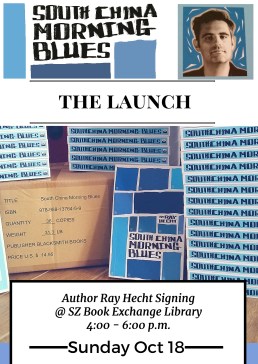
The first weekend after the book I had a launch party and signing here in Shenzhen, and the Book Exchange group in which expats meet up to exchange hard-to-find English language books.

I think the flyer turned out very well, if I do say so myself 🙂

1

I had a reading, and even sold a few.


Let me state, that my book is officially published in Hong Kong and future Western outlets to come. You know all the Hong Kong bookstores that carry it.

The mainland, however, is a different story. Legit publishers tend not to deal with undeveloped countries like so. Therefore, if I want distribution in cities like Shenzhen and Guangzhou, I need to do it myself. Treat it as an import, if your wondering about censors, and it is doable. Obviously, this is not an English-speaking country — unlike Hong Kong — but I think it’s worth doing.

Hence, I arranged a meeting with the bosses at Old Heaven Books in the hip OCT neighborhood of Shenzhen and they bought a good number of copies. My first for sale in China. More to come.

Felt good to see it on a bookshelf.


Then came the big time.

This very week begins the Hong Kong International Literary Festival, and on Sunday @ 3:30 yours truly will be in a panel on the topic of cross-cultural love with several other great writers…


http://www.festival.org.hk/program/cross-cultural-love/

Over the last decade, there has been an explosion of expat memoirs set in China, however many of these fail to depict romantic relationships.

But when foreigners arrive in China and Hong Kong, these amorous connections are often a central part of setting down new roots– and they are becoming more and more common. Susan Blumberg-Kason, Ray HechtShannon Young and Marshall Moore address writing about cross-cultural relationships from all angles.


Last Friday I was invited to an opening party for writers affiliated with the festival, and had an excellent time! Although a bit intimidating to be around such well-regarded authors, I made the best of it and hopefully left a good impression. I met Shannon Young in person, author of Year of the Fire Dragons. Susan Blumberg-Kason, of Good Chinese Wife fame, wasn’t in town yet but I look forward to seeing her at the panel next week. Please check out the link above and I hope you can make it.

And it was great to see my humble book stacked up against these great works in such an official capacity:

Continue reading

Interview with Ray Hecht on writing and his new book, “South China Morning Blues”

http://www.travis-lee.org/2015/10/30/interview-with-ray-hecht-on-writing-and-his-new-book-south-china-morning-blues/

12072550_10153370910948411_1039026707900739524_n


Interview with Ray Hecht on writing and his new book, “South China Morning Blues”

For author Ray Hecht, the answer is a psychedelic experience at Burning Man.

Author of Loser Parade411, The Ghost of the Lotus Mountain Brothel (which I reviewed here), and Pearl River Drama, his most recent book is South China Morning Blues. available now at the publisher’s website and for pre-order on Amazon.

I asked Ray his thoughts on writing, his inspiration for South China Morning Blues and much more:


Can you recall a single instance that inspired you to be a writer or is it something that you’ve always had an attraction to?

I can’t recall a specific incident, it’s something that developed slowly. I originally wanted to be an artist before I wanted to be a writer. I felt like writing would be a good thing superfluously in my teens, and tried some stories. It was in college – late years in college in my twenties – I decided to study film screenwriting. I remember at 23 for some reason I vowed to write a novel a year. I didn’t follow up on that particular pace, but I have been writing seriously ever since.


Do you work on a specific schedule, where you write every day?

I mainly like to write in the middle of the night, but life doesn’t always let me. Usually I do first drafts after midnight. Then, next day at noon to the afternoon I might slowly do rewrites. It would probably be a good idea to get a consistent schedule, wouldn’t it!


Do you have a preferred writing program? (Word, text editor, etc.?)

Microsoft Word of course. I’ve even been studying some of the more intricate ways to edit and use the software to the best of my ability. Got a lot of typing shortcuts memorized. If it’s not too obvious to say, isn’t Word basically a must in this day and age?


You’ve mentioned that your love for ‘Trainspotting’ and ‘Snow Crash’. Could you tell us more about why you like these novels?

I love the danger and the outlaw attitude and the intelligence and the punk rock aesthetics and just how damn sexy it is. The novels are quite different, although they are both written in present-tense first-person narration. They are also both novels that exploded their respective writers on the scene.

‘Trainspotting’ by Irvine Welsh is magnificent literary achievement. The phonetic dialectic in writing, the grittiness of the drug culture, the power of each separate narrator’s unique voice. And yet, it is a free-flowing art work that explores all over without sticking to the rigidity of a narrow plot. Plus, it can even be darkly funny.

‘Snow Crash’ by Neal Stephenson is incredibly smart, a complex cyberpunk postmodern science fiction epic, and yet it doesn’t take itself too seriously and is often hilarious. I wish I was smart enough to write science fiction, but I’m not. I do highly admire Stephenson’s ability to be brilliant and at the same time be that cool.


What do your friends and family back in America think of you being a writer? Are they supportive? Do you ever find that some people just don’t understand what being a writer actually is?

I’ve been very surprised how supportive most of my old friends have been. Although, due to the nature of my writing topics I tend to keep family at arm’s length. Hopefully though, I impress everyone back home and most are proud of me.

However, I tend to think most people don’t understand what being a writer is at all. Rather, they imagine that being a writer is this thing to be. Especially people who want to be writers. Nobody seems to imagine what it is to write. Writing is a thing to do. Lots of people want to be writers; most people do not at all want to do any of the writing. That’s the part people always get so particularly wrong.


What was the impetus for writing South China Morning Blues?

To put it bluntly, I feel compelled to spend endless lonely hours writing. I needed subject matter to write about. I ended up in China, studied a bit, observed here and there, and the stories had to be told. That’s the short version.


While reading your book I saw a lot of familiar people and situations. Was it much the same for you, in that you were drawing from personal experience?

Some of it was personal. Much of it was hearsay. A whole lot never happened to anyone I know (that I know of) but things I only learned of online.

I’ll go ahead and reveal this right now: The drug stuff was based on personal experience. The sex stuff was not.


Were there any big scenes / characters cut at the editing stage?

Not too much. Perhaps there should have been. I rewrote and rewrote and polished, and perhaps this is bad writing advice, but I don’t like to cut out too much.


The presence of Chinese zodiacs. Did you know about that when you started or did it happen naturally?

I knew the basics of the Chinese animals, even when in America – though never a believer – I knew I was dog year and so on. When I set out to write this novel, I further researched. The acknowledgments gives a shout out to the book I mainly used.

Can’t say it happened naturally; it was a conscious choice from the beginning to structure the characters that way in the foundation and then see which way their stories would go…


In the book we see people struggle with identity and ambition. Danny says, “Back home, my old college classmates are surpassing me”, a feeling I can relate to. Do you think the ambition that many foreigners in China have — opening the business, becoming the great writer, etc. — is a way for them to keep up with their contemporaries?

Sure. But not only for expats, many people often feel anxious that the people from their past are surpassing them. With expats in particular, the contrast between one’s own weird life and those left in the home country can be stark. It’s a positive thing to healthily compete and start a business or forge a craft. At least expats in China tend to be interesting people (even if weird) and that can make for good goals. Being motivated by old cohorts surpassing, whatever works.


Going with the previous question, do you think there is something about China that attracts these kinds of people?

Good question. There is something about the expat phenomenon that attracts odd people. Odd in good ways and bad. Adventurous, or the dreaded loser stereotype, I don’t know. But there’s something there.

And why China of all places? I suppose it’s a big place, and it’s blowing up right now in world history. I’ve always liked that the economic growth puts it in this sort of limbo between undeveloped and developed, full of cheap outdoor restaurants and expensive shopping malls, and somehow that can suit certain people.


To close it out, do you have any advice for new writers who are reading this?

Going back to perceptions of the writer versus writing, I can only say to write. You’d think it would be obvious. Don’t fantasize about being this mythical creature called the writer. Be a person who writes. Then, when the writing gets good, whatever your niche may be, go out there and network and best of luck to you in getting published.

That is all.


Big thanks to Ray Hecht for doing this interview. To learn more about Ray, visit his website. You can also follow him on Facebook and Twitter.

South China Morning Blues is available now on the Blacksmith Books website and for pre-order on Amazon.
Continue reading

Book of the week – South China Morning Blues

(The following review was posted on Susan Bloomberg-Kason’s website, author of the engaging tell-all memoir Good Chinese Wife. I am honored that she appreciated my novel, and in several weeks we will be participating in a panel at the Hong Kong literary festival. Please see her website and the links below for more.)


http://www.susanbkason.com/2015/10/04/book-of-the-week-south-china-morning-blues/

26512801

For almost a year, I’d been hearing about Ray Hecht’s forthcoming novel, South China Morning Blues (Blacksmith Books, 2015), which comes out from the publisher on October 15 and on Amazon later this year. When the author sent me a review copy, I found myself pausing at every break during the day and evening to get in more reading. This is not one to miss!

Most China novels and memoirs take place in other regions besides the Pearl River Delta. Hecht’s book is different in that it’s separated into three sections named after cities: Shenzhen, Guangzhou, and Hong Kong. I haven’t been to Shenzhen in 17 years and Guangzhou in 19, but felt like I was being transported back to a place I once knew well and one I’d visited a couple times, respectively. And I think I know Hong Kong well, so was excited he kept that one for the end.

Through his writing, Hecht shows he’s an adept observer of life in southern China and Hong Kong, capturing the spirit of each place he writes about and the issues that define these places. His twelve characters appear throughout the book and each brings a different perspective. There are English teachers, a journalist, artist, businessman, and a young woman who marries an old Taiwanese sugar daddy, to name some.

The format of the book is quite clever. As I mentioned above, it’s broken into three sections according to locale. But within each section, the chapters are arranged according to one of the twelve characters. Hecht doesn’t label the chapters with the characters’ names, but rather by the Chinese character of their zodiac animal. My short-term memory is not the greatest, but I found I had no trouble keeping up with which character was which.

It was fascinating for me to read about dating in Shenzhen and Guangzhou since I had heard some stories from my ex-husband’s friends who moved south to Shenzhen for better working opportunities. But I never knew foreigners who lived in Guangzhou back then, so that part was new to me. And the Hong Kong section was fun and completely realistic with many of the characters ending up at a rave on Lamma Island.

This is a dense book, yet a quick read. If you have trouble keeping the characters straight–which you shouldn’t have since I seemed to manage all right–you can always flip back to the list of characters and their zodiac animal at the front of the book. The stories are not always happy (in fact, more often than not they are pretty depressing), but they are realistic and tackle issues that many young people–expats, locals, and those who relocate from other parts of China–face every day.

The book is available for a GoodReads raffle until October 14. Click here to enter. I’ll be appearing with Ray at the Hong Kong International Literary Festival on Sunday, November 8 at 3:30pm. For more tickets and more information, click here.


Goodreads Giveaway

Dear Readers,

Hope you are on Goodreads.com. If you aren’t you’ve been missing out. I’ve enjoyed starring my graphic novels and organizing bookshelves for years now, even before I became an official “Goodreads Author.”

My novel South China Morning Blues is currently up as a giveaway. Please sign up for your chance to be one of ten winners to receive a free hard copy of the book!

Less than two weeks left…

https://www.goodreads.com/giveaway/show/156199-south-china-morning-blues

Goodreads Book Giveaway

South China Morning Blues by Ray Hecht

South China Morning Blues

by Ray Hecht

Giveaway ends October 14, 2015.

See the giveaway details
at Goodreads.

Enter Giveaway

Official Blacksmith Books page

Amazon link

About to go to South Africa

Apologies for no good blog post so far this week.

Actually, I have a whole lot to write about. I have many Chinglish pictures lined up for your amusement, some new interviews with brilliant young writers waiting to be posted for posterity, and of course the latest news on the promotion of my forthcoming novel South China Morning Blues.

(Please do check out the official new web page: http://www.blacksmithbooks.com/books/south-china-morning-blues)


But I am a bit busy lately, because I’m preparing to fly out for a big trip tomorrow: I’m going to South Africa

Shall be there for two weeks. Never been to that continent before. Should prove interesting.

More on that soon.


— And let me say that as a couple of white people going to Africa, this song has been stuck in my head! 🙂


Premiere of my novel: South China Morning Blues… Order now!

Here I go. My first (real) novel is about to be published, thanks to the good people at Blacksmith Books.

South China Morning Blues

http://www.amazon.com/South-China-Morning-Blues-Hecht/dp/9881376459

Not talking about an eBook here, but a physical novel. Not to mention professionally edited.

Of course, if you like eBooks please feel free to download at your leisure.

If you however prefer physical books to hold in your hand: Expect to see the novel soon available at bookstores everywhere in Hong Kong, and beyond. Don’t be hasty, feel free to pre-order it today!

My ensemble tale of modern China, full of expats and locals criss-crossing their lives through the cityscape. Twelve voices. Gaze within.

And check out this beautiful cover…

SouthChinaMorningBlues_cover

From Canton to Hong Kong, the booming megalopolis of the Pearl River Delta has endless stories to tell. Who finds themselves in rapidly changing 21st-century China? There’s Marco, a businessman with a penchant for call girls; Danny, a culture-shocked young traveler; Sheila, a local club girl caught up in family politics; Terry, an alcoholic journalist; and Ting Ting, an artist with a chip on her shoulder. Their lives intertwine in unexpected ways.

#Free #eBooks by Ray Hecht

51SLY6fgvWL._UY250_

With my new novel South China Morning Blues coming out thanks to the good people at Blacksmith Books, I’d like to celebrate by freely sharing all my previous eBooks for this week only!

Remember, the Amazon Kindle app is free as well. Please don’t forget to write a review.

Go to http://amazon.com/author/rayhecht and check out the following:

41fgNJ9XdtL._UY250_

http://www.amazon.com/411-Ray-Hecht-ebook/dp/B00EUBZRL2

411 is a horrifying short story loosely based on my time as an operator in the early 2000s. Intended to disturb, the tale concerns a deranged disgruntled employee utilizing technology to enact revenge upon the world. Read if you dare.

51SS1oQD8uL._UY250_

http://www.amazon.com/Loser-Parade-Ray-Hecht-ebook/dp/B00ETYSS5W

Loser Parade is my first novel, written in my mid-20s, which juxtaposes Los Angeles culture against my hometown of Cincinnati, Ohio. Although dated, I hope that the story does well express the themes of lost love. Loser Fenton Ota comes home a failure, and decides to write and produce a play in order to impress a girl. Inevitably, a romance ensues and the relationship is entirely based on lies. Things take a turn for the strange when his play-within-a-play starts to get to his head…

41SQi-6Z5nL._UY250_

http://www.amazon.com/Ghost-Lotus-Mountain-Brothel-ebook/dp/B00JJUXZFE

The Ghost of Lotus Mountain Brothel serves as sort of a prelude to the contemporary China novel. Set in Canton in the year 1911, the setting oddly reflects the present era of foreigner exploitation and political uncertainty. This historical novella presents the story of a lowly girl in times of great change. Revolution may be just around the corner, but she’s only trying to survive.

5167VtYaQFL._UY250_

http://www.amazon.com/Pearl-River-Drama-Dating-Memoir-ebook/dp/B00RQQIA26

Pearl River Drama is by far my most popular eBook, and perhaps with good reason. My expat memoir is, of course, focuses on dating. Through it all, I hope my heart made it through these experiences intact. “Sex, drugs, and Mandarin lessons” indeed.