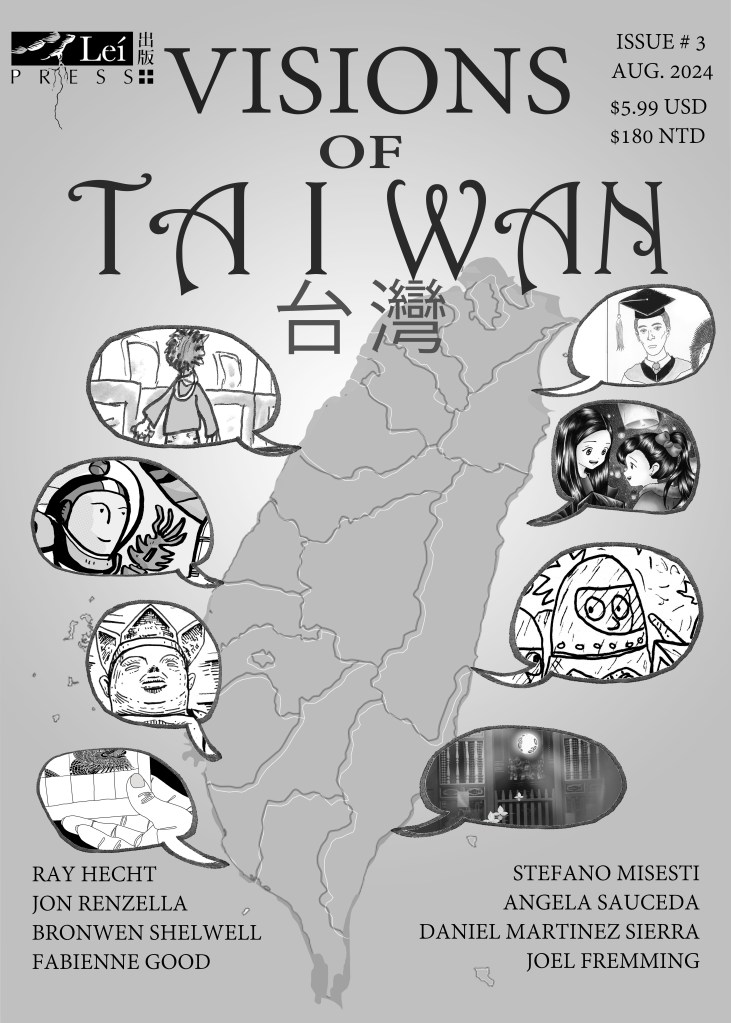
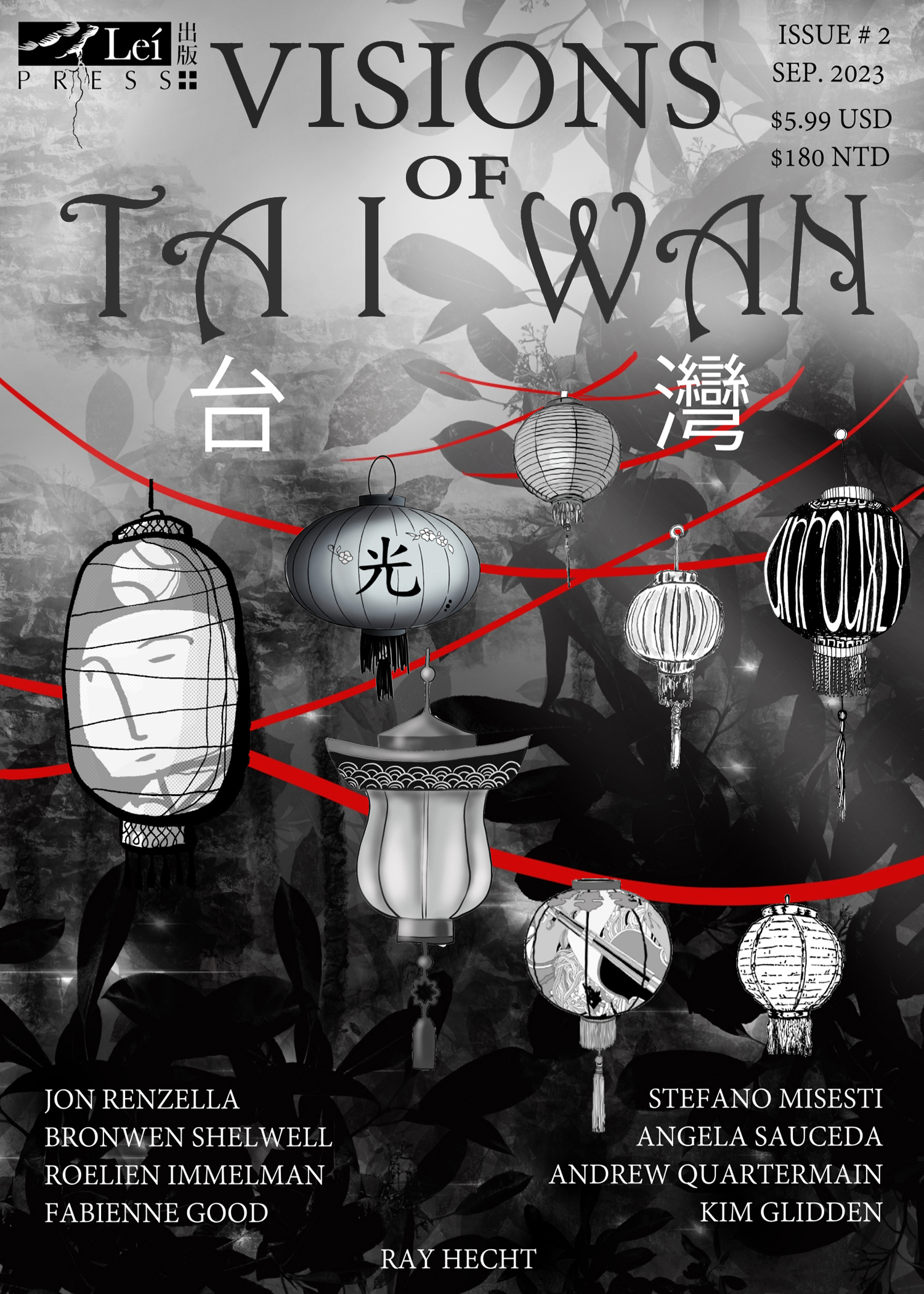
I am proud to present Visions of Taiwan # 3, the latest issue in the comics anthology:
Featuring stories by talented artists from all over the world, please enjoy the series which is free to download this weekend only! Check out all three issues now, via Amazon for the Kindle
Festivals and holidays, what better way to experience life in Taiwan than through its traditions? This issue of Visions of Taiwan features stories focused on different times throughout the year special to Taiwan.
Eight short comic stories by talented artists from all over the world, each with its own unique vision of life on this special island:
“Tales of the Taoyuan Airport” by Ray Hecht
“A Ph.D in Taiwan” by Daniel Martinez Sierra
“Once in a Dream” by Angela Sauceda
“Feng Pow” by Joel Fremming
“Tomb Sweeping” by Jon Renzella
“The not-so-typical Dragon Boat Festival on the Island of Xiaoliuqiu” by Fabienne Good
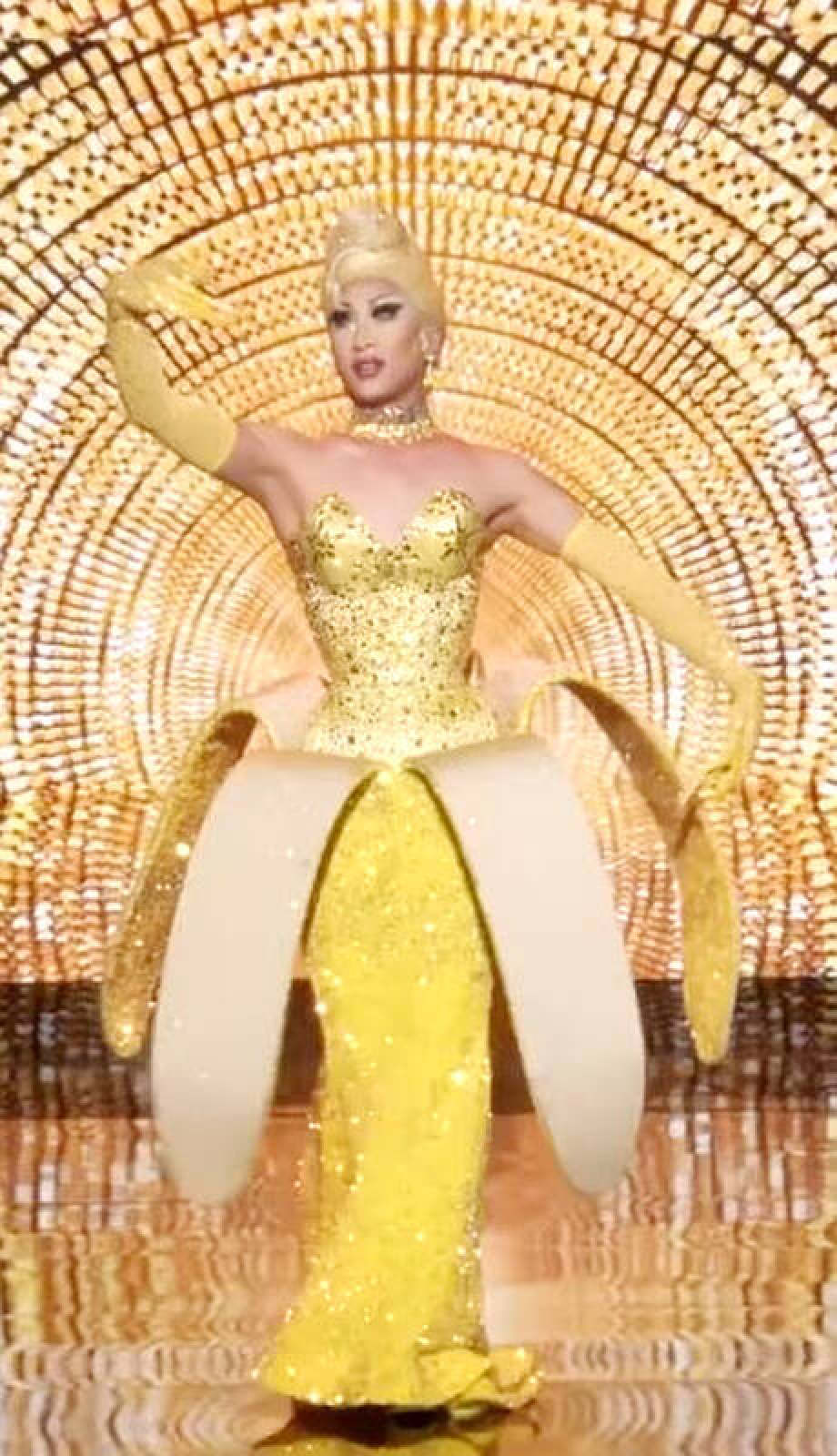
When Nymphia Wind became the first East Asian contestant to win “America’s Next Drag Superstar” on RuPaul’s Drag Race in April, celebrations erupted across her homeland.
Prominent gay bars from north to south held crowded screenings to cheer on their representative from afar, and the accolades were well received – and not just among the LGBTQ+ community.
On the show, Nymphia often talked about her heritage and drew on her background to create costumes and masks inspired by the traditional culture of Taiwan.
The 28-year old drag performer, known offstage as Leo Tsao, inspired millions from RuPaul’s vaunted international stage, announcing “Taiwan, this is for you”. In May, Nymphia returned to where she was raised – she was born in the United States, but moved to Taiwan at the age of six.
There was an unprecedented performance at the presidential office for Taiwan’s then leader, Tsai Ing-wen, just before the inauguration of William Lai Ching-te.
Nymphia headlined the show, joined by several other local drag queens, making the occasion a significant milestone in LGBTQ+ visibility on the island.
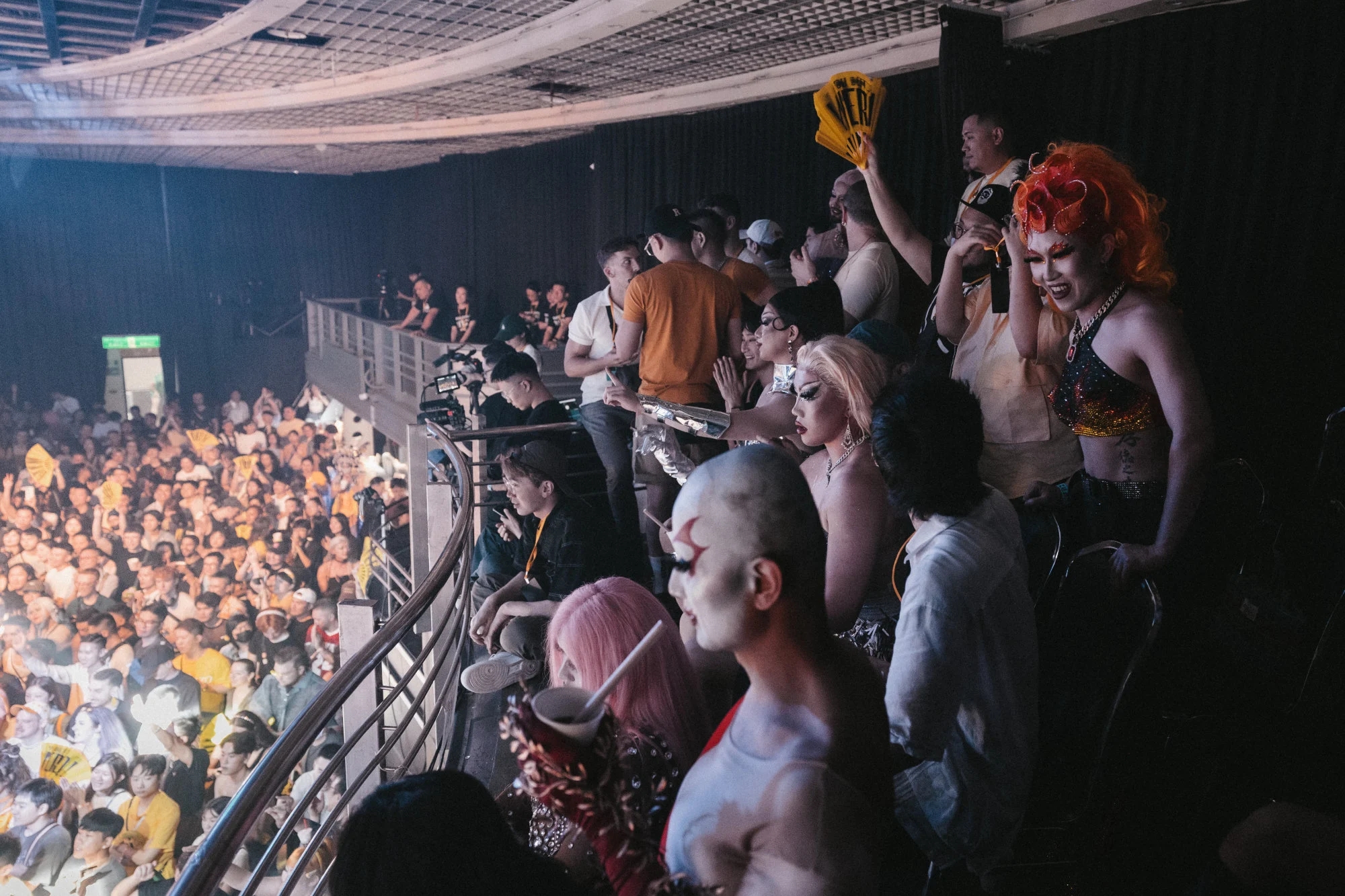
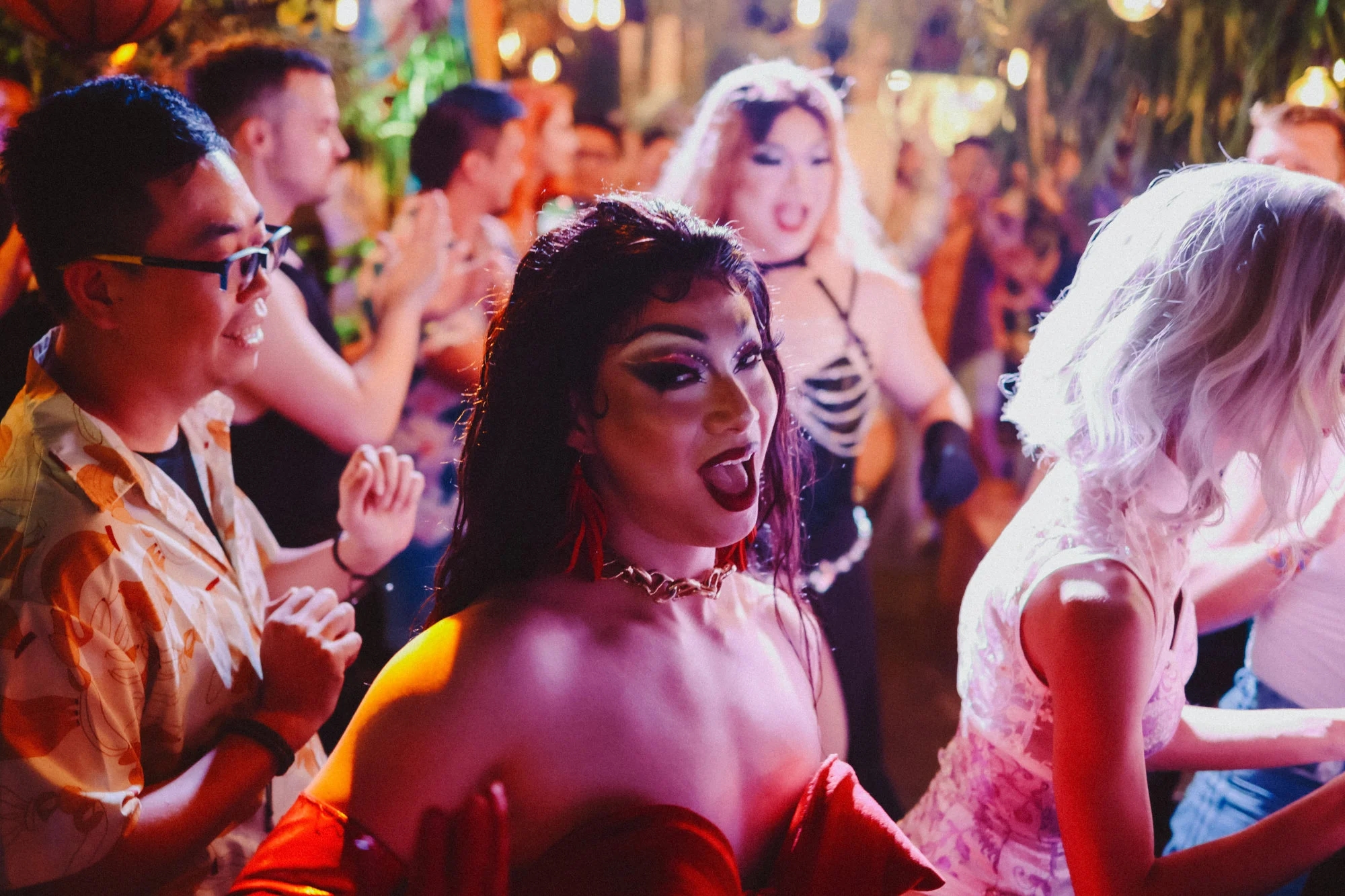
Drag queens in the audience at the Taipei International Drag Fest “You Better Werq” at Hanaspace in Taipei on May 25, 2024. Photo: Brian Wiemer
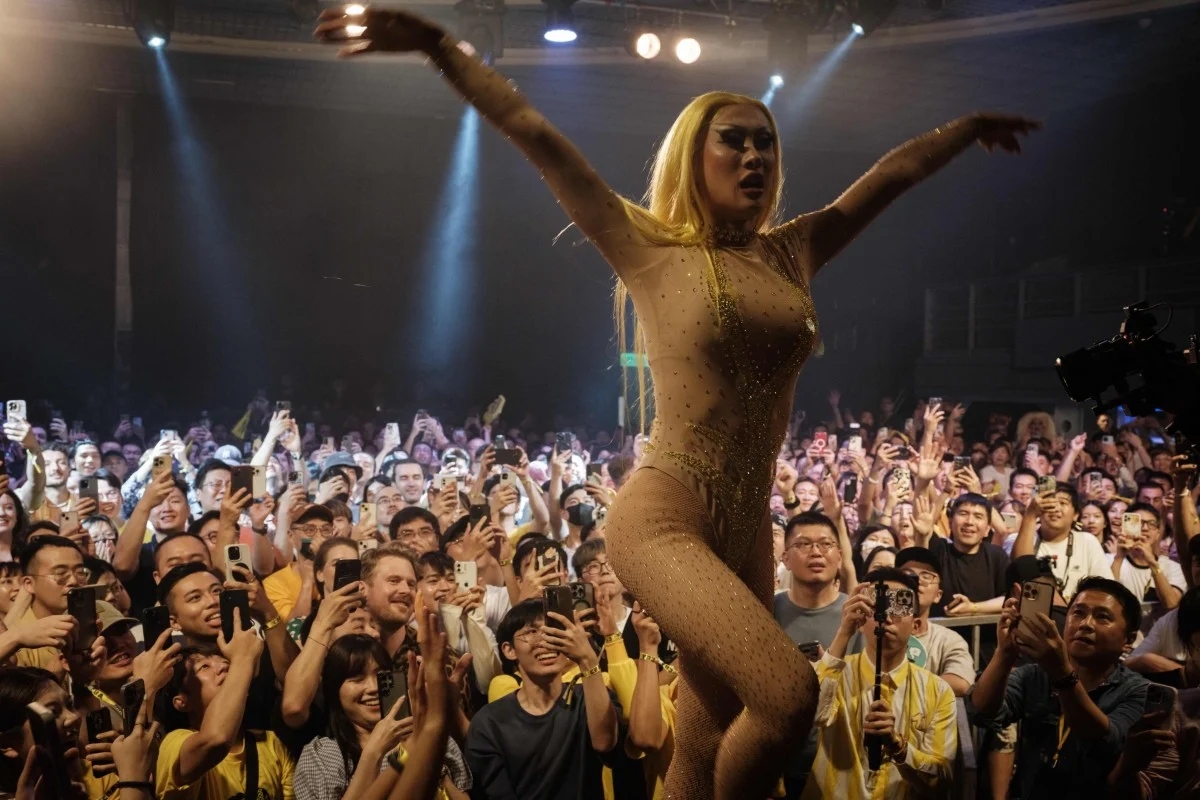
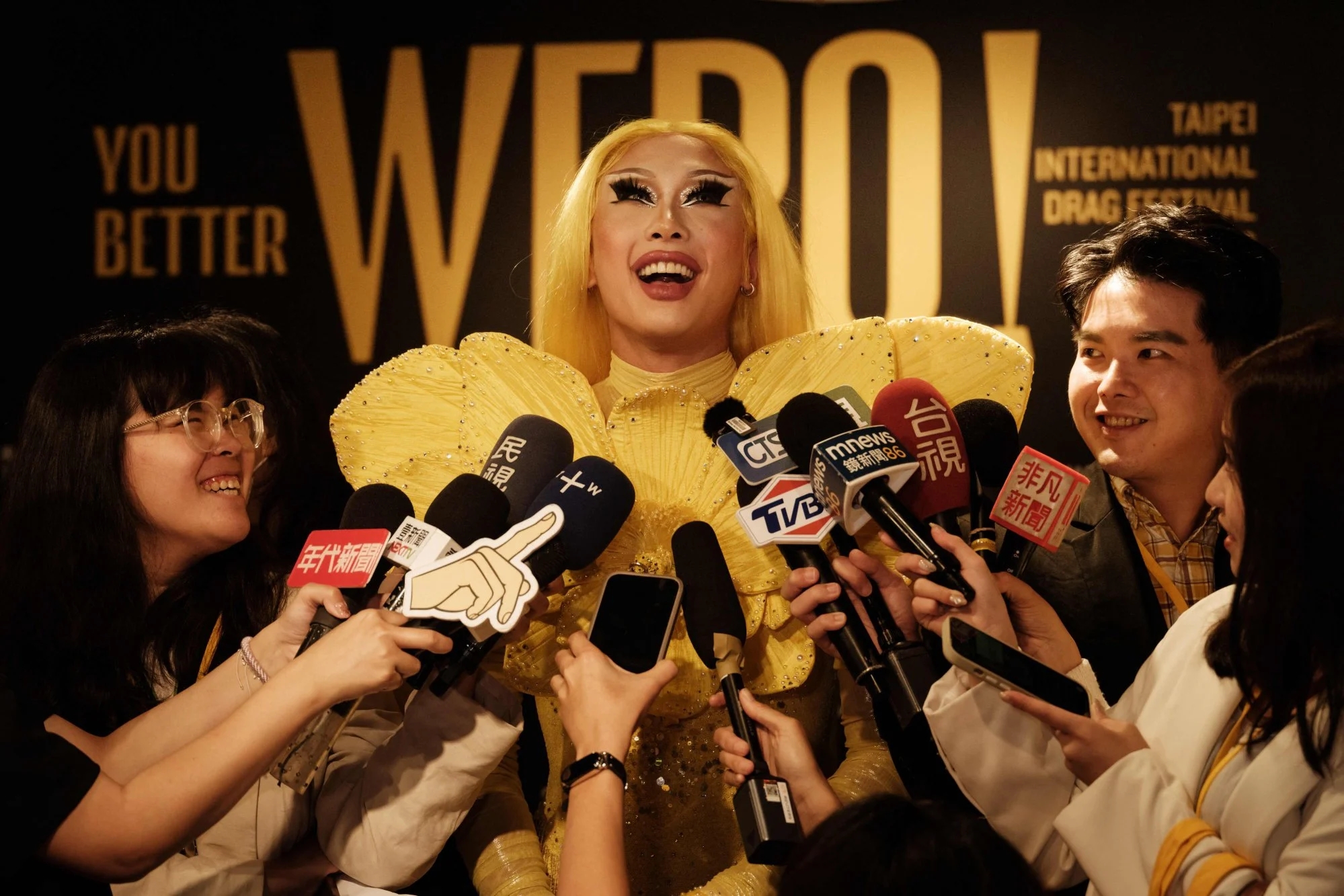
Nymphia followed this stately occasion with her first public performance since winning RuPaul’s Drag Race, at the second annual Taipei International Drag Fest “You Better Werq!” on May 25.
The event featured other American contestants from RuPaul’s Drag Race, Plane Jane and Mirage, Jade So from Drag Race Philippines, and 50 other local and international drag queens dancing and lip-synching to popular songs.
Held at the Hanaspace venue in Taipei, there was a both matinee and evening show with over 2,000 attendees in total. The audience was full of people wearing yellow and sporting banana iconography, marking them as fans of Nymphia’s signature style.
Other drag queens in the show came from all over the world. One who stood out at nearly two metres (6ft 6 inches) in height (in heels), was Popcorn, 34, from New Zealand.
Popcorn has been in Taiwan for seven years, and spoke about what it meant to be in the show.
“I’m very honoured,” said Popcorn. “I saw Nymphia’s very first performance, back when she was a baby drag queen. To see how she’s developed, her progress over the years, and seeing her work so hard, I think the overwhelming feeling is pride.
“She’s really representing Taiwan so well and so eloquently.”
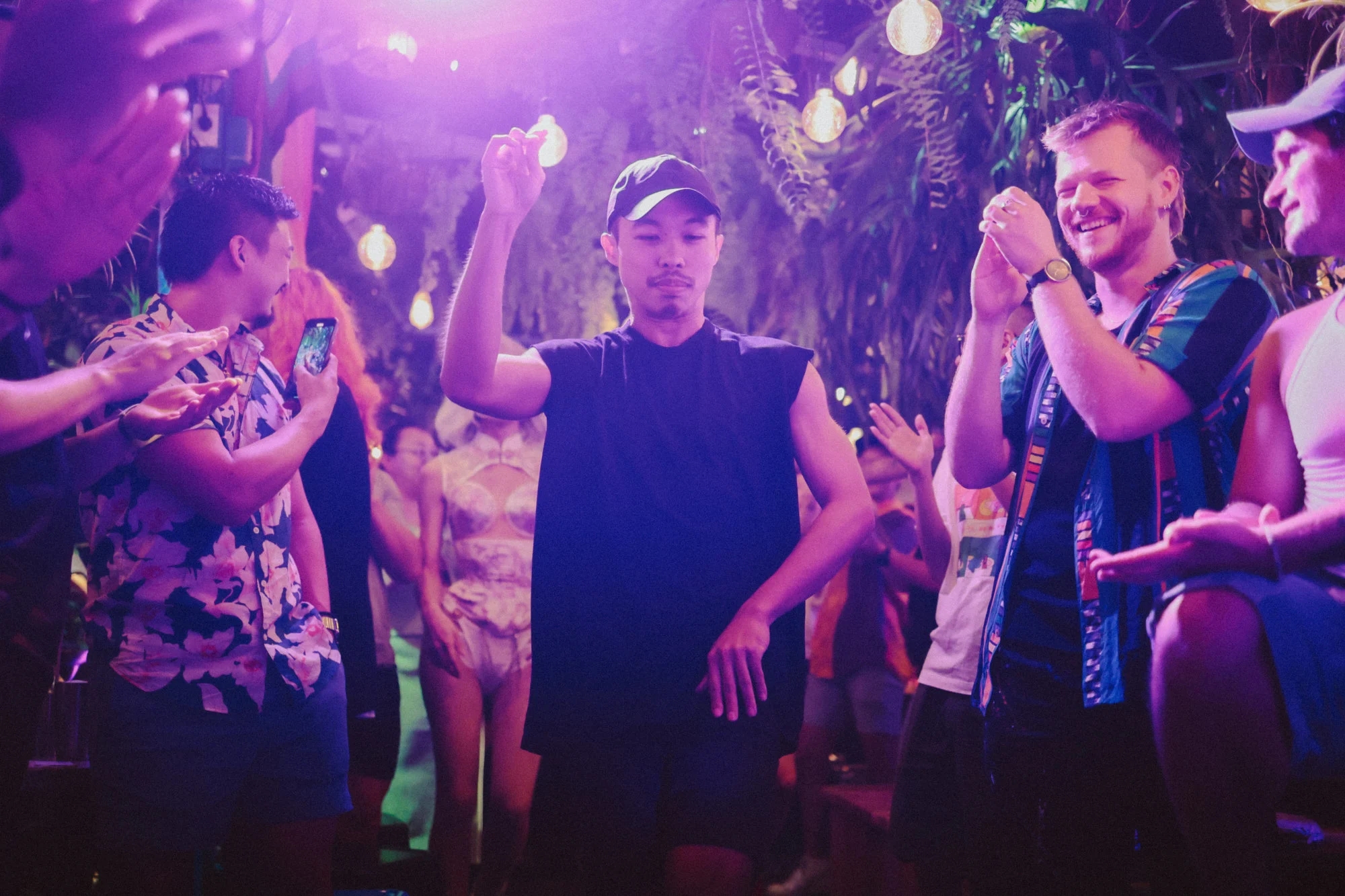
Drag queen Bagel RimRim lip-synching at Café Dalida in Ximending, Taipei. Photo: Brian Wiemer
Tinus “Bouncy Babs” Stander, 46, is from South Africa and hosted the “You Better Werq!” evening show. Babs has lived in Taiwan for 10 years, and often hosts shows in Taipei and Kaohsiung.
“I just know how I want the shows to pan out and to flow and how to get the audience involved,” he said of his hosting duties. “It’s really important for the audience to have a great time.”
Babs also shared his optimism about being part of the current movement: “We are the ones who are going to change LGBTQ rights and equality in Asia.”
Another drag queen, American Elja Heights, 34, is also optimistic about the future of the art form. Drag is “constantly moving in this direction of more people knowing about it, more people slowly – especially outside the LGBT community – are starting to understand that it is an art form”, she says.
“Everything has been really positive, which I’ve been happy to see. There have been a few online that are negative. Whatever, there’s always going to be people who do not understand what we’re doing; there’s always going to be a little resistance to progress.
“Everything has been really positive, which I’ve been happy to see. There have been a few online that are negative. Whatever, there’s always going to be people who do not understand what we’re doing; there’s always going to be a little resistance to progress.
Taiwanese Drag queen Nymphia Wind talks to media before the Second Taipei International Drag Festival in Taipei in May. Photo: CHIBA / AFP
Drag existed in some bars and nightclubs in Taiwan in the 1990s, such as at Paradise Party, which was the first gay club in Taipei, having opened in 1995.
In the early 2000s, the popular comedian Da Bing brought drag to Taiwanese television with his impersonations of female celebrities. Da Bing died in 2012.
The television series RuPaul’s Drag Race premiered in America in 2009 and had a big impact throughout the 2010s. Many drag queens around the globe have described how the show was a major influence for them.
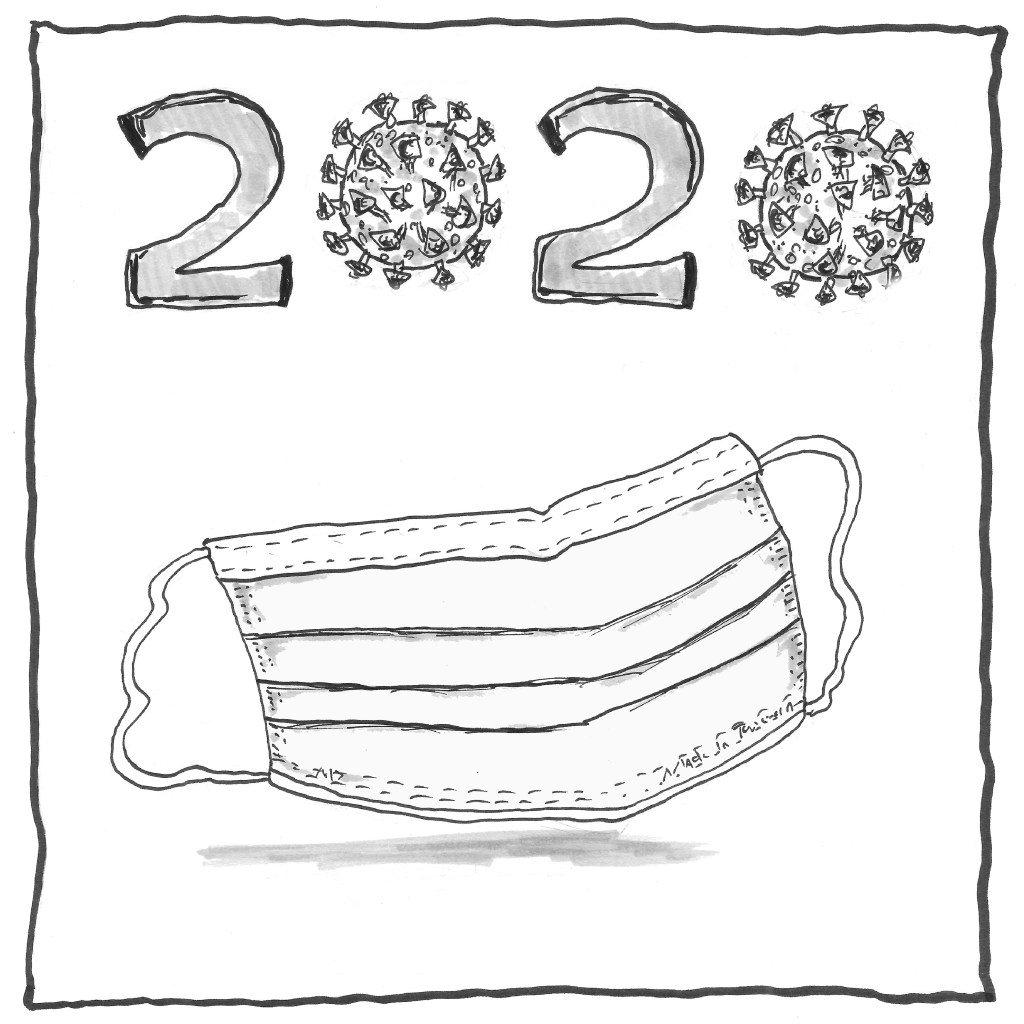
Social media also helped the culture grow, which led to brand sponsorship for some of the bigger stars, particularly during the Covid-19 pandemic, which led to more popularity.
Some of the other big names that came up at the same time on the island as Nymphia are Yolanda Masula, Chiang Weii, and Feilibing.
“I’m very happy because Nymphia won. Different people see drag as art. But the environment is still very hard for drag queens” Tseng Chih-wei, director of the Mommy Drag documentary
Drag queens have been around in Taiwan for decades and often performed in smaller venues, fostering their tight-knit community.
There is, for example, a bar in the Ximending shopping district where Elja had met Nymphia before the trappings of fame.
“I’ve known Nymphia for a long time,” she says “We’d see each other a lot at Café Dalida, an outdoor bar in Taipei that’s had drag performances for a long while.
“I jokingly call it the public gay square, because if you go to Dalida, you will run into people you know.”
Café Dalida has hosted frequent drag shows, featuring lip-synching performances with glamorous costumes and make-up, as well as other events important to the community.
On May 11, the documentary Mommy Drag (2020), which features Nymphia, was screened there. The director, Tseng Chih-wei, 32, attended and gave his perspective on the challenges that he feels still remain.
Tseng Chih-wei, director of Mommy Drag, at Café Dalida in Ximending, Taipei. Photo: Brian Wiemer
“I’m very happy because Nymphia won,” said Tseng. “Different people see drag as art. But the environment is still very hard for drag queens [in Taiwan]. They don’t get paid well.
“During the pandemic, the government had funding to help people, but when drag queens applied for funding as artists, they got refused. I wish drag queens were more recognised as artists.”
The owner of Café Dalida is Alvin Chang. He also organised “You Better Werq!” The 53-year-old is from Taipei; he opened his bar in 2006, and “the opening day had drag shows”.
Chang also knew Nymphia before she gained international fame by winning RuPaul’s Drag Race; she had hosted several of his events since 2019.
“Nymphia in person used to be very quiet,” Chang recalls, but since RuPaul’s Drag Race, he says he feels “everything has changed”.
As Nymphia harnessed the attention, so has Taiwan’s drag culture in general. “Before,” Chang says, “drag shows were underground, nobody cared. Now, everyone is focusing on it”.
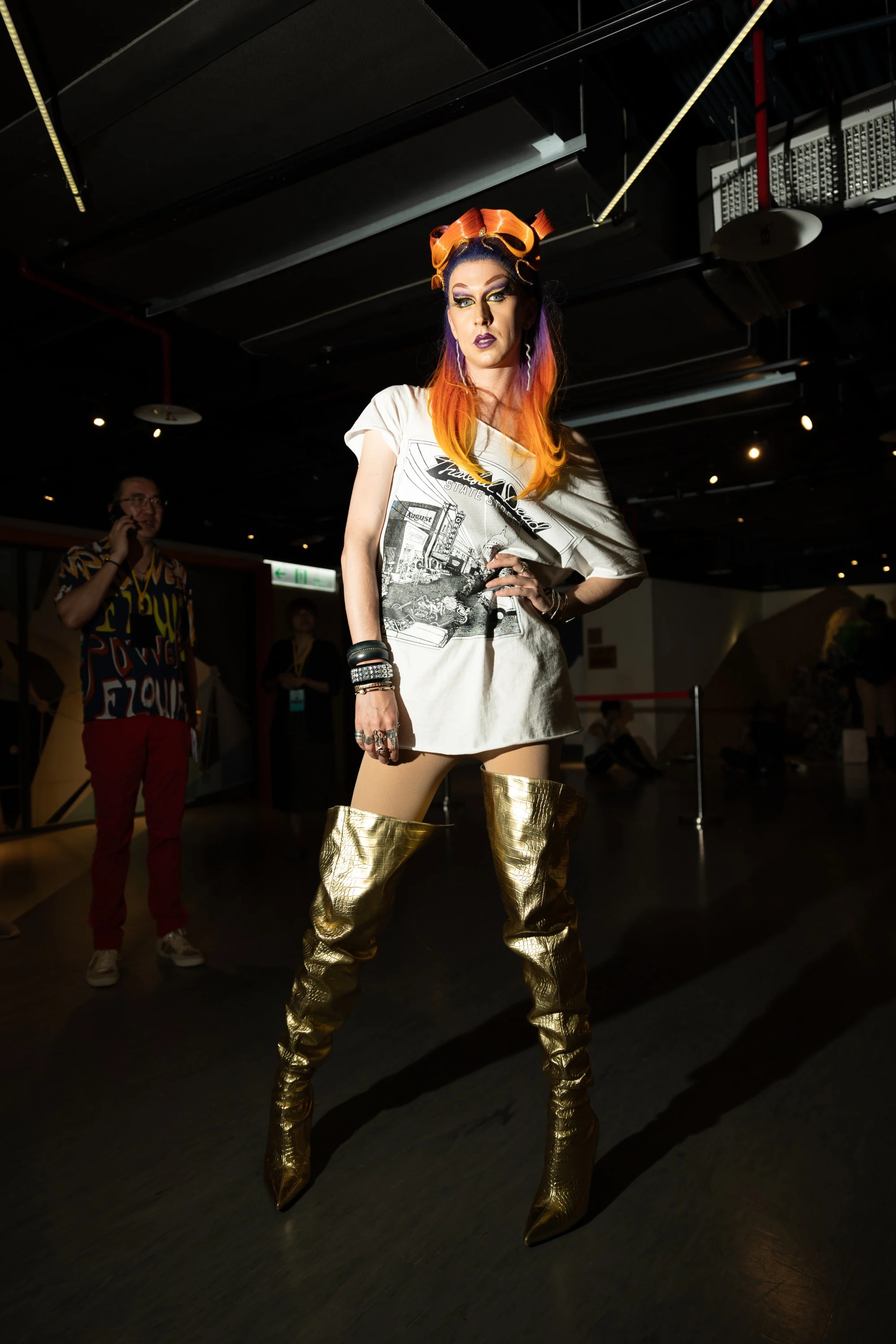
US drag queen Elja Heights posing at Hanaspace in Taipei, before performing at the Taipei International Drag Fest. Photo: Brian Wiemer
When asked about organising “You Better Werq!”, Chang says: “This was the grandest in our eight years of organising large-scale events. Our past experiences were insufficient for this event, especially with so many media and distinguished guests attending. It was a whole new level for us.”
For example, Taipei City counsellor Miao Poya, one of the few openly gay politicians in government, came to check it out. Taiwan’s Minister of Culture, novelist Li Yuan, attended and gave a speech during the matinee show.
“The Taipei International Drag Fest is a shining example of how diverse cultures and expressions can thrive in Taiwan,” he said. “It is wonderful to see such a vibrant celebration of creativity and inclusivity.”
Originally, the plan was to only have an evening show, but there was much more interest than anticipated and an afternoon matinee was added.
“On the day after Nymphia won the crown, the evening show, which had been on sale for a month with little progress, sold out within a day,” says Chang.
“The next day, many in the media suddenly contacted us wanting to film the event, and many friends couldn’t get tickets. So, after discussing with Nymphia and her fellow queens, we decided to add the afternoon show.
“Major media outlets, both domestic and international, reported on it, and the unexpected visit by the Minister of Culture was an unprecedented achievement.
“This event involved over 100 people, including performers and staff, working together to accomplish this difficult task!”
Nymphia Wind dedicated her Drag Race win to Taiwan. Photo: Instagram/@66wind99
In late October, Taipei will host the Taiwan Pride parade, the largest gay pride event in East Asia.
On October 26, as part of the festivities, Chang will organise another large drag queen party featuring Nymphia Wind, along with others from RuPaul’s Drag Race. The other attendees will include Kim Chi, the first Korean-American contestant on the show, as well as Filipino-American Manila Luzon.
Taipei’s Popcorn will perform on June 28 with the drag troupe The Haus of Dimensions during a screening of the 1927 Chinese horror film The Cave of the Silken Web, and will collaborate with the Yilan Traditional Arts Centre on October 5.
“With this experience, we are more confident in organising larger events in the future so that more people can personally experience the charm of drag queen performances.”
In the mountains of Miaoli county, about an hour-and-a-half drive from Taipei, a group of friends have rented out all eight bedrooms and the lobby of a bed and breakfast. It’s a fairly remote area of Taiwan, surrounded by forest and 40km (25 miles) from Miaoli’s central railway station.
It’s where the group can embrace nature without any interference from the outside world, and here, that’s important; because here, everyone is naked.
Strictly speaking, public nudity is against the law in Taiwan, as it is, for the most part, in the rest of Asia. And while Taiwan is known to be among Asia’s most progressive places – it voted in the island’s first female president in 2016 and legalised same-sex marriage in 2019 – there are no private nude resorts or nude beaches, although there are some hot springs where nudity is allowed.
Naturism – as the practice is known – is more common in Europe, where Freikörperkultur (“free body culture”) has been an accepted and celebrated part of German society since the late 19th century.
Retiree Julia Fu and farm owner Tom Yang at Yang’s farm in Sanzhi, Taiwan. Photo: Brian Wiemer
In Britain, and in other parts of the world, the term naturist is usually preferred over nudist, because the former also encompasses a love of nature.
According to the International Naturist Federation, headquartered in Austria and the largest such organisation in the world, naturism “isn’t sexual” and is rather “a way of life in harmony with nature characterised by the practice of communal nudity with the intention of encouraging self-respect, respect for others and for the environment”.
In Taiwan, naturists call themselves tiāntǐ in Mandarin, meaning “celestial bodies”, and organise activities using their Line social-media app group “Return to Nature”, which currently counts 260 members.
The subculture was introduced to the island in the mid- to late 2000s and flourished as social media allowed people to network online.
The group’s events are held monthly and range from dozens of people meeting in rented spaces to small house parties of fewer than 10 people.
Members so far are all Taiwanese, with the confidential group chats written exclusively in Chinese – today’s Miaoli attendants have organised their au naturel retreat through Line.
The group’s moderator is fifty-something Keven Liao Tian-wei, from the southern port city of Kaohsiung, who describes himself as a semi-retired auto-parts dealer.
He first connected with the group “out of curiosity, and I fell in love with it after joining about 10 years ago”, he says.
“The original organiser stopped holding events for some reason, so our friends who lived in the south met for a party, and as a result, I started these activities. Naturism has been in Taiwan for at least 20 years and I believe it will continue. Even if one day I don’t host it, younger people will come forward to take over.”
Fu in a forest pathway at a farm in Sanzhi, Taiwan. Photo: Brian Wiemer
While naturism can seem, at first, well, unnatural, after a while with the group in Miaoli, one forgets that no one is wearing any clothes. Today, about 20 men and 10 women attend, aged in their 30s to 70s.
Bare breasts and genitals are exposed, yet people speak to each other casually, lounging on sofas, cooking together in the kitchen or singing karaoke.
Everyone is here to have fun, but there are rules. No photos are to be shared online without consent, and if any are, faces are blurred. Sharing pornography is prohibited and violators will be removed from the Line group.
Liao also enforces rules forbidding public displays of sexuality, and he emphasises that harassment of female members is not allowed. Men often outnumber women at these events, so he does his best to make sure women feel comfortable and safe.
Return to Nature members are also required to attend at least one party every two months, in an attempt to keep out any interlopers.
Peter Chan and Fu take cover from the rain under a canopy at a farm in Sanzhi. Both are sporting anti-war body paint. Photo: Brian Wiemer
Most of the women at the Miaoli event arrive with their husbands and the majority of attendees are couples, with several single men but few single women.
One couple is playing the saxophone, and Stephen Chang Tai-sho, from Taipei, is happy to introduce me, the only foreigner in the group, to his wife, Yen, and talk about their experiences with naturism.
An engineer and amateur musician in his late 60s, Chang “discovered naturism on the internet”, he says. “I liked it, so I researched it. I went to a nude beach in Florida the first time I visited there. I found this group on Twitter, and if we have a meeting, I will show up.”
Asked what he likes most about the lifestyle, he responds, just as several others do, that it’s simply the “freedom”.
I first attended one of the group’s events in 2023, at a hot-spring hotel in Wulai, in New Taipei, at a meet-up organised by Julia Fu Yong-en, a retiree in her 60s.
Hot-spring culture is popular all over Taiwan, but is usually gender-segregated. It may be traditional to go nude, but hot-spring locations will either separate men and women or require bathing suits in public spas.
However, that doesn’t stop some from renting out a hot spring for a private party and using it however they like.
Along with Liao, Fu has been organising activities for the group for the past decade. “I went river tracing [a combination of hiking, swimming and rock climbing] with friends 10 years ago,” she says. “I liked swimming, but the first time I wasn’t naked. The second time I enjoyed a waterfall, and took off my clothes. The men were respectful.”
Yang leans on a gate at his farm in Sanzhi. Photo: Brian Wiemer
She also spends much of her time at a farmland location in Sanzhi, north of Taipei, where some of the Return to Nature members have created their own unofficial nudist resort.
A small isolated farm full of chickens and vegetables, it hosts gatherings on weekends for meals and sunbathing. It was a sunny day when I visited, and the outdoor shower was refreshing.
There I met Tom Yang Hai-yang, who runs the farm. He spoke of his brother, Lu Yi, who owned the property and died in June 2023 at the age of 103. Lu “was the pioneer of naturism here”, he says. “Since then, Julia and I have worked hard to create this place.”
Like many others in Taiwan, Yang first experienced social nudity abroad. “I was living in New York in 1992 and visited a nudist beach in New Jersey. I came back to Taiwan in 2010, and a friend told me about [the nudist] activities in the south of Taiwan, in Kaohsiung.
“The people are very friendly. When we meet up, everybody is like an old friend. It’s like déjà vu.”
Fu, writer Ray Hecht and Yang admire the scenery at a farm in Sanzhi. Photo: Brian Wiemer
Tony Liu Chao-chun, a product designer from Taipei in his early 50s, joins Fu and Yang for lunch. He recalls his first experience of nudism: “I was studying Japanese in Japan, and I bought a magazine about hot springs,” he says. “I had some issues with my body, and I thought hot springs would help me become healthier, so I searched for it.
“When I went to the resort for the first time, the boss told me that in Japan we must be nude together. I was with strangers; I didn’t know them, but I learned to accept those customs.”
Back in Taiwan, he found like-minded souls on social media, and has been attending the Return to Nature meetings for several years.
Nevertheless, there are risks to becoming a naturist. EE Ruan Ren-zhu, an artist from Kaohsiung, is open about this part of her identity, which has caused some challenges.
She’s been featured in the Taiwanese media a number of times, sharing her story on multiple television shows and news outlets, but “most naturists don’t come out; they keep it a secret”, she tells me. “But when I do performance art, I am naked. So it was easier for me to be a naturist.”
The 65-year-old has been part of the naturist community since 2005. Unfortunately, not everyone in her family was accepting. “I came out to the newspapers, and TV. It’s hard for people to understand.
“My son, who was at university, told me, ‘How can I tell my girlfriend about you?’ I said, ‘That’s your problem, not mine.’”
The artist says she has always done things her own way. “My mother was a traditional woman. She worked so hard, and was so sad. It was the woman’s fate. I didn’t want to be like my mother. I wanted to be independent. I like the freedom.”
Yang cuts the grass at his farm in Sanzhi, Taiwan. Photo: Brian Wiemer
Yet when asked about the future of naturism in Taiwan, she is not optimistic: “I don’t think it will become more acceptable.”
As I explored the community from the hot springs of Wulai to the mountains of Sanzhi and Miaoli, I couldn’t help but notice that most of the naturists are in the older demographic.
Many were retired, and at least over 50. While young people tend to be more open-minded and progressive, it doesn’t seem the younger generations are as interested.
There are, however, some exceptions. Born in the late 1980s, Anne Chen Hao-an is a millennial, and one of the youngest people at the most recent event I attended. As with many of the others I speak to, she first experienced social nudism abroad.
“I went to Berlin in 2008. I didn’t really join in any [naturist] activities, I just saw them. It’s their daily life – they sunbathe or they go swimming without clothing. That was a culture shock, but I thought it was good.
“The main idea is body positivity, which is more important for females. Because women are so self-conscious about their bodies, it’s hard for them, and I wish they could appreciate themselves.”
Fu and Yang at a farm in Sanzhi. Photo: Brian Wiemer
People of all shapes, sizes and levels of attractiveness attend these events. If someone were to show up and expect to be aroused, they would likely be disappointed. But attraction is not the point.
Body positivity is about challenging social norms and accepting people regardless of perceived flaws, which is why these naturists are so comfortable in their own skin.
“We all play characters,” says Chen. “Clothing is like your weapon in society, but with nudity, you can take that away, and I think different kinds of bodies are beautiful.
“If people all looked the same, it would be so boring.”
Visions of Taiwan brought new voices to explore Taiwan, and now returns with a second issue featuring original works by artists from all over the world. Eight short stories in total, each with their own unique styles experimenting with the medium of comics in order to share something different about life in this strange land.
“Chariot” by Jon Renzella features the point-of-view of a scooter, “Moving to Taiwan” by Roelien Immelman is about the annoying challenges of working abroad, “Ludwig” by Stefano Misesti focuses on the musical charms of local garbage trucks, “A Slug’s View” by Bronwen Shelwell explores camping and nature with cute bugs as narrators, “People-watching on the Train” by Ray Hecht is a meditation on the strangers we pass by while commuting, “The Taiwanese Farm Adventure” by Fabienne Good is a surreal take on traveling blind, “A Dream Called Taiwan” by Angela Sauceda has a heartfelt focus on friendship, while “Moonshot” by Kim Glidden and Andrew Quartermain has a touch of the supernatural.
There’s only one place on Earth that could have inspired all these visions . . .
I am excited to share that my new comic anthology is free to download for this weekend on Amazon:
Visions of Taiwan is an anthology comic series focusing on the lesser-known land of Taiwan.
Featuring a range of new voices from around the world, each artist has made Taiwan their home and has a unique take on what it is truly like to be there. With seven stories in total, Visions of Taiwan is sure to have something for everyone.
There’s “Nineteen and Moving Along” by Erique Chong; “An Island of Inspiration” by Fabienne Good; “Some People” by Joel Fremming; “How Not to Get Your Scooter License in Taiwan” by Ray Hecht; “Green Island” by Bronwen Shelwell; “Walk & Talks” by Patty Hogan and Todd Allen Williams; and “ConSequential” by Jon Renzella.
Each story contains its own perspective about what makes life worth living in Taiwan, told with humor and depth. It’s not always easy and there are all kinds of experiences, but above all it is never boring…
In the mountains of Yilan, far from the confines of everyday life, people gather during the holidays to celebrate. Outlandish costumes are the norm. The fashion styles run from Mad Max-inspired outfits, to anime cosplay, along with colorful makeup and dresses for both men and women.
It’s time for the Turtle Burn, the official “regional Burn” of Taiwan. This is a spinoff of Burning Man, the world’s largest art and music festival held annually in Nevada. For one week a year, over 70,000 people camp out in Black Rock Desert to attend this seminal countercultural event. All over the world, there are also smaller regional Burns, and the Turtle Burn will be a more intimate affair, capping at 150 people.
Although the main Burning Man event was canceled last year due to COVID-19, the Turtle Burn did have a successful opening in 2019 and plans to continue annually. The latest will be from April 2 to April 5, over the Tomb-Sweeping Festival holiday weekend, at Shanlinciji campsite.
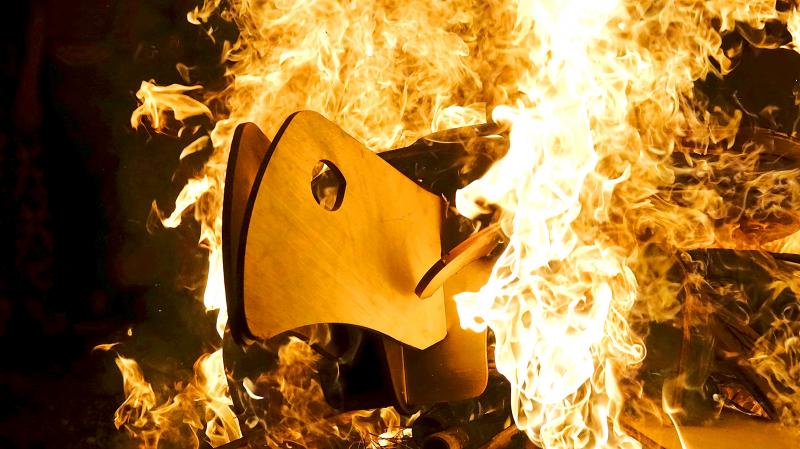
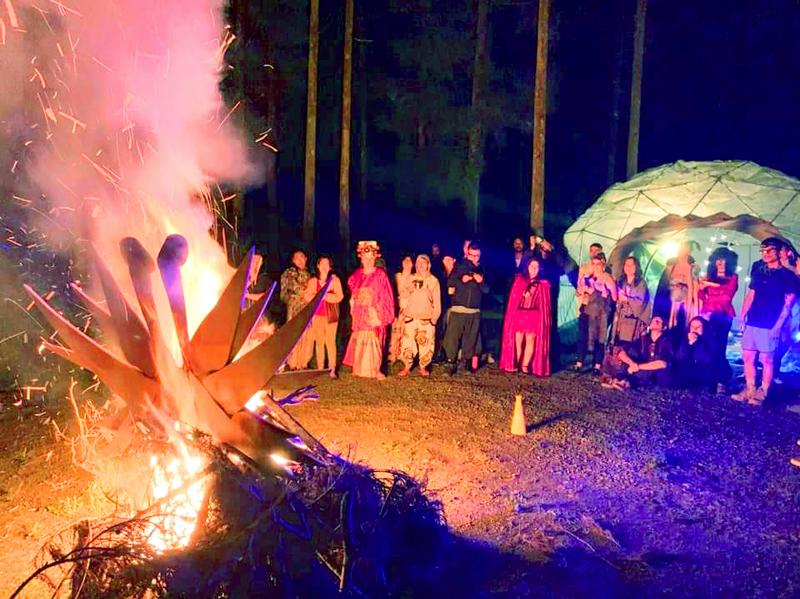
Wooden turtle sculpture is set aflame on last night of Turtle Burn, 2019.
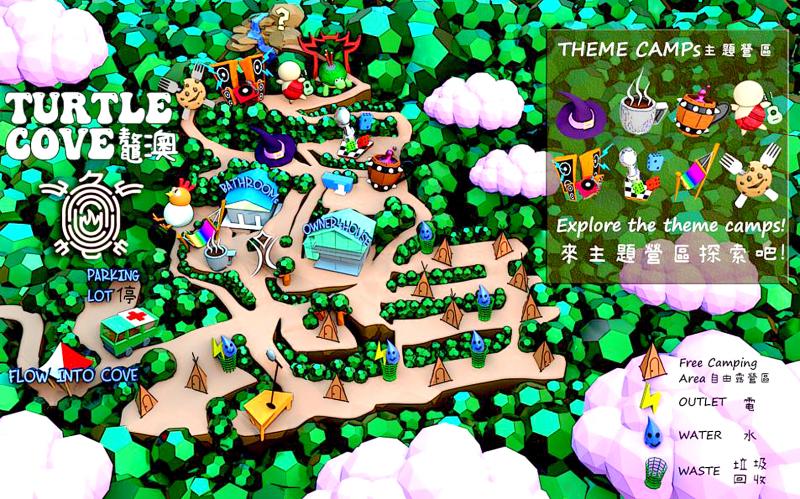
The site is filled with several “theme camps,” which groups organize in order to spend time with likeminded friends and to pool resources together. One is the Tavern of Truth, headed by Kate Panzica, which holds a free bar to give drinks to everyone who strolls by.
“Educating both foreigners and locals on the Ten Principles is a net positive,” Panzica says. “I think it’s great for folks to explore themselves and what they want to be in the ‘default world’ as well as a Burn.”
The Ten Principles of Burning Man, written by late founder Larry Harvey in 2004, are: Radical inclusion, gifting, decommodification, radical self-reliance, radical self-expression, communal effort, civic responsibility, leaving no trace, participation, and immediacy.
Attendees gather around a flaming effigy on the last night of Turtle Burn 2019.
These guidelines help to make the event stay as ethical as possible, and people are encouraged to clean up after themselves and promote sustainable living. Radical self-reliance refers to how attendees must bring their own food, cookware, tents and other camping supplies. People are encouraged to contribute to the culture by building their own artistic creations, whether individually or as part of a group. And after the event is over, they must make sure to leave no trace by cleaning up all “MOOP” — matter out of place.
For four days the Turtle Burn will hold a variety of workshops and activities. The gifting principle doesn’t just refer to handing out free drinks or personalized jewelry, although that is also common. It can also be expressed by giving one’s time by hosting workshops.
In the past, these workshops have included improv comedy sessions, where participants learn to play and practice their comedic skills, yoga classes for keeping fit, lip-singing performances, fashion shows on a makeshift runway and even impromptu puppet shows. Some camps contribute at meal-times, cooking pancakes or grilled cheese sandwiches to share with the entire community. At night, fire-dancers are a particular attraction of any Burn, dancing to the beat of electronic music and entertaining others as they express their craft.
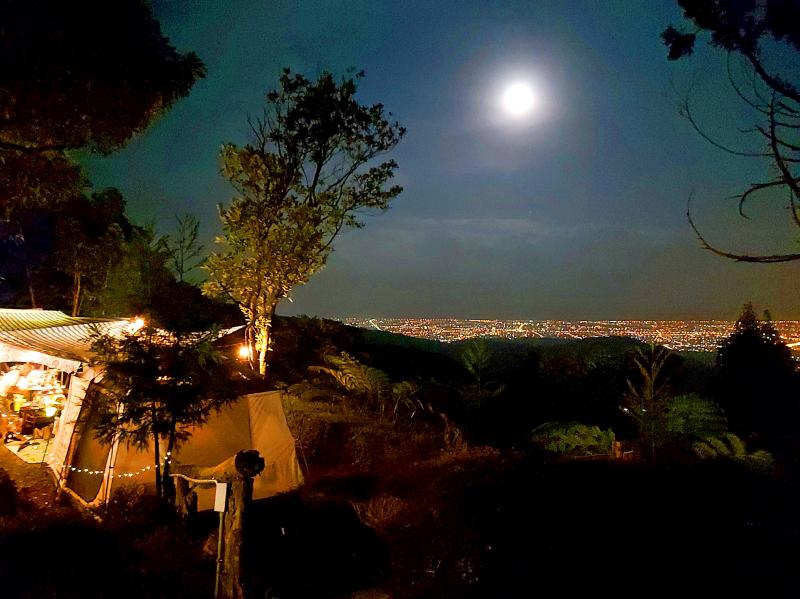
Shanlinciji campsite overlooking the city of Yilan under a full moon.
“I was part of the Queen of Hearts camp,” said Michi Fu, sharing her experiences. “We had a shared costume closet with a full-length mirror to encourage radical self-expression through costuming. I sang with my furry, lavender bunny ears and turquoise silk robe and we all had hand-cranked ice cream.”
On the final night, tradition dictates that a wooden effigy is to burn. This started in 1986 at the very first Burning Man in San Francisco, as a symbol of how to keep the creative “fire” burning on even after the event concludes. At the Turtle Burn, a two-meter wide wooden turtle sculpture is scheduled to be set aflame. Dale Albanese, Taiwan’s official Burning Man contact, said of the installation: “There’s a sense of buildup and tension, and this sudden quietness and a collective shared spirit. You hear the oohs and the aahs at similar times. There’s a kind of shared attention. We’ve all been busy doing our own thing, and then there’s a pause. A reset. It’s also a moment to open up and say it wasn’t just about me.”
As 150 artists and performers gather their community together to continue the Turtle Burn tradition, they are also planning for next year and beyond. Tickets for this year’s event have already sold out but there is a waiting list. For more information, visit: turtleburn.com.
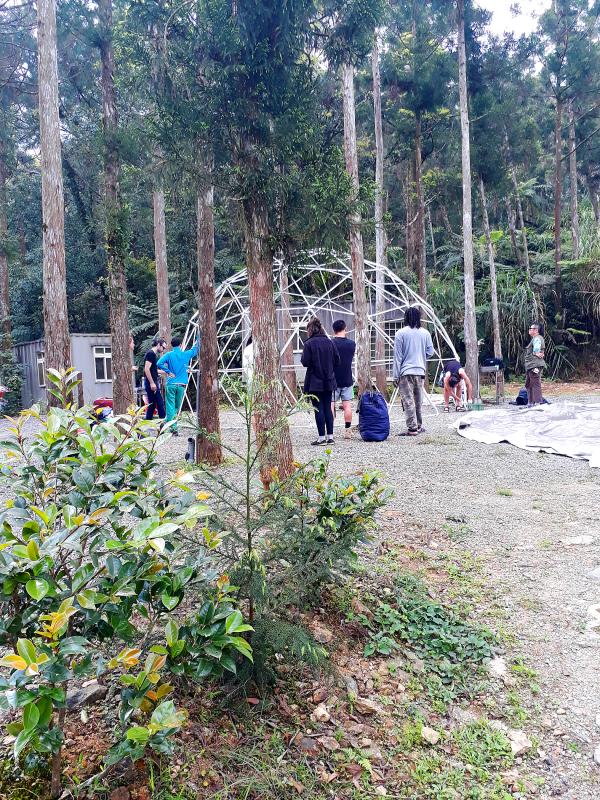
Preparing for Turtle Burn in 2019, attendees construct a communal dome space.
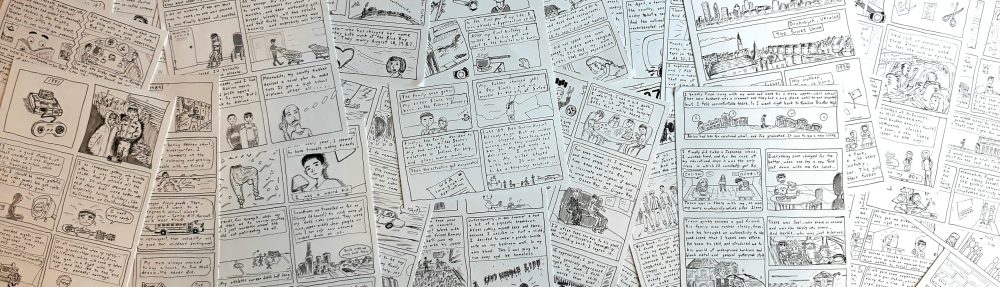
What I Says: An autobiography about somebody unknown and done in the format of a comic, how could that work? Well it worked for me, I really enjoyed reading this, I can’t stand those autobiographies by famous people full of name dropping and desperately trying to make every aspect of their life interesting. Always Goodbye is the sort of book that could be about you, the reader, if you are a child of the 80’s then you’ll see similarities to your own life in this book, as Ray Hecht describes events you’ll be going “I remember that” and you’ll end up on your own journey down memory lane. And being born in the 80’s means a lot of big moments in your life would be defined by technology, getting that first email address, joining myspace and Facebook, games consoles and smart phones are all big points in Rays life and until reading this I have never thought of things like that before.
A huge part of Rays life has been spent reading and making comics, falling in love with Marvel and DC universes and because he has that huge knowledge about comics it has made this book much more special. Some clever little bits really bring this to life, describing his parents, birth, upbringing and how they met was cleverly done, drawn as a column with each event side by side worked well. Each chapter starts off with a year of Rays life and the first window shows a significant event from that year and I loved trying to figure out what they represented. There was the odd quirky bit thrown in too which gave me a chuckle, favourite bit was Ray sat at his desk at school and the writing about the scene takes up so much space that he has to have his head at an angle.
The comic has been hand drawn, which gives it a personal touch that would have been taken away by a piece of software, whenever Ray draws one of his girlfriends the amount of detail increases until they are almost glowing, it shows just how important they were in his life.
I have really enjoyed reading about Ray’s life and now wish I had a time machine to go and get my hands on the sequel in 30 years time 🙂
Ray Hecht’s autobiographical graphic novel starts with his birth in Israel, where his parents were immigrants, and ends up with him working in Asia. Moving to America as a small child he has an unstable upbringing, thanks to his Ukrainian mother and American father divorcing. The drawings and the layout here obviously took a lot of work and I dare say it may have been easier just to write the narrative, however, this was a more interesting way to tell his story. Each year is introduced with a picture of a key event and I laughed when I saw OJ’s Bronco being chased by police down the highway for 1994.
Things start out well for the family in America, but after a few years the cracks begin to show and his parents get divorced in the early nineties. His mother remarries a none-too trustworthy Israeli man and Ray stays with his Dad, who trains to be a nurse. Ray does recognise his father’s efforts to better himself. His sister is academic and as she grows up gets sucked into a conservative Israeli world that Hecht wants no part of. She learns Russian and presumably Hebrew too — as she moves to Israel and gets married there. Ray’s trips to Israel don’t work out well, it’s not a place he connects with. With this in mind, it’s not surprising that he prefers to study Japanese and later Chinese.
A self-confessed nerdy child, Hecht struggles socially and finds solace in comic books. (I was waiting for his reading to break out from the pure escapism of comics and this does eventually happen.) A convincing portrayal of how America can be a lonely place for a teenager, a lot of this must have been hard to bring to the surface again. One major problem for him is always moving from school to school, as the title indicates it is “Always Goodbye”. Probably the most painful incident is when he gets kicked out of school for something he says about a mass shooting. Despite being an introvert, he makes various efforts to improve his social life, investigating subcultures — punk, Goth, arty-type, straight edge, hippie — looking for something to hold onto. His friends do the same thing and he falls in and out with them depending on what phase they are in — a problem of a fractured society: you can join many different tribes but a sense of belonging is not guaranteed. He does some hallucinogenic drugs, but the answer doesn’t lie there.
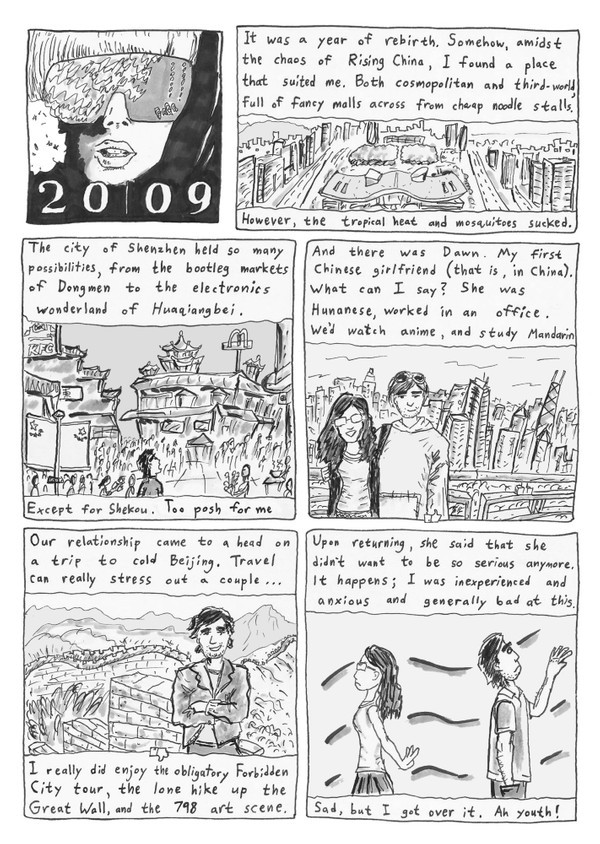
In his early twenties Ray moves out of his Dad’s place and back again several times, in a non-linear surge towards independence common in his generation. He has a string of dead-end jobs in various States and then vaguely commits to life in California. Salvation comes in the form of China, recommended to him by a random character at the Burning Man Festival 2008. Like many young Westerners who go to work in Asia (me included), it’s the first time he has the luxury of living alone in a decent apartment. He begins teaching at a kindergarten in Shenzhen, the huge city over the border from Hong Kong where everything is new and exciting. He mentions the bootleg markets and this reminded me that one of the pleasures (and even social activities) of living in China back then was shopping for pirated DVDs; now of course we just download movies without leaving the house. He survives the kindergarten, moves onto a Korean owned school in Guangzhou, and escapes the English teaching world to become a copy editor.
Ray realises that a lot of the expat life is about drinking and tries to find meaning through writing and dating. The dating doesn’t go so well, but gives him material to write about. While many say it’s easy to get an Asian girlfriend, it doesn’t work out most of the time because of different expectations and, sure enough, Hecht takes us through a few awkward flings. The world of online dating also turns out to be a wash-out. Despite these romantic failures, he publishes a novel and eventually gets involved in a serious relationship with a creative South African woman— i.e. finally he has some good luck. I was interested to read that he initially went down to Hong Kong every six months to get visas, but later got a ten year China visa. Surely long term visas like this are not on the table anymore?
The text isn’t that polished and there are still a few mistakes to be ironed out, or perhaps they were left in the on purpose to emphasize the DIY nature of this work? His analysis of society is usually spot on and you can see a narrow view of the world broadening as he travels more — this gives the story a nice arc. As a thirty-something he ends up in Taiwan, looking at current events it was probably a wise decision to leave China and move there.
In this midst of this worldwide pandemic, I’ve found myself passing on those dystopian novels I used to adore and instead seeking out a little more “comfort food” in the books I’ve read this year. Lighthearted, humorous and even self-deprecating stories of people grappling with everyday problems that you wouldn’t find in a disaster film have offered me much-needed refuge in these unusual and challenging times for all. Bonus if they touch on experiences I’ve had living here in China and Asia, including cross-cultural dating and relationships.
Thank goodness Ray Hecht sent me his new graphic novel Always Goodbye, which really hit the spot on all fronts.
The graphic novel spans Ray’s life from birth up to 2019, and it makes for a pleasant read, thanks to its honesty. As much as it charts the highs in his life, the novel also delves into those lows and failures too as he pursues a variety of different careers, not always with success. Ray approaches even difficult topics and moments with a refreshing sense of humor, and we could all use a laugh these days. And Ray’s experiences in moving to China and dating locals will resonate with those of us who have visited or lived here.
I’m honored to feature this interview with Ray Hecht about Always Goodbye.
I’ve always loved the comics medium. I worry I”m not quite good enough at drawing, and that’s why I’ve been focusing on prose writing for most of my creative career, but after a bit of a dry spell in book publishing I decided to return to my first love…
The decision was partly due to me just trying to practice the art of cartooning again. Focusing on myself has worked well with my writing before, so why not? Autobiography/memoir has been an indie comics tradition for many years, and it simply felt right for me to share my perspective that way. When I sat down and thought about the whole of my life, with the second half focused on being an expat in China until in the “climax” finale I moved to Taiwan, it seemed like a story worth telling.
What’s the story behind the title?
To be honest, I struggled to come up with a title. At last, it came to me.
Perhaps it’s a somewhat dark interpretation, but the one constant in my life seems to be that I always move. I moved from Israel to Indiana to Ohio to California to Ohio again to California again to China to Taiwan.
That’s a lot of goodbyes. So what else could I call this, other than “Always Goodbye”?
In your graphic novel, you chose to organize it chronologically, through your entire life. Why did you choose this approach?
Good question. Indeed, such a narrative doesn’t necessarily need to be chronological. Nor must it start at the beginning. Authors more clever than me may have taken a non-linear approach, but I went with being direct.
Back when I first thought about how to explain my life in a way that made sense, taking notes and interviewing my mom, I realized I didn’t just need to start with my birth; I actually needed to start with my parents. So the first years covered were 1954 and 1956, in Chicago and in the Ukraine of the former Soviet Union. From there, naturally it led to the year that I was born, and so on.
Plus, it was fun to map out a pop cultural or technological marker. Once I started, I couldn’t stop. 1982 to 2019, every year needed at least it’s own little chapter.
What was your favorite year to detail and why?
That would probably be 2008. A seminal year for me.
It was of course the year I risked it all and moved to Shenzhen, China to do the expat thing. If it wasn’t for that, I wouldn’t be in the China blog scene at all! But even before I moved, over in Southern California, a lot changed in my life. Maybe in a way that was the year I finally grew up. The crazy Burning Man festival part of that story was pretty interesting as well.
Your graphic novel gets very personal, including in how it portrays people close to you, such as family and friends. How have family and friends responded to your book?
I’ve been very fortunate to so far have almost no negative criticism from anyone portrayed in the book. I feel extremely lucky and grateful for that, otherwise it could have gone awkward.
Even if someone did respond negatively: My philosophy is that they were my experiences and I have a right to express what happened as long as I was involved (so long as I don’t literally libel someone, or expose some deep dark secret or anything). There was a common sense balance to the portrayals. I also didn’t include any last names for obvious reasons.
I needn’t have worried. For the most part, I have found that a lot of people are flattered to be caricatured in a graphic novel by me!
What do you hope people come away with from reading your graphic novel?
I suppose the main hope is to increase readers’ empathy.
If you’ve met me in person, please read to get a better understanding of who I am and where I come from. If you haven’t met me in person, I do hope that my life stories around the world are interesting and entertaining, and can also give some sort of deeper window into a different person’s perspective.
After all, isn’t that ultimately what all art is all about?
Many thanks to Ray Hecht for this interview! You can learn more about Always Goodbye on Ray’s website. The graphic novel Always Goodbye is available on Amazon, where your purchase helps support this blog.
Always Goodbye by Ray Hecht. 88 pages. TWG Press, 2019, paperback, $5.99. With great insight and humor, Ray Hecht shares his life with the reader in his autobiographical graphic novel, Always Goodbye. This is an ambitious work as Hecht takes stock of his whole life thus far. Hecht sums up his life, year by year, […]
Always Goodbyeis an excellent title for your book. It really captures the bitter-sweet emotions of constantly moving on, whether that be leaving relationships or physical locations. I could relate to the semi-nomadic upbringing you describe as I’m a first-generation Kiwi with few roots in my home country. On balance do you find that rootlessness liberating?
Why thank you. It’s different for everybody, but I guess I’m just used to being rootless and that helped me to first move to California and then to China. It’s the way I happened to be raised. Not recommended for everyone. Perhaps people who still visit the childhood home they grew up in aren’t my best audience, who knows.
In this increasingly globalist world that we now find ourselves in, more and more might relate to my lack of a homeland…
I know I’m old-fashioned but I find it remarkable that an adult has such an interest in superhero comic books. Aren’t they just for kids?
Ha, this is an old take. Weren’t comics pretty much proven to be a valid literary medium in the 1980s when Watchmen won a Hugo award? Even last year the graphic novel Sabrina was a contender to win the Booker prize.
By that logic Bob Dylan’s winning the Nobel Prize for Literature would make pop songs a literary medium.
There was controversy about that wasn’t there, but I think an argument can be made that some songwriting is literary for sure. Well, maybe I can’t convince everybody. To me it seems self-evident to me that comics have writers and it is a medium of literature. They do have graphic novels at bookstores, right?
The superhero genre is as big as it’s ever been due to the phenomenal success of Marvel movies, although they are worthy of criticism. However, that criticism – as Scorsese might say – is about the corporate vs. art argument. There’s certainly nothing wrong with adults being entertaining by Superman or whatever.
That said, those black & white indie comics tend to be more literary. Superheroes are just a pop culture fun thing for me, serious or not. And yes, childhood nostalgia is a factor.
While superheroes (or fantasy, or science fiction) may not be for everyone, and that’s fine. My point is I’d passionately argue that everyone should give comics a chance as a broader medium.
Any kind of story can be told with both words and pictures.
You’re only 37 years old. Isn’t it rather a young age to be writing an autobiography?
Perhaps I am too young and haven’t accomplished enough to be able to write a valid memoir. But it is what it is. I start Always Goodbye with an immediate admission that I was creatively spent at the time, and just wanted to practice the comic medium. Perhaps my personal experiment makes for a good read, perhaps it doesn’t.
There is a long tradition of autobiographical comics which can work very well in a slice-of-life type way, and I hope at best I tap into those sorts of stories in my work. If I can be 1% of Harvey Pekar, I’ll take it.
And I’m not claiming that my humble travels through Asia are that terribly special, but still some people may enjoy a window into my personal experiences.
I’m still not sure what to make of your book. It’s different from anything I’ve ever read. However, a friend whose judgment on literary matters I greatly respect was raving about it to me the other day. He said it was a work of historical importance, that it was “a Diary of Samuel Pepys for our times.” What kind of response have you had to Always Goodbye?
I’m honored to have such a comparison! I’ve been lucky to have a lot of positive reviews, even though some people certainly don’t know what to make of my book. Usually, those already into comics more “get it.” I’m still very pleased that others who are new to to the medium have found some things to enjoy about Always Goodbye.
Of course, I’ve had some fair criticism as well from both comics aficionados and novices. Usually concerning the work being overly wordy and rushed. The whole thing is an experiment, and those don’t always work.
The drawings work really well, and are consistent throughout the book. Over what period of time did you draw them (I have vague memories of reading a blog post from years back about you working on the memoir)?
The entire word took me a bit less than a year, about ten months. I did post early drafts of the pages online. For anyone on a budget who doesn’t want to buy a book, check out my blog!
Basically, from mid-2018 to 2019 I drew two pages a week. I interviewed my parents for the early portions, I sorted old photos, I reread my journals, dug through ancient social media. Then day after day I wrote a script, penciled, inked, and lettered.
It was honestly the hardest I’ve ever worked on anything in my life.
One of the things that comes through Always Goodbye is the importance of pop culture in your life. What do you think provides the backdrop to one’s life – is it the big moments of history, the likes of Operation Desert Storm, 9/11, the Olympics, or is it the television, music and movies we consume?
I find that these images of the big thing of each year are a good way to anchor a moment in time. It can be personal, like when Jurassic Park came out. Or tragic, like 9/11. Sometimes they didn’t have much to do with me, like say the fall of the Berlin Wall. I suppose everything indirectly affects us all if it was sufficiently impactful, especially the political ones or even the technologies of the ages. Both are valid, but the music and movie portions do tend to have more of a personal spark even if it’s more arbitrary objectively-speaking.
As you’re flying to China to take up a teaching position in Shenzhen, you reflect on how it all started: “I’d been interested in China ever since I saw Farewell My Concubines. Anime –> Kurosawa –>Fifth-Generation Chinese cinema, that was my journey.” Can you say more about the attraction to East Asian culture and also why you chose China over Japan?
Well, obviously Japanese popular culture has been more open to the West for a longer time. And with regards to my nerdy youth, I did love me some manga and anime. But as I got older I was also more interested in “serious” film as well and then Chinese cinema was my entry-point.
And I’m not even into martial arts.
Maybe the real reason I liked Asia was because it was as far from my homelands as possible. I always did want to get away.
Japan is a great place I love to visit, by the way, but how Rising China is both developed and undeveloped suited me better. It’s been quite the adventure learning about this massive part of the world, even considering the negative factors of living in a communist dictatorship. I was lucky I happened to end up with a job in China after that momentous Burning Man conversation…
You went to China in 2008 to teach English. Those days were pretty good going for a young Westerner. What’s it like now?
From what I understand, the standards are much higher today. More expenses, less breaking of the rules. Not quite as worth it.
To be frank China isn’t so desperate for random white teachers anymore, and a lot of unqualified people are getting kicked out. Fair enough on that. I wouldn’t recommend others to movie the mainland anymore, at least not to teach, but for a real professional it’s not a bad deal to live in places like Shanghai or Shenzhen. I do still like visiting on occasion, even if it is less wild.
As well as teaching English you also worked for the Shenzhen Daily, first writing articles part-time and then full-time as a copy editor. How were those experiences?
I enjoy a bit of journalism, writing little restaurant reviews and the like. I still do full-on film and book reviews all the time basically for free. Overall it wasn’t my particular dream or anything.
As for working as a copy editor in the office, I absolutely loathed it. Eight hours a day drained me of all my creativity. It was a good day job for a while, and I gained valuable experience (I still work as a freelance editor on occasion), but most of all that time in my life taught me that office jobs are not for me. Chinese offices in particular are so boring.
How are enjoying Taiwan so far?
Taiwan is perfect for me! A mix of Japan and China, but not crowded and very chill – in particular, the literary scene in Taiwan has been good. Most of all, I’m happy to live in a free country that speaks Mandarin. No more VPNs for this guy.
Yep, a mix of Japan and China – that’s the short-hand I often use for describing Taiwan to people back home. Hopefully, you’ll stay here a while and write something about the country.
I hope so. My current goal is to stay here for at least five more years and then get a permanent residency status. After that, shall see what’s next.
Indeed, one day I hope to write something important about Taiwan and it’s precarious position in the world…
…….
Always Goodbye is published by TWG Press and is available from Amazon.com for a very reasonable $5.99 for the paperback and half that for the ebook.
You can find out more about the Ray Hecht and his writing at rayhecht.com.








 Ray-Comics