Movie Review: Left-Handed Girl is worth watching this Chinese New Year, for its gripping family drama as well as colorful tour of Taipei

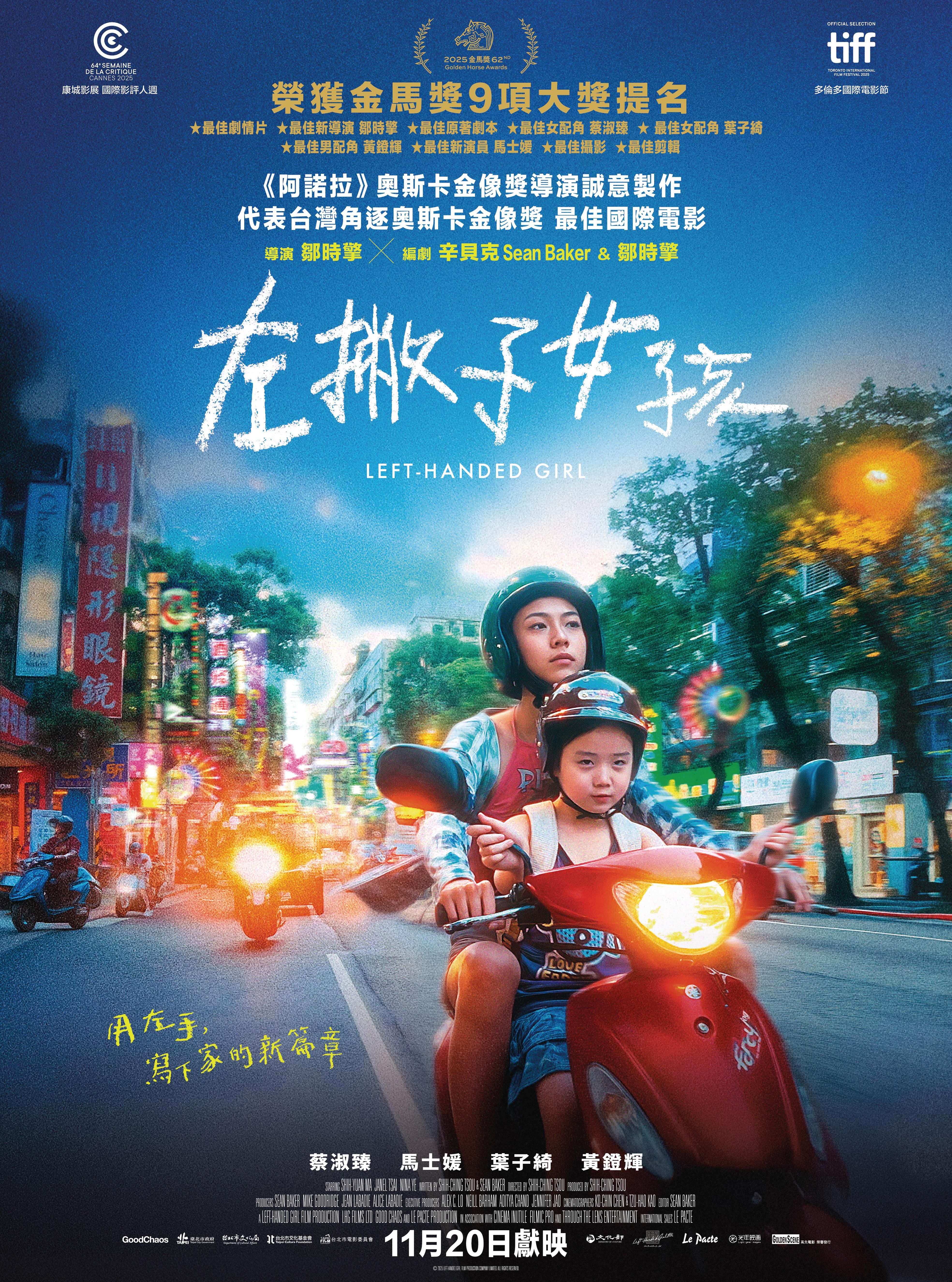
Left-Handed Girl (左撇子女孩), directed by Shih-Ching Tsou, is a movie you should have watched already. It was released last November on Netflix, at least in America. However, the theatrical run took longer in Taiwan and it was only recently released in its country of origin for streaming. Therefore, this review has come a bit late. But considering it is now the Lunar New Year holiday in Taiwan, a good time to catch up on movies at home, I think it’s a fitting time to share my view.

With gorgeous visuals, Left-Handed Girl takes the audience on a tour of the city of Taipei. The crowded night markets, the flurrying scooter rides, the steaming servings of noodles—all make for a wonderful setting that feels authentic to locals and a fascinating introduction to anyone who hasn’t been before. It’s quite something to learn that it was all shot on an iPhone.

Director Shi-Ching Tsou (鄒時擎) is a frequent collaborator with Sean Baker, who directed last year’s Academy Award-winning Anora. Baker, who also co-wrote Left-Handed Girl, is of the Dogme 95 movement which espouses naturalistic filmmaking without special effects and studio interference. Baker and Tsou make a powerful team fulfilling the ethics of that movement. She’s produced many of his films, but hasn’t directed since Take Out in 2004 which was Baker’s first film which they co-directed together. Left-Handed Girl is shot with lots of confidence, and one would assume the director must have had ample experience.

The story centers around I-Jing, the titular main character, who is a naïve little girl surrounded by adults with problems that she can’t understand. Her single mother struggles with money as the family starts up a noodle stand in Linjiang Night Market, while her rebellious older sister I-Ann works at a betel nut shop.

Sean Baker’s films are often about sex workers, such as the aforementioned Anora, and working at a betel nut shop is at least adjacent to this line of work, although that may not be clear to those who don’t know as much about Taiwan. It’s a semi-sleazy job, known as a “betel nut beauty,” who dress provocatively to sell a kind of stimulant. But they don’t necessarily do offer any other services. Seeing the personal lives of the girls who work at such a place is very humanizing, and of course makes for drama in the larger plot.

There is a multi-generational theme throughout the film, with four generations in all but to say more would spoil the main revelation in the end. The grandparents are also central to the story, as the grandfather insensitively tells little I-Jing that it’s sinful to use her left hand, causing the poor girl to have a crisis of her own. The climax of the film takes place during the grandmother’s 60th birthday party, where terrible family secrets come out and there is much losing face. Even for Western audiences, it’s a cringe scene and the drama is pure cinema.

There’s lots of tragedy, but there’s also lots of love. When I-Ann steps up to take care of I-Jing, it’s very heartwarming and moving. There’s also a certain strange, almost surreal atmosphere in the world of this struggling family. For a while, they have a pet meerkat of all things. Apparently, the director is left-handed and was shamed by her own grandfather about using the wrong hand. In some criticism of the film, it’s been said that no one in Taiwan today, even the elderly, would demonize left hands anymore and that’s from a long-gone era. But in the world of Left-Handed Girl, where everything is a little weird and hard to understand from the point of view of a child, it works well and feels fitting.

Left-Handed Girl will be the Taiwanese entry for Best International Film in the forthcoming 2026 Academy Awards, and I wish the movie great luck. It’s good exposure for Taiwan, and it’s also good exposure for artistically dynamic films about real people in the real world. Definitely worth watching.

Joker

Has enough time passed to post a Joker review? Or, is it too late?

In any case, I shall share some spoilers. Note that this review shall be divided into three parts below: on the subject of problematic issues, the actual content, and of the more comic book-ish implications.

On the *problematic* issues:

Firstly, there hasn’t been a real-life shooting inspired by this film. Looks like that criticism so much in the media brought up was extremely overblown. And to fair, there have always been violent movies about criminals with various degrees of controversy. Is 2019 really such a different time that society can’t handle a movie with such overtones?

There’s nothing wrong with criticizing a film or any work of art, for any reason at all. But to say that bad movies should be banned, because it may inspire violence, still feels like a stretch to me. If you just find the movie immoral and whatnot, then don’t pay for it or give it a low rating and move on.

It is interesting that Joker specifically says “I’m not political” in the infamous De Niro talk show scene. It’s a bit of a cop out, but I do appreciate that the themes are all over the place enough to be interpretable. One could just as much say that there’s a leftist moral lesson is about austerity–that Gotham shouldn’t have cut civil services and then all the tragedies could have been avoided.

(And as for the whole incel thing, while the character did fantasize about a girlfriend and couldn’t get any action, ultimately there never seemed to be a strong hating women theme.)

Last point with the controversies here. Director Todd Phillips has shown himself to be a douche with some of his “anti-woke” statements as a comedy director, which is very disappointing. If only he would let the work speak for itself, instead of lazily complaining about he resents that audiences don’t finding him funny anymore.

As for the actual content:

I happen to think the Joker is a vastly overused character. He’s supposed to be mysterious, not such a mainstream nemesis. There are of course many classic Joker storylines, but just because Batman is the most popular DC hero and he’s the main villain doesn’t mean they keep having to go back to Joker trying to top himself again and again and again. It’s an overplayed gimmick, at least in the comics.

I do appreciate Warner Bros-DC doing something different with the superhero film genre. A rated R villain film is certainly a different style than that Marvel Cinematic Universe formula.

Still, a definitive origin for the Joker is paretly of missing the point. The Dark Knight and The Last Laugh were simply smarter in exploring ambiguity. The Joker of the film is an unreliable narrator at times, but perhaps not unreliable enough.

Another valid criticism is how derivative of Scorsese this is. Both Taxi Driver and The King of Comedy? There is such a thing as too much homage. And Arthur Fleck living with his mother, that is pretty cliched.

However, I watched the movie and I’m still thinking about it weeks later. That is saying something. The arc of Fleck’s descent into madness powerfully told, I have to admit. From the beginning it can’t be denied Joaquin Phoenix is an absolutely brilliant actor, carrying every scene and pushing himself to the limit. As he descends into violence, first by killing in self defense and then immediately after by killing someone running away, the audience is sucked into his disturbing world until the body count rises enough to take down the whole city.

Damn, what an ending. Incredibly pessimistic as Gotham is on fire, his minions in clown masks burning it all down in anti-1%er riots. It may or may not be happening in the titular character’s mind to some degree, but either way, geez what an effect as he dances to the tune! Finally, the world pays attention to one Arthur Fleck.

One leaves the theater affected for sure, and in some sense that means it is a successful work.

Overall, after giving it maybe too much thought, I conclude it’s a good movie. The Joker is well-crafted and leaves a deep impression. Very much worth watching as long, assuming you’re already into gruesome crime dramas.

Comic book implications: 

Lastly, here’s my take as a fanboy. It was an entertaining twist to speculate on Joker maybe-or-maybe-not being Bruce Wayne’s illegitimate brother. (Glad it’s left open; those ambiguous factors are always the strongest.) Thomas Wayne as an out of touch rich asshole, who is partly responsible for the iconic orphaning of his son, now that sure is an original version.

Continuity-wise the age difference is too wide to have this be the same villain who will one day fight Batman. Bruce was only a child right, so it would have to be twenty years later at least. It is fun to see some of the Batman origin, however overdone, even if it doesn’t quite fit.

Plus, the Joker should be a genius. I don’t see this guy inventing chemical compounds or even planning any intricate crime sprees. His only ‘power’ really is that he acquired a gun, and that some his murders are big deals. Also, he’s not funny. There are several dark humor scenes to be sure, but Arthur Fleck’s tragedy is that he’s not even good at being a comedian which just isn’t really the Joker in my view.

Hence… the only way this could work in any DC universe is if Fleck isn’t so much *the* Joker as much as he is *the first* Joker. The comics do say there were three. Like there have been a series of Jokers, and Arthur Fleck inspired them. Maybe that’s the point?

Even if so, let’s still repeat that it’s just a movie and please don’t be inspired to be super-villain in the real world. So long as that’s clear, enjoy 🙂

Interview with a Chinese Learner

Interview With a Chinese Learner: Ray Hecht

Originally posted at EazyChinese.com
http://eazychinese.com/interview-chinese-learner-2

Hey everyone, how’s it going? Today I’m coming at you with another interview. Today’s victim is Chinese learner Ray Hecht. He”s been living in Mainland China for years, and has a lot of interesting things to say on his blog about China, dating in China and learning Chinese. Plus he shares some pretty sweet art and poetry as well, so hop on over to his site and check out his writing! Being a fellow comic geek, I can relate to a lot of what he has to say!

Now on to the interview.

Q: What Made you decide to learn Chinese?

I was first interested in Asian culture by way of Japanese manga and anime, being a long-time comic geek in my youthful days (and still a geek in my older days). As I got older I became more interested in film, and after watching many classic Kurosawa I came upon Cantonese films of Wong Kar-wai in my teenage years. Eventually this led to watching the film Farewell my Concubine, directed by Chen Kaige, which is one of my favorite movies of all time. In addition to watching the 90s films of Chinese 5th generation filmmaker Zhang Yimou, I became fascinated by China. However, I studied Japanese in college. Learning kanji did give me me a head start in learning hanzi, although the languages are quite different. I never did end up moving to Japan, just visiting a few times (learning some of the language did help). I later got an opportunity to move to Shenzhen and I fully embraced it. Currently, Mandarin is the only other language besides English I speak with any fluency, though I always have more to learn.

Q:How long have you been a student of Chinese, and how long did it take you to become conversational?

I’ve been studying for six years, and in the first year I learned ‘survival Chinese.’ I’ve been getting better at being more conversational in the last 3 years I suppose, but on having deep conversations I know I still have ways to go. The problem is that most conversations are the same: “Where are you from?”, “Are you married?” “How many years have you been in China?” etc.

Q:What was your biggest challenge learning Chinese? And what came easiest to you?

My biggest challenge at first was definitely the tones. Then, the characters although I am always making progress even though it takes years. When it comes to characters, just be patient but make a little progress all the time. In speaking, the grammar of Chinese is easier and I was able to formulate simple sentences quite fast (even if not pronouncing it correctly). “I like…” “I’m from…” and that sort of thing.

Q:What advice would you give to our readers who are just embarking on their journey with Chinese?

I suppose the best advice is to be fully immersive, go to China — or Taiwan, or Singapore — and start speaking. If you are in a big city in China, be careful not to be in the bubble that is the expat scene in which you rarely even speak Mandarin. Push yourself to practice those phrases you studied in real-life, it’s the only way!

Q:Do you have a favorite Chinese phrase? If so, what is it and why?

Well, 多少錢 duoshaoqian (“How much money?”) would be the phrase I say the most often, in going out shopping everyday. Some vocabulary words are fun, when Chinese can be so literal. Technological words such as 電腦 diannao (electric brain: computer) and 電影 dianying (electric shadow: movie) and many more.

Q:What’s your one biggest “hack” for learning Chinese?

One trick is to not stress about tones too much, and just try wait you’re best until one day it becomes effortless. You can still communicate, don’t be afraid to make mistakes. With pronunciation, one can imitate another more advanced learner of Mandarin instead of imitating native speakers. After all, any fluent learner was once a beginner and can offer great advice.

Thanks for taking the time to share with us Ray! I hope everyone will learn from Ray’s experiences, and move forward in their own studies. I especially agree with his point on getting out there and SPEAKING. So what are you still doing here? Get out there and practice your Chinese!