As an American living in Asia for over a decade, and a writer at that, I have read my fair share of “expat” books. This term refers to those privileged Westerners who move to generally poorer countries, which differentiates it from the typical immigrant story. I’ve read many memoirs, by men and women who have traveled the world and gotten into various bizarre or disastrous situations, and written my fair share of that sort of thing as well. More often than not, these sorts of books are about young white men (often English teachers) with similar attempts at bouts of literary hedonism, sex and drugs in the Far East and so on, some more shocking than others, with a wide range of quality writing.
Although these aren’t necessarily typical experiences, this has become something of a cliché—at least in the circles I’ve been a part of. Honestly, I get it already. If you’re willing to give up everything, it’s a surprisingly easy path to just show up in a nonwhite country and suddenly have access to an extreme lifestyle that is far more interesting than the boring drudge of Middle America. This was very interesting to me, back when it was new. But by now, I’ve just read too much of it.
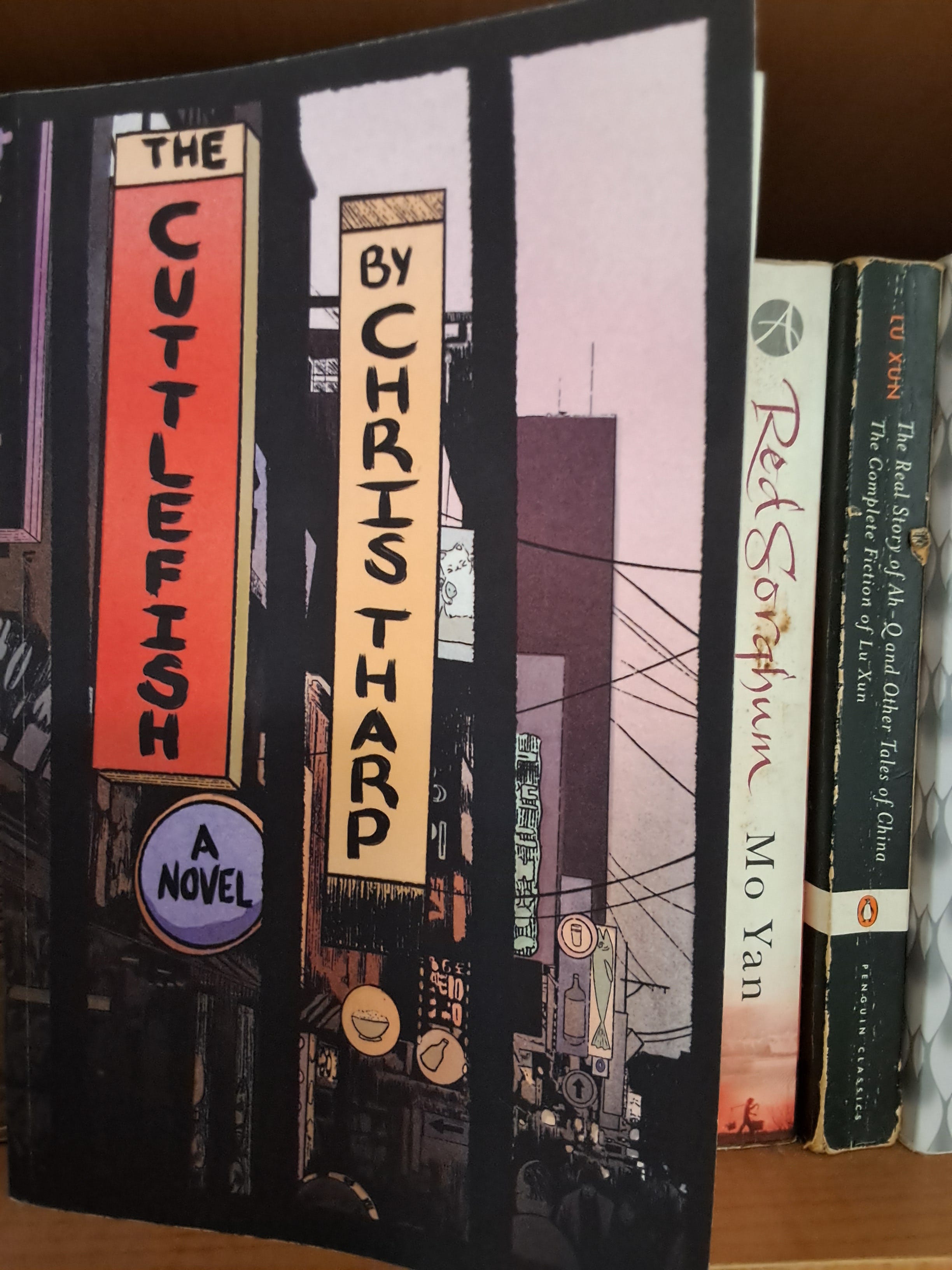
In the first few chapters of The Cuttlefish, I was admittedly worried this novel was going to be more of the same. But as the story developed, it became a page-turner with unexpected twists and turns which took a sharp mind to come up with. Like many such books, the writing is about being a writer: the protagonist is Zach who is an aspiring writer. One wonders how much of it autobiographically corresponds to Chris Tharp himself. Zach is a bit of a loser teacher, a young American phoning it in at his overpaid English classes abroad while drunk or hungover half of the time. It’s a cynical take, and also hilarious. He works at Bichy Bee English Institute, at least for a while, where the children call him a pig and fantasize about murdering him. He gorges on oily streetfood dumplings, strikes out with women, there’s a bit of a romance as well, and he feels jealous over the more successful writers he comes across. If the character is autobiographical in nature, it’s definitely the self-deprecating kind.
But then it gets more interesting. One reason the novel works so well, is that it isn’t actually about a real country. It takes place in the fictional city of Paigon on the island of Sukhan, and this gives the author freedom to imagine anything without having to pinpoint any one real place. It becomes more universal this way, and Sukhan becomes a fascinating setting. This Southeast Asian nation is both modern and backwards, full of chaos and corruption and speeding scooters with traffic laws barely followed. It seems to be a mix of the Philippines and perhaps Taiwan. Maybe some Vietnam, and/or Indonesia in there as well? It’s traditionally Confucian, but also Catholic. It used to be a dictatorship, had a bloody civil war in recent memory, is currently under the threat of a Chinese invasion, and is also wealthy enough to have once had the world’s third-tallest skyscraper. And it is very, very hot (it opens during the “fire” season of the year).
Almost like a fantasy novel, there is much world-building. One chapter is devoted to the complex political history. It feels like there is a real culture referenced, with locals spouting proverbs like “You must wear the medal that the general pins to your breast,” or “like a shark’s greedy mouth.” Very clever. There’s another infodump chapter about baseball, with just as much detail, being that sports fandom matters plenty to a culture. Baseball becomes particularly central to the plot later with the introduction of a celebrity pro player in Zach’s cast of characters. The only thing that’s missing in the book is one of those high-fantasy maps on the last page, the kind that used to be so fun to pour over for readers of Lord of the Rings and it’s derivative paperbacks.
As much fun as Sukhan is, one of the most interesting parts is when Zach travels to Thailand. For the purposes of drug trafficking, by the way. Chris Tharp’s descriptions of a real place, which many of the readers attracted to this kind of novel have probably been to, are written with authority and feel eminently familiar. It’s still comedic, mostly, and the dark underworld aspect works well in the narrative.
By the midpoint, Zach gets arrested. This is when the novel gets even better. Ostensibly, he does this on purpose for the literary credit in this goal of one day selling a powerful memoir. A narcissistic, unsympathetic decision for a fool who gets what’s coming to him? Or, a cautionary tragic circumstance by a desperate artist who doesn’t deserve the overblown punishment from a cruel system? You decide. Either way, Zach’s arc shows tremendous growth as a person over the course of his journey.
I don’t think it’s a spoiler that he ends up in “the Cuttlefish,” the maximum security island prison, being that it’s the name of the book. He ends up there due to a prison break attempt, which shows how exciting the story gets. Zach’s new life as an inmate is fascinating, showing a whole other side of life which is not typical at all for the usual expats slumming it. The climax is likened to a sports movie, with a high-stakes game of baseball—prisoners versus the guards—and descends into a fantastical and satisfying ending which I shall not spoil.
The Cuttlefish is perhaps overwritten at times, but also often poetic, with lines such as: “He could think of nothing more dramatic, brutal, or absolute than being ripped apart in a feeding frenzy of ravenous crocodiles. There was something beautiful in the natural violence of it.” The crass sense of humor is one side of the writing, and then all of a sudden stunning prose comes in out of nowhere: “On the morning of May 1st, the sun rose over the Pacific like a bloated tangerine, pouring its rays over the dappled waters and bathing the rocky outcropping known as Nangki Island in a brilliant, golden light.”
The Cuttlefish is published by Plum Rain Press based in Taiwan, and is a book I’d recommend above all to the English-speaking world within Asia. It’s also a highly entertaining yarn for readers anywhere in the world.

